Virginia SOL 11.RI.1.C
The Standard
Evaluate the relevance and quality of an author’s premises, claims, counterclaims, and evidence by corroborating or challenging them with other information.
Virginia Standards of Learning for English · Key Ideas and Confirming Details
Teacher's field guide
What This Standard Means
What Students Need to Do
- Students break an argument into its premises, claims, counterclaims, and evidence. They compare those parts with reliable outside sources to judge relevance, accuracy, and strength.
What Mastery Looks Like
- Students can separate premises, claims, counterclaims, and supporting evidence within an argument. They use reliable outside information to explain why a point is supported, weakened, or left unresolved.
Common Misconceptions
- Students may treat any related fact as relevant evidence. They may also accept evidence that supports their view without checking the source, or mistake a counterclaim for the author’s main claim.
How to Assess It
- Give students a short editorial paragraph and two source snippets, one reliable and one weak. Ask them to choose which snippet best tests one claim and explain its relevance and quality.
Lesson moves
Ways to Teach It
Give groups a printed editorial and four source cards; students sort each card as support, contradiction, or irrelevant evidence.
Ask students to write: Which claim survives outside fact checking, and which source most changes your judgment?
Run a corroboration relay where teams match claim cards to reliable sources, then explain why each match strengthens or weakens the argument.
Compare claims in two news reports about a local policy, then verify key evidence using the city website or public records.
Free download
Printable 11.RI.1.C Worksheet
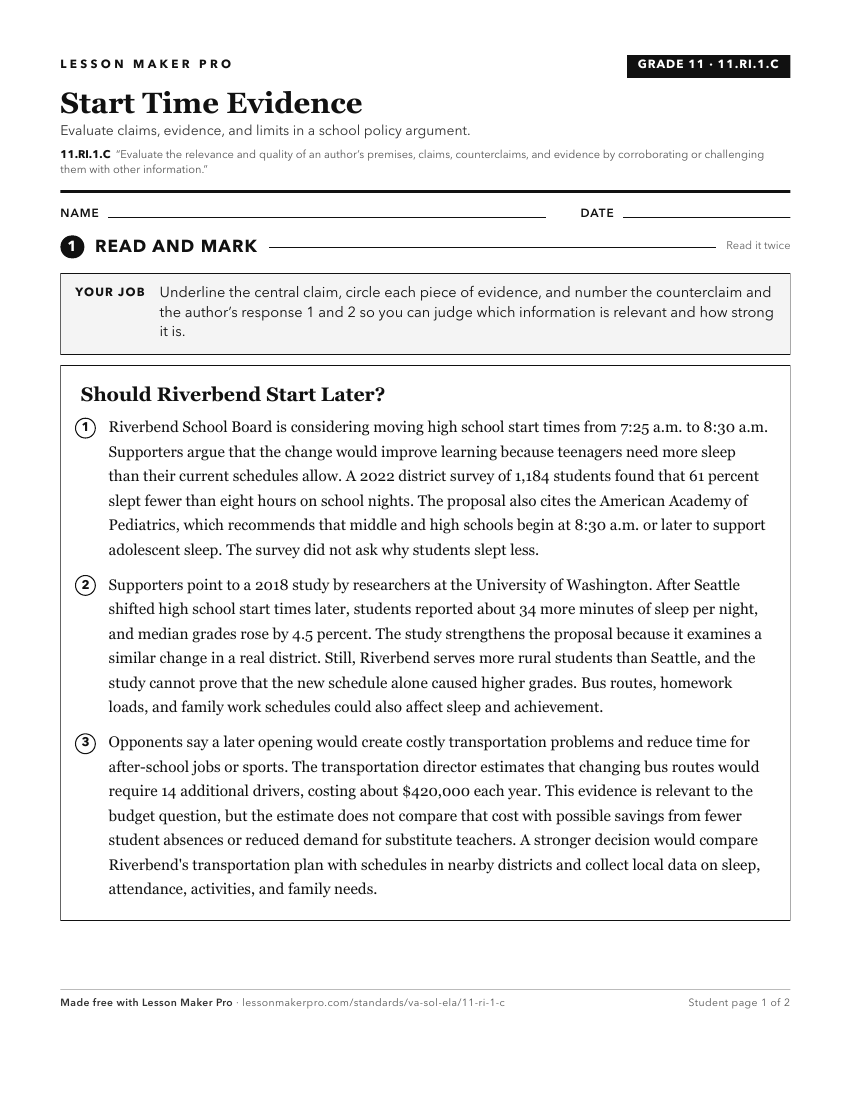
A ready-to-print activity worksheet aligned to 11.RI.1.C, with an answer key for the teacher on its own page. No account needed.
PDF, US Letter, prints cleanly in black and white.
Download the worksheetKeep exploring
Related Standards
- 8.R.1.C
Evaluate and analyze the relevance, validity, and credibility of sources (primary, secondary, digital, and print) identifying main and supporting ideas, conflic...
- 12.C.3.B
Examine multimodal sources’ claims, arguments, ideas, and any point of personal bias by evaluating them for reliability and relevance to serve as credible suppo...
- 9.RI.3.B
Evaluate the clarity and accuracy of information found in informational texts, corroborating or challenging conclusions with other sources of information.
- 10.RI.1.C
Evaluate the argument and specific claims in texts, examining whether the reasoning is valid, the evidence is relevant, and whether there are any false or unsup...
Turn this exact standard into a lesson
Grade, subject, topic, and the complete standard are prefilled. Create one free, no account needed.
Also for this standard:Make a WorksheetMake a QuizMake a Sub Lesson