Virginia SOL 9.RI
SOL Standard (Knowledge and Skills Cluster)
The student will use textual evidence to demonstrate comprehension and build knowledge from grade-level complex informational texts read.
Virginia Standards of Learning for English
Cluster contents
Knowledge and Skills in This Standard
9.RI is a Standards of Learning standard. These are the knowledge and skills expectations under it.
- 9.RI.1
Key Ideas and Confirming Details
- 9.RI.1.A
Analyze the development of main ideas over the course of texts, including how they emerge, are shaped, and are refined by specific details to help reveal the au...
- 9.RI.1.B
Explain the purpose and interpret the use of data and information in maps, charts, graphs, timelines, tables, and diagrams in informational, historical, scienti...
- 9.RI.1.C
Distinguish among, facts, reasoned judgments, and/or speculation in texts to determine where a position/argument is to be confirmed, disproved, or modified.
- 9.RI.2
Craft and Style
- 9.RI.2.A
Compare characteristics of expository, technical, and persuasive texts, including their differences in purpose, format, and text structure.
- 9.RI.2.B
Analyze an author’s word choice and use of rhetorical devices to persuade or convince an audience.
- 9.RI.2.C
Analyze how authors use rhetorical devices to create ethos, logos, and pathos and impact the reader.
- 9.RI.3
Integration of Concepts
- 9.RI.3.A
Compare the perspectives and viewpoints of two or more authors regarding their treatment of the same or similar topics, including the details they include and e...
- 9.RI.3.B
Evaluate the clarity and accuracy of information found in informational texts, corroborating or challenging conclusions with other sources of information.
Teacher's field guide
What This Cluster Means
What Students Need to Do
- Students explain how an author develops a main idea through details and uses language, structure, graphics, and rhetorical appeals for a purpose. They distinguish facts, judgments, and speculation. They compare authors’ viewpoints and qualifications, then verify claims across reliable sources.
What Mastery Looks Like
- Students trace how details shape a main idea and connect that development to the author’s purpose. They interpret graphics, separate facts from judgments and speculation, and explain rhetorical appeals. They compare accounts using evidence, author qualifications, source accuracy, and differences in emphasis.
Common Misconceptions
- Students may treat every statement as a fact or assume a graph is neutral because it uses numbers. They may name ethos, logos, or pathos without explaining its effect. They may also confuse topic with main idea or judge a source only by whether they agree with it.
How to Assess It
- Give students two short articles and a graph about the same issue. Ask them to state each author’s main idea, classify one claim, explain one rhetorical choice, and identify which source is better supported.
Lesson moves
Ways to Teach It
Give pairs printed article sections, evidence strips, and graph cards to arrange by main idea, purpose, and strength of support.
Ask students to write which of two authors presents the stronger account, citing one detail, one rhetorical choice, and each author’s qualifications.
Play a claim-sorting relay where teams label cards as fact, reasoned judgment, or speculation, then defend disputed choices with text evidence.
Fact-check a current news post by comparing its claims and graphic with two reliable sources, then write a correction or confirmation.
Free download
Printable 9.RI Worksheet
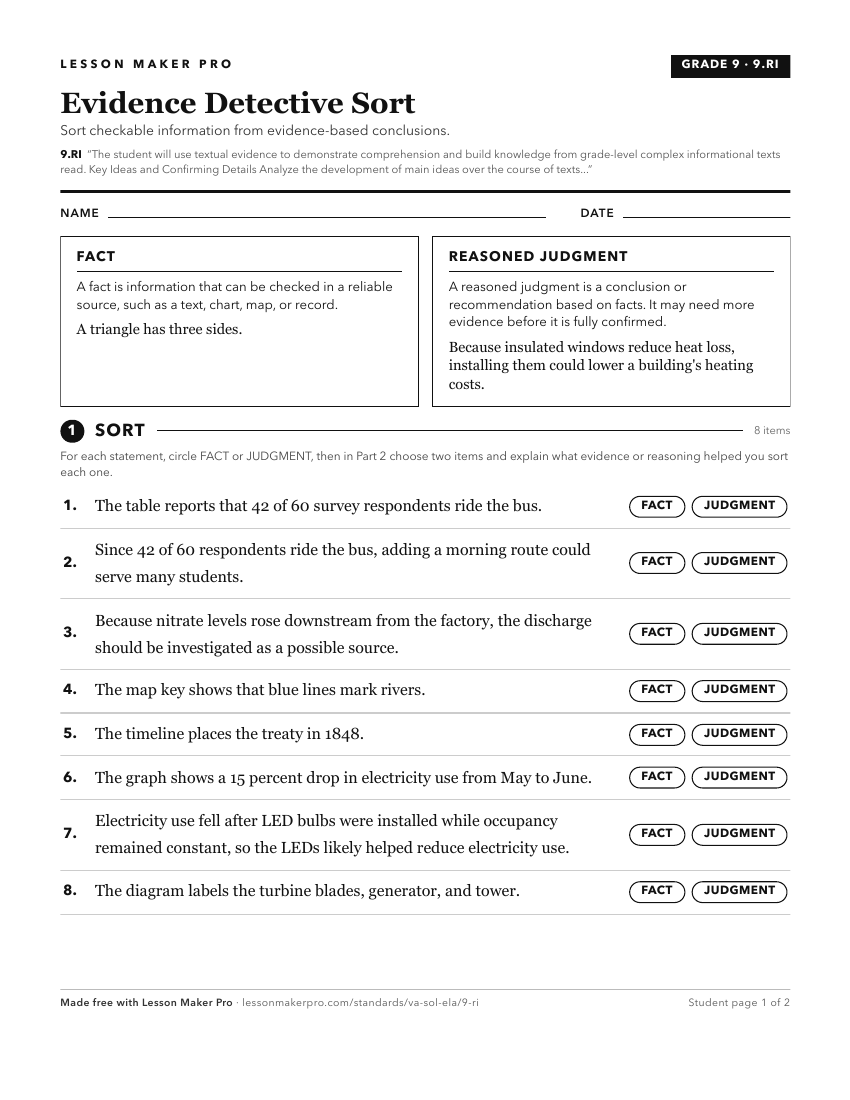
A ready-to-print activity worksheet aligned to 9.RI, with an answer key for the teacher on its own page. No account needed.
PDF, US Letter, prints cleanly in black and white.
Download the worksheetKeep exploring
Related Standards
Turn this cluster into a lesson
Grade, subject, topic, and the complete cluster are prefilled. Create one free, no account needed.
Also for this cluster:Make a WorksheetMake a QuizMake a Sub Lesson