Virginia SOL 9.RI.2.B
The Standard
Analyze an author’s word choice and use of rhetorical devices to persuade or convince an audience.
Virginia Standards of Learning for English · Craft and Style
Teacher's field guide
What This Standard Means
What Students Need to Do
- Students locate charged words and devices such as repetition, rhetorical questions, parallelism, and analogy. They explain how each choice shapes tone and influences a particular audience.
What Mastery Looks Like
- Students cite an exact phrase or device and explain the response it is meant to create. They connect that response to the writer's purpose and intended audience. Their explanation goes beyond saying it "makes the argument stronger."
Common Misconceptions
- Students may name a device without explaining its effect. They may label every question rhetorical or assume charged words affect all audiences the same way. They may also confuse persuasive techniques with proof that a claim is true.
How to Assess It
- Give students a short paragraph from a school editorial. Ask: "Choose one phrase or rhetorical device, then explain how it could influence the intended audience."
Lesson moves
Ways to Teach It
Give pairs printed advertisements and two highlighters to mark charged words in one color and rhetorical devices in another.
Discuss this prompt: "Which phrase would most influence a ninth-grade audience, and why might it fail with a different audience?"
Run a card sort matching short excerpts with repetition, rhetorical questions, parallelism, analogy, and each device's likely effect.
Compare two public service posts aimed at teens and adults, then rewrite one sentence to fit the other audience.
Free download
Printable 9.RI.2.B Worksheet
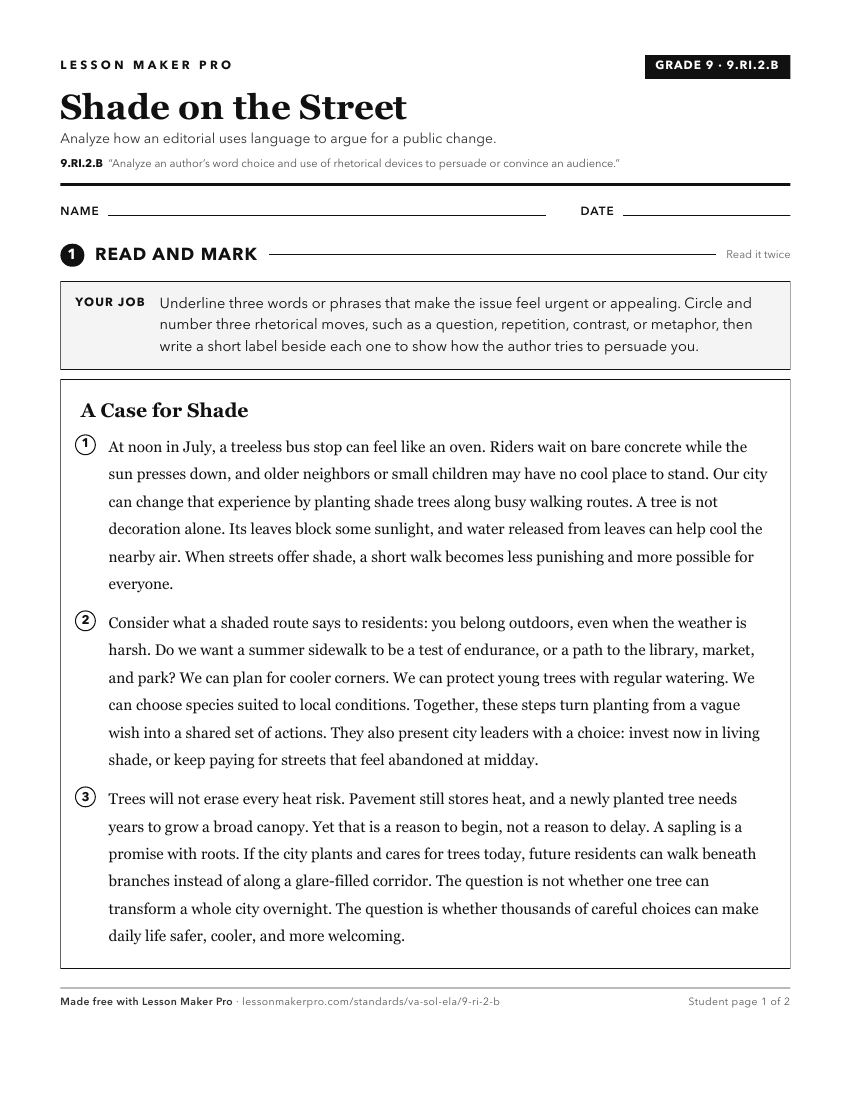
A ready-to-print activity worksheet aligned to 9.RI.2.B, with an answer key for the teacher on its own page. No account needed.
PDF, US Letter, prints cleanly in black and white.
Download the worksheetKeep exploring
Related Standards
- 10.RL.2.C
Analyze how authors use specific word choices, syntax, tone, and voice to convey the author’s intent and viewpoint.
- 7.RL.2.B
Analyze how the elements of an author’s style (e.g., word choice, sentence structure, dialogue, figurative language, imagery) are used to influence and develop ...
- 9.RI.2.C
Analyze how authors use rhetorical devices to create ethos, logos, and pathos and impact the reader.
- 7.RI.2.B
Analyze how an author’s word choice, organizational pattern, and language structure impact the author’s purpose and support the reader’s comprehension.
Turn this exact standard into a lesson
Grade, subject, topic, and the complete standard are prefilled. Create one free, no account needed.
Also for this standard:Make a WorksheetMake a QuizMake a Sub Lesson