Virginia SOL 3.RI
SOL Standard (Knowledge and Skills Cluster)
The student will use textual evidence to demonstrate comprehension and build knowledge from grade-level complex informational texts read.
Virginia Standards of Learning for English
Cluster contents
Knowledge and Skills in This Standard
3.RI is a Standards of Learning standard. These are the knowledge and skills expectations under it.
- 3.RI.1
Key Ideas and Confirming Details
- 3.RI.1.A
Determine the main idea of multi-paragraph texts as well as specific paragraphs within them.
- 3.RI.1.B
Summarize texts using language that pertains to time, sequence, and cause and effect, referring to historical events, scientific ideas, or steps in technical pr...
- 3.RI.1.C
Identify and explain how an author uses reasons and evidence to support specific points in texts.
- 3.RI.2
Craft and Style
- 3.RI.2.A
Describe major structural differences between the organizational patterns of different informational texts (e.g., cause/effect, comparison/contrast, problem/sol...
- 3.RI.2.B
Use text features and search tools (e.g., sidebars, hyperlink) to locate and gain information efficiently.
- 3.RI.2.C
Identify the author’s purpose for writing, including what the author wants to answer, explain, or describe.
- 3.RI.3
Integration of Concepts
- 3.RI.3.A
Use prior (experience) and background (content) knowledge as context for new learning.
- 3.RI.3.B
Compare and contrast the most important points and key details presented in two texts on the same topic.
- 3.RI.3.C
Describe the connection between a series of historical events, scientific ideas or concepts, or steps in technical procedures in a text.
- 3.RI.3.D
Demonstrate comprehension by writing about what is read using the text for support.
Teacher's field guide
What This Cluster Means
What Students Need to Do
- Students read informational texts and determine what each paragraph and the whole text are mostly saying. They explain how ideas, events, or steps connect and how structure, purpose, reasons, evidence, and text features shape meaning. They compare sources and write responses that use accurate details from the texts.
What Mastery Looks Like
- Students state the main idea of a whole text and individual paragraphs, then support their thinking with relevant details. They explain the author’s purpose, evidence, organization, and connections between ideas. They can compare two sources and write an accurate summary in their own words.
Common Misconceptions
- Students may name the topic instead of stating what the author says about it. They may copy whole sentences for a summary, choose weak evidence, or label a structure from one signal word without checking the whole text.
How to Assess It
- Give students a two-paragraph article. Ask them to state the main idea, name the structure, cite one supporting detail, and write a two-sentence summary.
Lesson moves
Ways to Teach It
Give pairs mixed paragraph strips from an article to order, label by structure, underline clue words, and write the main idea.
Read two short texts about one animal adaptation, then have students write one shared point supported by a detail from each text.
Run a text-feature scavenger hunt where teams use headings, captions, sidebars, and links to answer five posted questions.
Compare a weather service page with a local news report, then decide which source better helps the class plan outdoor recess.
Free download
Printable 3.RI Worksheet
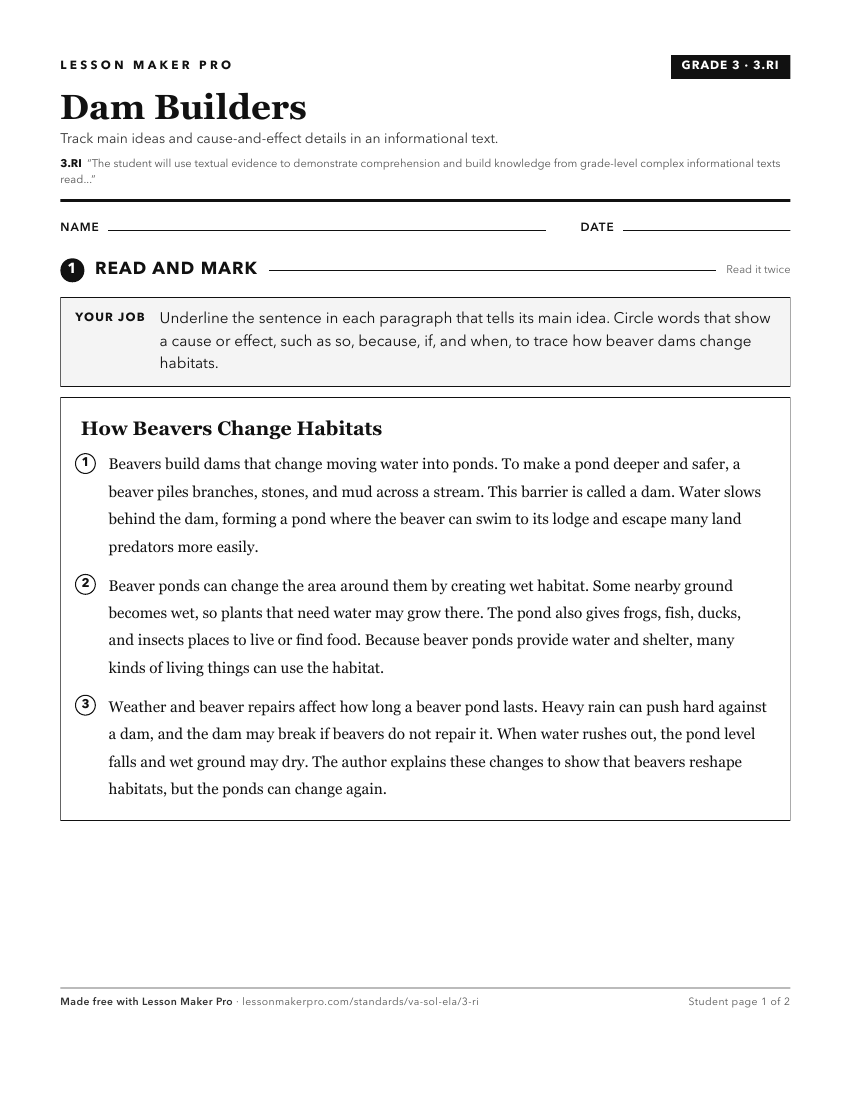
A ready-to-print activity worksheet aligned to 3.RI, with an answer key for the teacher on its own page. No account needed.
PDF, US Letter, prints cleanly in black and white.
Download the worksheetKeep exploring
Related Standards
Turn this cluster into a lesson
Grade, subject, topic, and the complete cluster are prefilled. Create one free, no account needed.
Also for this cluster:Make a WorksheetMake a QuizMake a Sub Lesson