Virginia SOL 3.RI.2.C
The Standard
Identify the author’s purpose for writing, including what the author wants to answer, explain, or describe.
Virginia Standards of Learning for English · Craft and Style
Teacher's field guide
What This Standard Means
What Students Need to Do
- Students determine why an author wrote a nonfiction text and identify the specific question, idea, or subject being addressed. They use titles, details, and word choice as evidence.
What Mastery Looks Like
- Students can state a specific purpose for a short nonfiction passage rather than give a broad label. They support their answer with a relevant detail from the text.
Common Misconceptions
- Students may name the topic instead of the author’s reason for writing. They may answer only “to inform,” rely on the title, or choose their own reason for reading.
How to Assess It
- Give students a short paragraph and ask, “Why did the author write this, and which sentence gives the strongest clue?”
Lesson moves
Ways to Teach It
Give pairs nonfiction text cards to sort by purpose, then have them underline one sentence that supports each choice.
Read two paragraphs about frogs and ask students to write how each author’s reason for writing differs.
Play Purpose Detective by revealing one text clue at a time while teams revise and defend their purpose statements.
Examine a weather forecast, museum label, and school notice, then identify what each writer wants readers to understand.
Free download
Printable 3.RI.2.C Worksheet
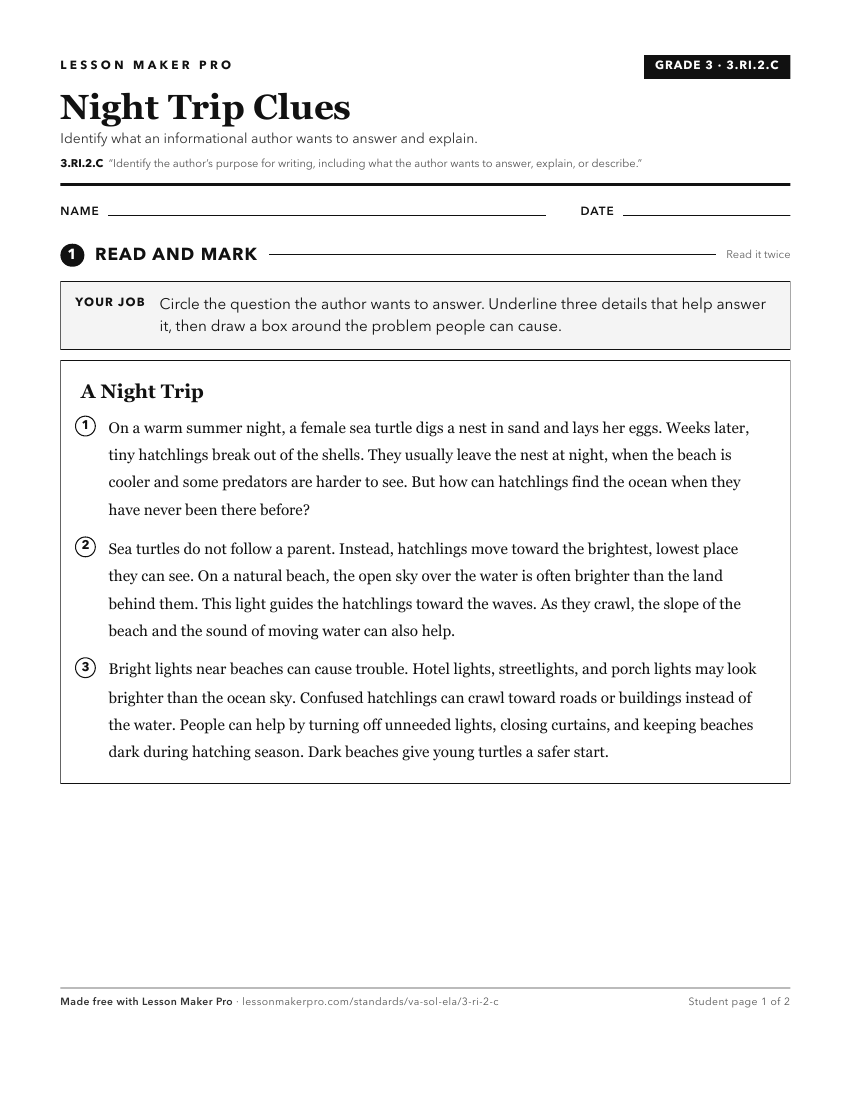
A ready-to-print activity worksheet aligned to 3.RI.2.C, with an answer key for the teacher on its own page. No account needed.
PDF, US Letter, prints cleanly in black and white.
Download the worksheetKeep exploring
Related Standards
- 5.RI.2.C
Determine the author’s purpose(s) and describe how the author’s perspective (e.g., beliefs, assumptions, biases) influences the meaning of the text.
- 4.RI.2.C
Explain the author’s purpose for writing, including what the author wants to answer, explain, or describe based on the connections between particular sentences ...
- 2.RI.2.B
Identify the main purpose of a text, including what the author wants to answer, explain, or describe.
- 2.W.2.A.ii
Identifying the audience and purpose of the writing.
Turn this exact standard into a lesson
Grade, subject, topic, and the complete standard are prefilled. Create one free, no account needed.
Also for this standard:Make a WorksheetMake a QuizMake a Sub Lesson