TEKS ELAR 7.6
Knowledge and Skills Statement (Standard Cluster)
The student responds to an increasingly challenging variety of sources that are read, heard, or viewed
Texas Essential Knowledge and Skills for English Language Arts and Reading
Cluster contents
Student Expectations in This Statement
7.6 is a knowledge and skills statement. These are the student expectations under it.
- 7.6.A
describe personal connections to a variety of sources, including self-selected texts
- 7.6.B
write responses that demonstrate understanding of texts, including comparing sources within and across genres
- 7.6.C
use text evidence to support an appropriate response
- 7.6.D
paraphrase and summarize texts in ways that maintain meaning and logical order
- 7.6.E
interact with sources in meaningful ways such as notetaking, annotating, freewriting, or illustrating
- 7.6.F
respond using newly acquired vocabulary as appropriate
- 7.6.G
discuss and write about the explicit or implicit meanings of text
- 7.6.H
respond orally or in writing with appropriate register, vocabulary, tone, and voice
- 7.6.I
reflect on and adjust responses as new evidence is presented
Teacher's field guide
What This Cluster Means
What Students Need to Do
- Students respond to sources they read, hear, or view through speaking, writing, notes, annotations, or illustrations. They make personal connections, compare sources, explain explicit and implied meanings, and support ideas with evidence. They also summarize, paraphrase, use new vocabulary, and revise responses when new evidence appears.
What Mastery Looks Like
- Students write or speak clearly about explicit ideas and reasonable inferences. They compare sources, choose relevant evidence, paraphrase accurately, use new vocabulary, and revise a claim when new evidence appears.
Common Misconceptions
- Students may retell a source instead of explaining its meaning. They may copy sentences as evidence, confuse paraphrasing with changing a few words, or ignore evidence that challenges their first response.
How to Assess It
- Give students a short article and image. Ask them to state one shared idea, cite one detail from each source, and explain whether the image changed their response.
Lesson moves
Ways to Teach It
Give pairs a printed article and infographic to annotate with colored pencils, marking shared ideas, differences, evidence, and unfamiliar words.
Ask, "How did this source connect to your experience, and which detail strengthened or challenged that connection?"
Play Evidence Match by having teams pair claim cards with quotation or paraphrase cards, then defend each match aloud.
Compare a news report and public service video about the same local issue, then write which source would persuade families more effectively.
Free download
Printable 7.6 Worksheet
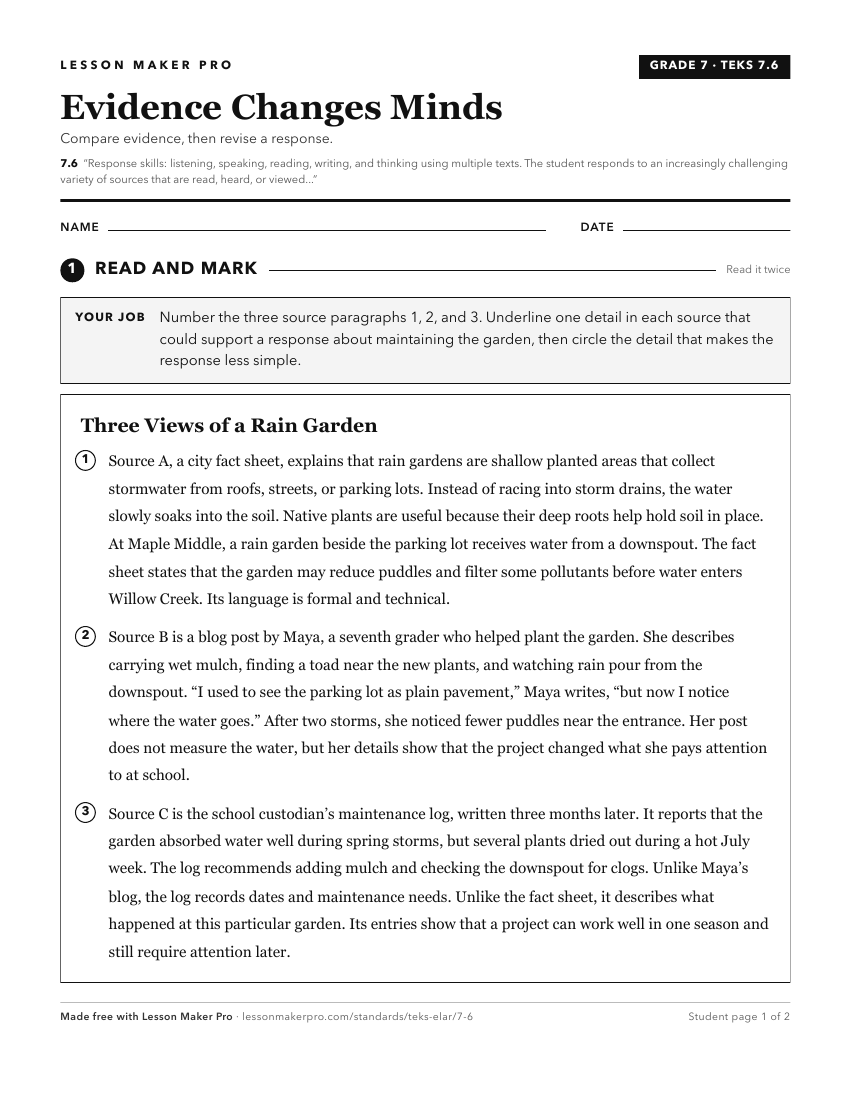
A ready-to-print activity worksheet aligned to 7.6, with an answer key for the teacher on its own page. No account needed.
PDF, US Letter, prints cleanly in black and white.
Download the worksheetKeep exploring
Related Standards
- 8.6
The student responds to an increasingly challenging variety of sources that are read, heard, or viewed.
- 2.7
The student responds to an increasingly challenging variety of sources that are read, heard, or viewed.
- 5.7
The student responds to an increasingly challenging variety of sources that are read, heard, or viewed.
- 1.7
The student responds to an increasingly challenging variety of sources that are read, heard, or viewed.
Turn this cluster into a lesson
Grade, subject, topic, and the complete cluster are prefilled. Create one free, no account needed.
Also for this cluster:Make a WorksheetMake a QuizMake a Sub Lesson