TEKS ELAR 5.7
Knowledge and Skills Statement (Standard Cluster)
The student responds to an increasingly challenging variety of sources that are read, heard, or viewed.
Texas Essential Knowledge and Skills for English Language Arts and Reading
Cluster contents
Student Expectations in This Statement
5.7 is a knowledge and skills statement. These are the student expectations under it.
- 5.7.A
describe personal connections to a variety of sources, including self-selected texts
- 5.7.B
write responses that demonstrate understanding of texts, including comparing and contrasting ideas across a variety of sources
- 5.7.C
use text evidence to support an appropriate response
- 5.7.D
retell, paraphrase, or summarize texts in ways that maintain meaning and logical order
- 5.7.E
interact with sources in meaningful ways such as notetaking, annotating, freewriting, or illustrating
- 5.7.F
respond using newly acquired vocabulary as appropriate
- 5.7.G
discuss specific ideas in the text that are important to the meaning.
Teacher's field guide
What This Cluster Means
What Students Need to Do
- Students explain their thinking about texts they read, hear, or view. They make personal connections, compare ideas across sources, and support responses with specific details. They also take notes, discuss key ideas, and summarize information clearly in their own words.
What Mastery Looks Like
- Students can explain how ideas in two sources are alike or different and support the explanation with relevant details. They can paraphrase or summarize accurately, keep ideas in order, and use source notes and new vocabulary in their response.
Common Misconceptions
- Students may give a personal opinion without connecting it to a source. They may copy evidence without explaining it, retell every detail, or change only a few words when paraphrasing. Some use new vocabulary in ways that do not fit the context.
How to Assess It
- Have students read a short passage and study an infographic. Ask them to compare one shared idea, support it with evidence from both sources, and summarize their learning in two sentences.
Lesson moves
Ways to Teach It
Give groups sentence strips from an article to arrange in order, annotate, and use to write a three-sentence summary.
After students choose a book, ask: What experience or belief helped you understand one important idea, and which detail made the connection?
Play Evidence Match by having teams pair claim cards with quotation cards, then explain why each quotation supports the claim.
Compare a school lunch menu with a nutrition article, then recommend one meal using evidence and two new vocabulary words.
Free download
Printable 5.7 Worksheet
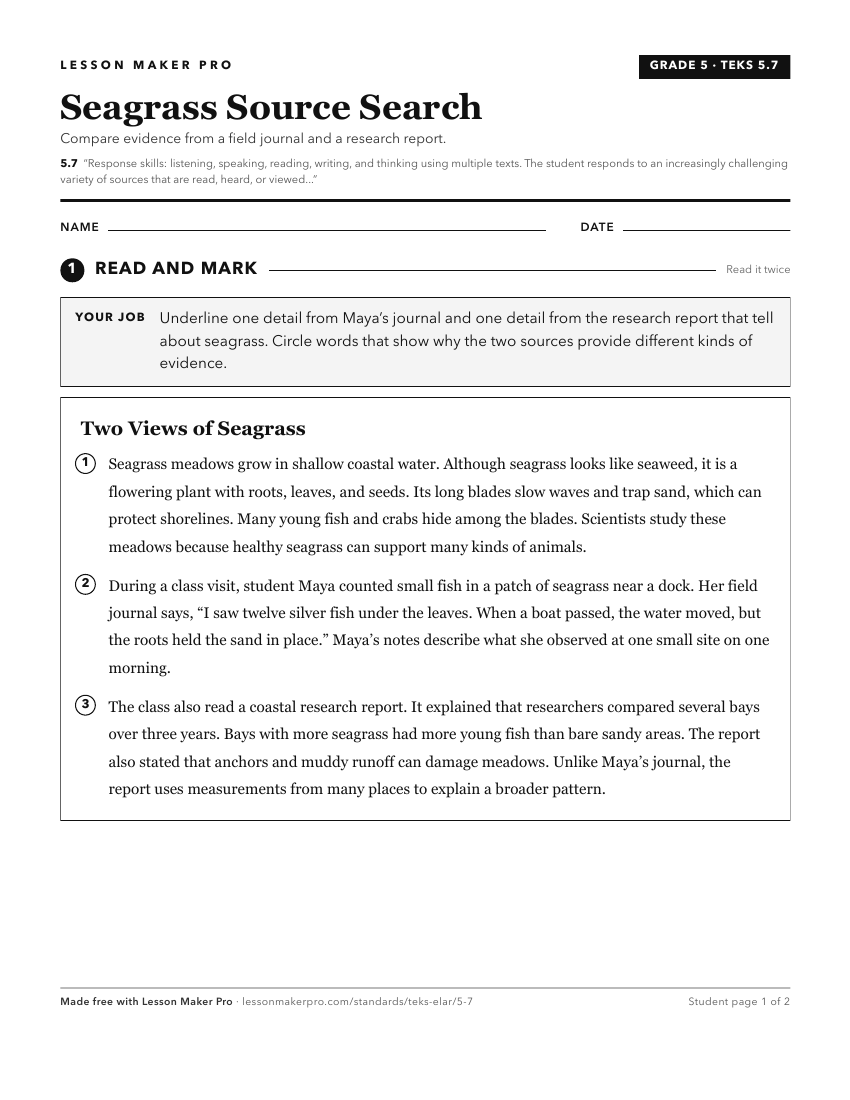
A ready-to-print activity worksheet aligned to 5.7, with an answer key for the teacher on its own page. No account needed.
PDF, US Letter, prints cleanly in black and white.
Download the worksheetKeep exploring
Related Standards
Turn this cluster into a lesson
Grade, subject, topic, and the complete cluster are prefilled. Create one free, no account needed.
Also for this cluster:Make a WorksheetMake a QuizMake a Sub Lesson