TEKS ELAR 1.9
Knowledge and Skills Statement (Standard Cluster)
The student recognizes and analyzes genre-specific characteristics, structures, and purposes within and across increasingly complex traditional, contemporary, classical, and diverse texts.
Texas Essential Knowledge and Skills for English Language Arts and Reading
Cluster contents
Student Expectations in This Statement
1.9 is a knowledge and skills statement. These are the student expectations under it.
- 1.9.A
demonstrate knowledge of distinguishing characteristics of well-known children's literature such as folktales, fables, fairy tales, and nursery rhymes
- 1.9.B
discuss rhyme, rhythm, repetition, and alliteration in a variety of poems
- 1.9.C
discuss elements of drama such as characters and setting
- 1.9.D.i
the central idea and supporting evidence with adult assistance
- 1.9.D.ii
features and simple graphics to locate or gain information
- 1.9.D.iii
organizational patterns such as chronological order and description with adult assistance
- 1.9.E
recognize characteristics of persuasive text with adult assistance and state what the author is trying to persuade the reader to think or do
- 1.9.F
recognize characteristics of multimodal and digital texts.
Teacher's field guide
What This Cluster Means
What Students Need to Do
- Students identify common genres and point to details that reveal each one. They discuss rhyme, rhythm, repetition, and alliteration in poems, plus characters and settings in plays. With support, they find central ideas and evidence, use text features, notice organization, explain persuasion, and interpret digital elements.
What Mastery Looks Like
- Given short examples, a student can sort folktales, fables, fairy tales, nursery rhymes, poems, plays, informational texts, and persuasive texts. The student names a clear clue, such as a moral, rhyme, speaker label, heading, sequence, fact, or call to action. The student also explains how a picture, audio clip, or button adds meaning to a digital text.
Common Misconceptions
- Students may call every imaginary story a fairy tale or assume every poem is a nursery rhyme. They may confuse rhyme with rhythm and miss repetition or alliteration. They may mistake a topic for a central idea, treat any detail as evidence, or confuse facts in an advertisement with its persuasive purpose.
How to Assess It
- Give students a nursery rhyme, a short play scene, an informational paragraph with a heading, and an advertisement. Ask them to label each, circle one genre clue, and explain what the advertisement wants readers to do.
Lesson moves
Ways to Teach It
Have pairs sort eight excerpt cards into folktale, fable, fairy tale, nursery rhyme, poem, play, informational, and persuasive groups.
Read two versions of Cinderella, then ask, “Which details show both are fairy tales, and what changed between versions?”
Play Genre Clue Bingo: read clues such as “teaches a moral” or “uses headings,” and students cover the matching genre.
Compare a cereal box nutrition panel and front label, then identify facts, graphics, and words meant to persuade shoppers.
Free download
Printable 1.9 Worksheet
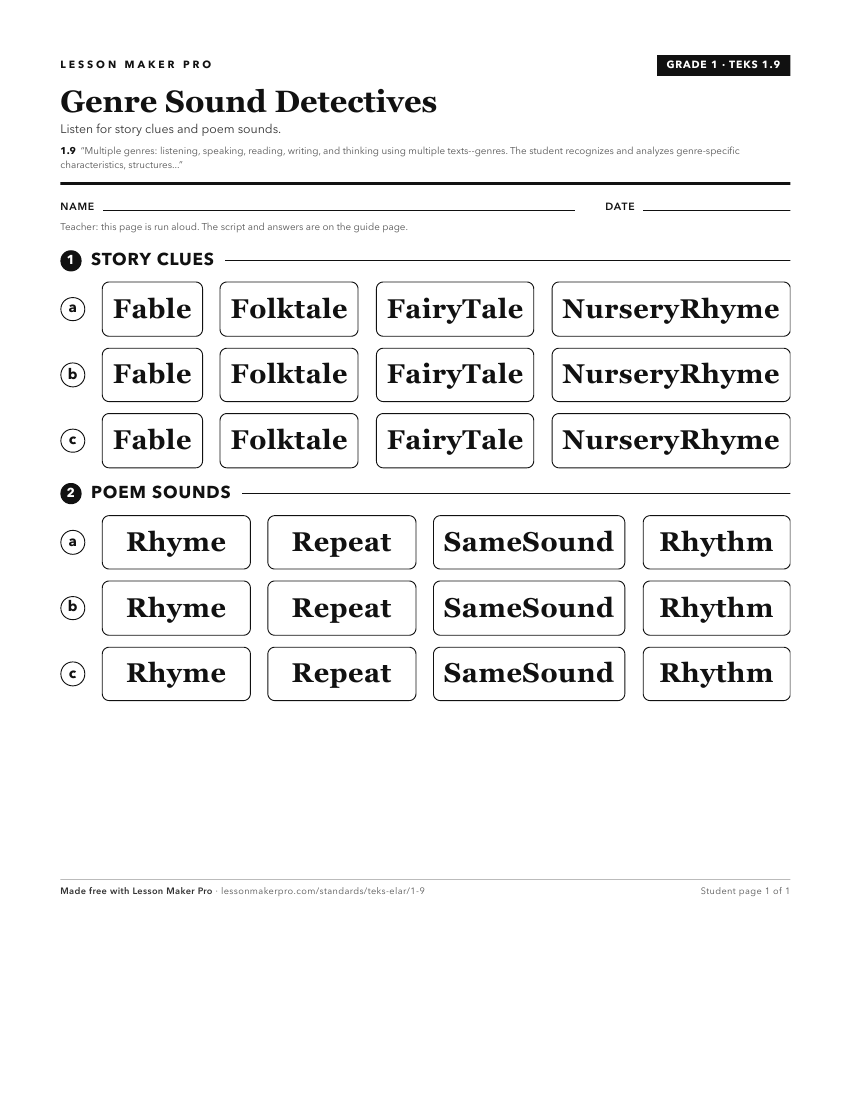
A ready-to-print activity worksheet aligned to 1.9, with an answer key for the teacher on its own page. No account needed.
PDF, US Letter, prints cleanly in black and white.
Download the worksheetKeep exploring
Related Standards
Turn this cluster into a lesson
Grade, subject, topic, and the complete cluster are prefilled. Create one free, no account needed.
Also for this cluster:Make a WorksheetMake a QuizMake a Sub Lesson