TEKS ELAR 6.8
Knowledge and Skills Statement (Standard Cluster)
The student recognizes and analyzes genre-specific characteristics, structures, and purposes within and across increasingly complex traditional, contemporary, classical, and diverse texts.
Texas Essential Knowledge and Skills for English Language Arts and Reading
Cluster contents
Student Expectations in This Statement
6.8 is a knowledge and skills statement. These are the student expectations under it.
- 6.8.A
demonstrate knowledge of literary genres such as realistic fiction, adventure stories, historical fiction, mysteries, humor, and myths
- 6.8.B
analyze the effect of meter and structural elements such as line breaks in poems across a variety of poetic forms
- 6.8.C
analyze how playwrights develop characters through dialogue and staging
- 6.8.D.i
the controlling idea or thesis with supporting evidence
- 6.8.D.ii
features such as introduction, foreword, preface, references, or acknowledgements to gain background information
- 6.8.D.iii
organizational patterns such as definition, classification, advantage, and disadvantage
- 6.8.E.i
identifying the claim
- 6.8.E.ii
explaining how the author uses various types of evidence to support the argument
- 6.8.E.iii
identifying the intended audience or reader
- 6.8.F
analyze characteristics of multimodal and digital texts.
Teacher's field guide
What This Cluster Means
What Students Need to Do
- Students identify features of fiction, poetry, drama, informational writing, arguments, and digital texts. They explain how structure, evidence, dialogue, visuals, and other genre choices affect meaning and purpose. They also compare how different texts handle similar ideas.
What Mastery Looks Like
- Students accurately identify genres and support their choices with specific features. They explain how poetic structure, dialogue, staging, organization, evidence, and digital elements shape meaning. They compare texts without relying only on topic or format.
Common Misconceptions
- Students may name a genre from its topic instead of using text features. They often confuse a thesis with a topic, or list evidence without explaining how it supports a claim. They may treat line breaks, stage directions, visuals, and links as decoration rather than choices that shape meaning.
How to Assess It
- Give students a short poem, play scene, and online article. Ask them to identify one genre or structural feature in each and explain its effect or purpose using text evidence.
Lesson moves
Ways to Teach It
Give groups excerpt cards and feature cards, then have them match each excerpt to a genre and defend one match with text evidence.
Ask students to compare a poem and a play scene: How do line breaks, dialogue, and stage directions shape meaning?
Play Genre Detective: teams draw an excerpt, name its genre or structure, and earn a point by citing two clues.
Compare a news article, product review, and sponsored post, then identify each claim, evidence, audience, and digital feature.
Free download
Printable 6.8 Worksheet
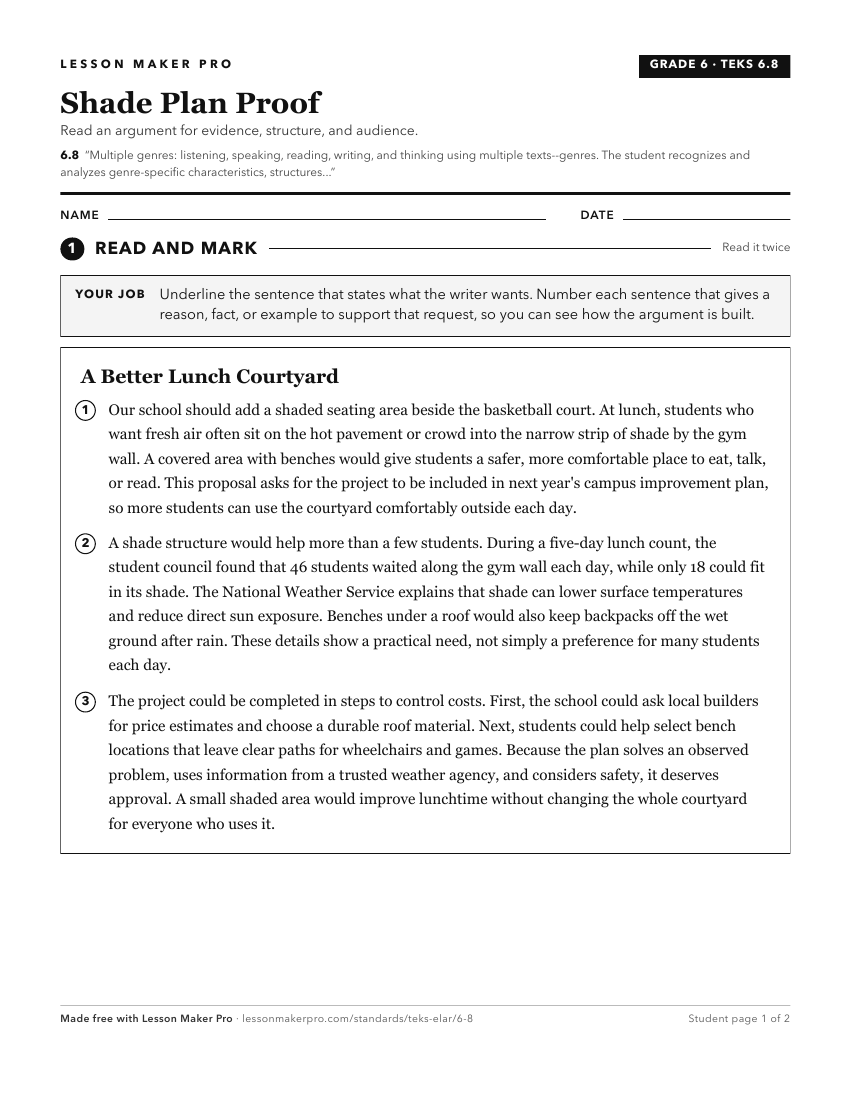
A ready-to-print activity worksheet aligned to 6.8, with an answer key for the teacher on its own page. No account needed.
PDF, US Letter, prints cleanly in black and white.
Download the worksheetKeep exploring
Related Standards
Turn this cluster into a lesson
Grade, subject, topic, and the complete cluster are prefilled. Create one free, no account needed.
Also for this cluster:Make a WorksheetMake a QuizMake a Sub Lesson