TEKS ELAR 2.9
Knowledge and Skills Statement (Standard Cluster)
The student recognizes and analyzes genre-specific characteristics, structures, and purposes within and across increasingly complex traditional, contemporary, classical, and diverse texts.
Texas Essential Knowledge and Skills for English Language Arts and Reading
Cluster contents
Student Expectations in This Statement
2.9 is a knowledge and skills statement. These are the student expectations under it.
- 2.9.A
demonstrate knowledge of distinguishing characteristics of well-known children's literature such as folktales, fables, and fairy tales
- 2.9.B
explain visual patterns and structures in a variety of poems
- 2.9.C
discuss elements of drama such as characters, dialogue, and setting
- 2.9.D.i
the central idea and supporting evidence with adult assistance
- 2.9.D.ii
features and graphics to locate and gain information
- 2.9.D.iii
organizational patterns such as chronological order and cause and effect stated explicitly
- 2.9.E.i
stating what the author is trying to persuade the reader to think or do
- 2.9.E.ii
distinguishing facts from opinion
- 2.9.F
recognize characteristics of multimodal and digital texts.
Teacher's field guide
What This Cluster Means
What Students Need to Do
- Students use clues in the words, structure, and layout to identify what kind of text they are reading and why it was made. They compare stories, poems, plays, articles, arguments, and digital texts, then explain how each communicates meaning.
What Mastery Looks Like
- Students sort unfamiliar texts into likely genres and point to details that support each choice. They explain patterns in poems, identify speakers and settings in plays, and use headings, graphics, sequence, or causes to understand articles. They identify an author’s intended action, separate facts from opinions, and explain how words, images, sound, or links work together.
Common Misconceptions
- Students may call any old story a folktale, confuse a fable’s lesson with its plot, or assume every fairy tale has a princess. They may count poem lines without explaining the pattern, or confuse dialogue with narration and setting with plot. They may overlook headings and graphics, mistake the topic for the central idea, or treat strong opinions as facts.
How to Assess It
- Give students a page with a fable excerpt, poem, play excerpt, short article, and ad. Have them label each text, underline one genre clue, state the article’s main point, and identify the ad’s intended action.
Lesson moves
Ways to Teach It
Give pairs excerpt cards from a fable, poem, play, article, ad, and webpage to sort, then label the clue used.
Read two versions of one story and ask, “How do their genre features change how the message is presented?”
Play Genre Detective: teams identify a text sample, name one feature, and earn a point only when they cite evidence.
Compare a cereal box, public service poster, and news webpage to find facts, opinions, graphics, and each creator’s purpose.
Free download
Printable 2.9 Worksheet
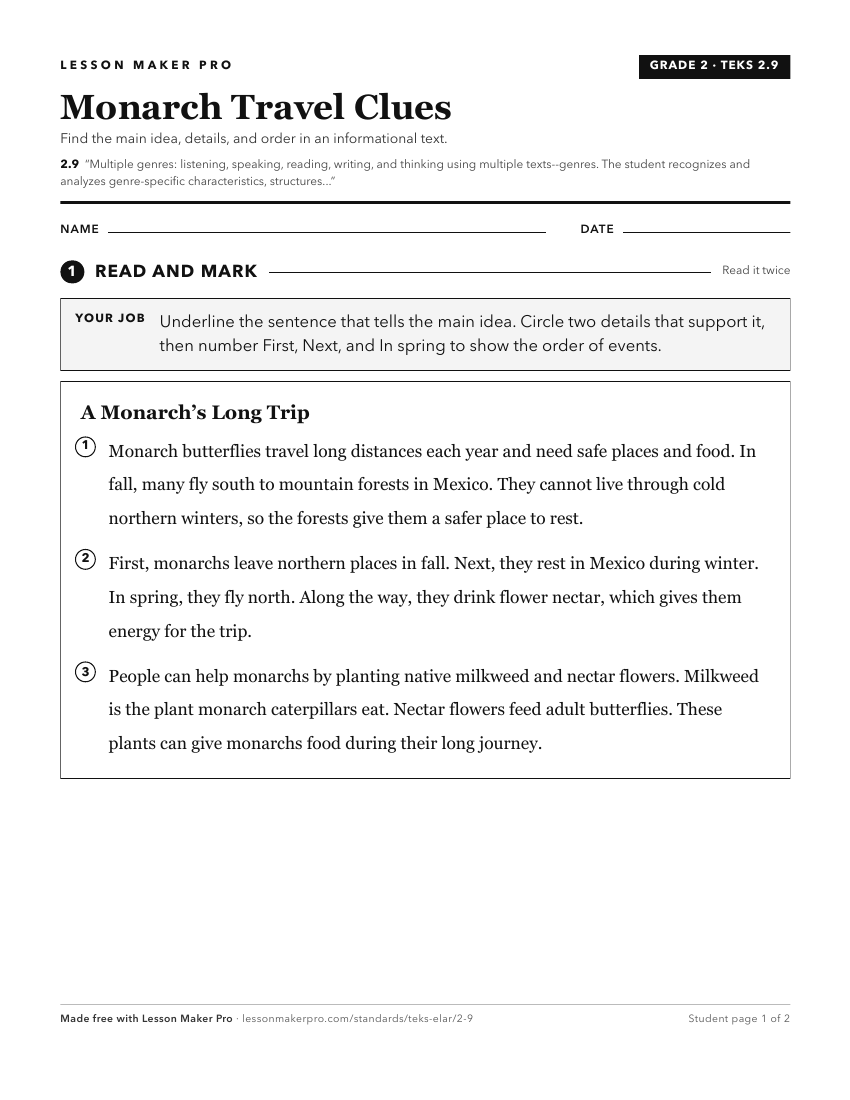
A ready-to-print activity worksheet aligned to 2.9, with an answer key for the teacher on its own page. No account needed.
PDF, US Letter, prints cleanly in black and white.
Download the worksheetKeep exploring
Related Standards
Turn this cluster into a lesson
Grade, subject, topic, and the complete cluster are prefilled. Create one free, no account needed.
Also for this cluster:Make a WorksheetMake a QuizMake a Sub Lesson