TEKS ELAR 2.9.D.i
The Standard
the central idea and supporting evidence with adult assistance
Texas Essential Knowledge and Skills for English Language Arts and Reading · The student recognizes and analyzes genre-specific characteristics, structures, and purposes within and across increasingly complex traditional, contemporary, classical, and diverse texts.
Teacher's field guide
What This Standard Means
What Students Need to Do
- Students tell what a short informational text is mostly saying. With teacher questions or modeling, they find details that prove or explain that main point.
What Mastery Looks Like
- A student states the main point of a short informational text in their own words. With a teacher prompt, they point to two details that support it and explain each connection.
Common Misconceptions
- Students may name the broad topic, such as frogs, instead of stating what the author says about frogs. They may choose an interesting fact, opinion, title, or first sentence as evidence even when it does not support the main point.
How to Assess It
- Exit ticket: Read, “Bees carry pollen from flower to flower. This helps many plants make seeds. Bees help plants grow.” Write the main point and underline two supporting details.
Lesson moves
Ways to Teach It
Give pairs a main-point card and six detail strips, then have them sort the strips into supports and does not support groups.
After a shared reading, ask, “What does the author want us to understand, and which sentence helped you decide?”
Play Evidence Detective by reading a main point and having students hold up cards showing which details support it.
Read a school weather notice, then identify its main message and two facts families need to know.
Free download
Printable 2.9.D.i Worksheet
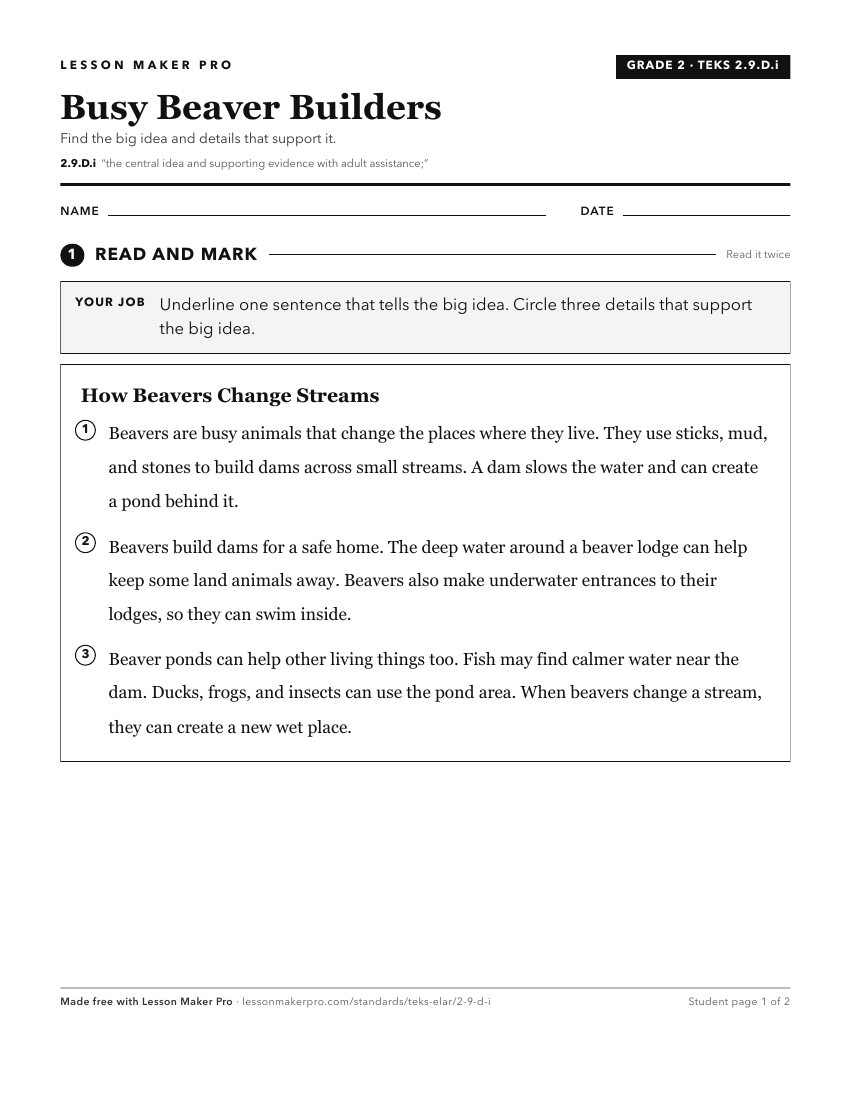
A ready-to-print activity worksheet aligned to 2.9.D.i, with an answer key for the teacher on its own page. No account needed.
PDF, US Letter, prints cleanly in black and white.
Download the worksheetKeep exploring
Related Standards
Turn this exact standard into a lesson
Grade, subject, topic, and the complete standard are prefilled. Create one free, no account needed.
Also for this standard:Make a WorksheetMake a QuizMake a Sub Lesson