TEKS ELAR 2.9.D.ii
The Standard
features and graphics to locate and gain information
Texas Essential Knowledge and Skills for English Language Arts and Reading · The student recognizes and analyzes genre-specific characteristics, structures, and purposes within and across increasingly complex traditional, contemporary, classical, and diverse texts.
Teacher's field guide
What This Standard Means
What Students Need to Do
- Students use headings, captions, labels, diagrams, maps, bold print, glossaries, and indexes to find facts. They explain what each feature helps them learn.
What Mastery Looks Like
- Students quickly choose the heading, caption, diagram, map, index, or glossary that answers a question. They explain the information they found and how the feature helped.
Common Misconceptions
- Students may treat captions, labels, maps, and diagrams as decoration. They may also choose a feature without explaining what information it provides.
How to Assess It
- Give students one informational page with a heading, caption, and diagram. Ask, "Which feature helps you learn where the animal lives, and what does it tell you?"
Lesson moves
Ways to Teach It
Give pairs a nonfiction book and sticky notes to label headings, captions, diagrams, maps, bold words, glossaries, and indexes.
Display a diagram and ask, "What can you learn here that the paragraph does not tell you?"
Play Feature Hunt by naming a question and having teams point to the page feature most likely to answer it.
Examine a bus schedule, menu, or weather map and identify which visual features help readers find needed information quickly.
Free download
Printable 2.9.D.ii Worksheet
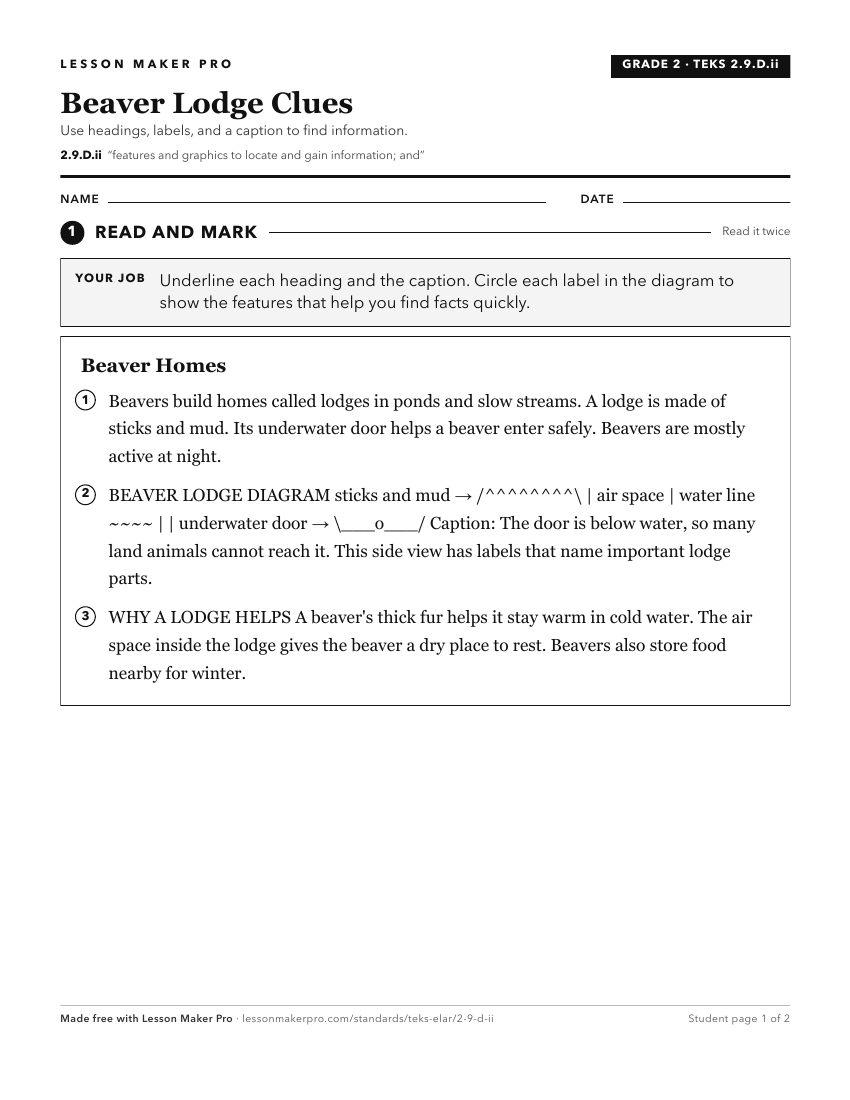
A ready-to-print activity worksheet aligned to 2.9.D.ii, with an answer key for the teacher on its own page. No account needed.
PDF, US Letter, prints cleanly in black and white.
Download the worksheetKeep exploring
Related Standards
- 1.9.D.ii
features and simple graphics to locate or gain information; and
- 5.9.D.ii
features such as insets, timelines, and sidebars to support understanding; and
- K.8.D.ii
titles and simple graphics to gain information; and
- 3.9.D.ii
features such as sections, tables, graphs, timelines, bullets, numbers, and bold and italicized font to support understanding; and
Turn this exact standard into a lesson
Grade, subject, topic, and the complete standard are prefilled. Create one free, no account needed.
Also for this standard:Make a WorksheetMake a QuizMake a Sub Lesson