TEKS ELAR 1.1
Knowledge and Skills Statement (Standard Cluster)
The student develops oral language through listening, speaking, and discussion.
Texas Essential Knowledge and Skills for English Language Arts and Reading
Cluster contents
Student Expectations in This Statement
1.1 is a knowledge and skills statement. These are the student expectations under it.
- 1.1.A
listen actively, ask relevant questions to clarify information, and answer questions using multi-word responses
- 1.1.B
follow, restate, and give oral instructions that involve a short, related sequence of actions
- 1.1.C
share information and ideas about the topic under discussion, speaking clearly at an appropriate pace and using the conventions of language
- 1.1.D
work collaboratively with others by following agreed-upon rules for discussion, including listening to others, speaking when recognized, and making appropriate ...
- 1.1.E
develop social communication such as introducing himself/herself and others, relating experiences to a classmate, and expressing needs and feelings.
Teacher's field guide
What This Cluster Means
What Students Need to Do
- Students listen closely, respond with several words, and ask questions that help them understand. They give and follow short sets of directions in order. They take turns in conversations, share relevant ideas, and communicate needs, feelings, and experiences clearly.
What Mastery Looks Like
- A student listens without interrupting, responds in a complete thought, and asks a question that fits the topic. The student gives short directions in order and speaks clearly enough for a partner to follow them. During group talk, the student takes turns and expresses needs or feelings appropriately.
Common Misconceptions
- Students may think active listening means staying quiet, even if they cannot explain what they heard. They may answer with one word, interrupt, ask unrelated questions, or give steps out of order.
How to Assess It
- Give this exit prompt: “Tell your partner how to draw a house using three steps.” The partner follows the directions, then asks one related question.
Lesson moves
Ways to Teach It
Give pairs picture cards showing three actions, then have students arrange the cards and orally guide a partner through the sequence.
Ask, “What makes someone a good partner?” Students share an idea, respond to a classmate, and ask one related question.
Play Direction Detective, where one student gives three oral steps and the group identifies any missing or out-of-order step.
Set up a classroom help desk where students practice introducing themselves, stating a need, and answering a follow-up question.
Free download
Printable 1.1 Worksheet
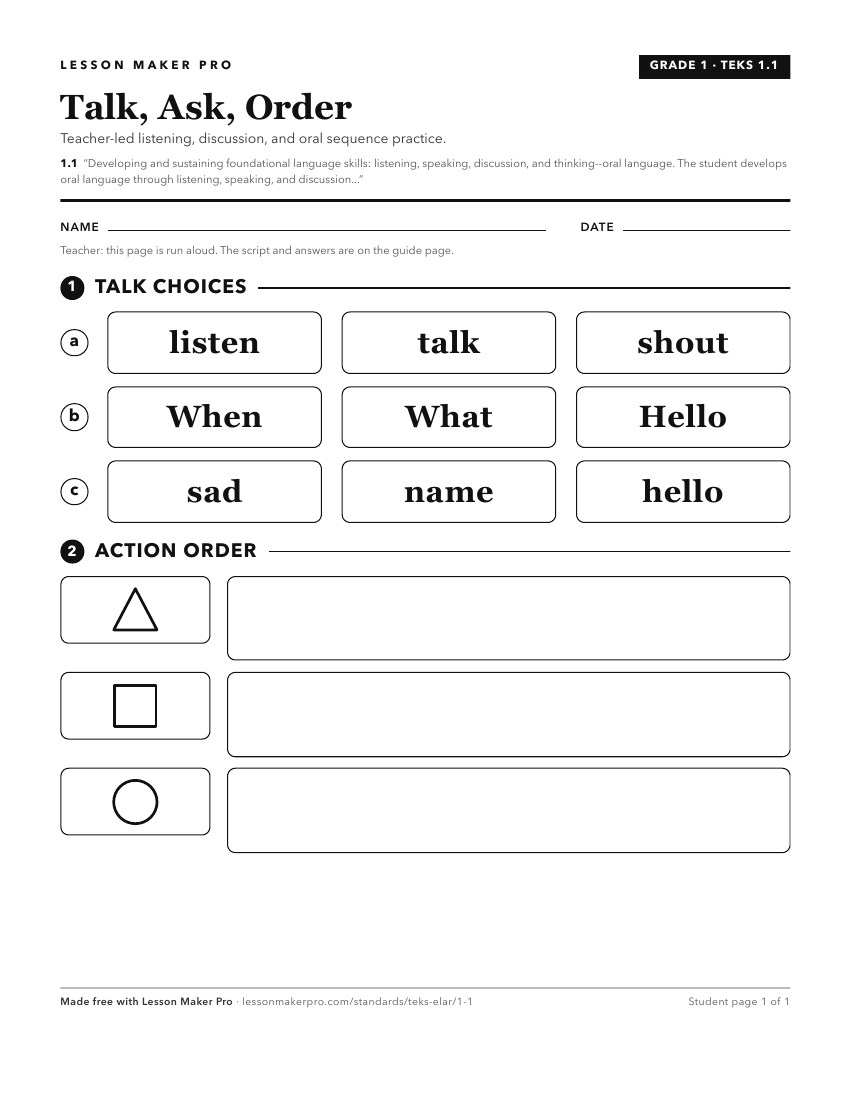
A ready-to-print activity worksheet aligned to 1.1, with an answer key for the teacher on its own page. No account needed.
PDF, US Letter, prints cleanly in black and white.
Download the worksheetKeep exploring
Related Standards
Turn this cluster into a lesson
Grade, subject, topic, and the complete cluster are prefilled. Create one free, no account needed.
Also for this cluster:Make a WorksheetMake a QuizMake a Sub Lesson