TEKS ELAR 6.1
Knowledge and Skills Statement (Standard Cluster)
The student develops oral language through listening, speaking, and discussion.
Texas Essential Knowledge and Skills for English Language Arts and Reading
Cluster contents
Student Expectations in This Statement
6.1 is a knowledge and skills statement. These are the student expectations under it.
- 6.1.A
listen actively to interpret a message, ask clarifying questions, and respond appropriately
- 6.1.B
follow and give oral instructions that include multiple action steps
- 6.1.C
give an organized presentation with a specific stance and position, employing eye contact, speaking rate, volume, enunciation, natural gestures, and conventions...
- 6.1.D
participate in student-led discussions by eliciting and considering suggestions from other group members, taking notes, and identifying points of agreement and ...
Teacher's field guide
What This Cluster Means
What Students Need to Do
- Students listen for meaning, ask focused questions, and respond to what others actually said. They give and follow spoken directions with several ordered steps. They present a clear position and contribute to group discussions by taking notes, inviting ideas, and comparing viewpoints.
What Mastery Looks Like
- Students complete spoken directions in the correct order and ask focused questions when details are unclear. They present a clear position with logical points, steady volume, suitable pacing, and audience contact. In groups, they take useful notes and explain where ideas match or differ.
Common Misconceptions
- Students may think listening means staying quiet rather than tracking and interpreting ideas. They may skip steps, ask unrelated questions, or treat disagreement as a personal conflict. During presentations, they may read directly from notes, speak too quickly, or use volume instead of clear reasoning.
How to Assess It
- Give a three-step oral direction, then have students complete it and write one clarifying question. Each student gives a 30-second opinion while a partner notes the main claim and one supporting point.
Lesson moves
Ways to Teach It
Pair students with identical building blocks and a screen; one builds a model, then gives numbered directions for the partner to copy.
Discuss whether homework should be limited; each student records one agreement, one disagreement, and one clarifying question before responding.
Play Instruction Relay: teams hear a four-step task once, complete it in order, then revise unclear directions.
Hold a mock city council meeting where students give one-minute park improvement pitches using note cards, clear volume, eye contact, and gestures.
Free download
Printable 6.1 Worksheet
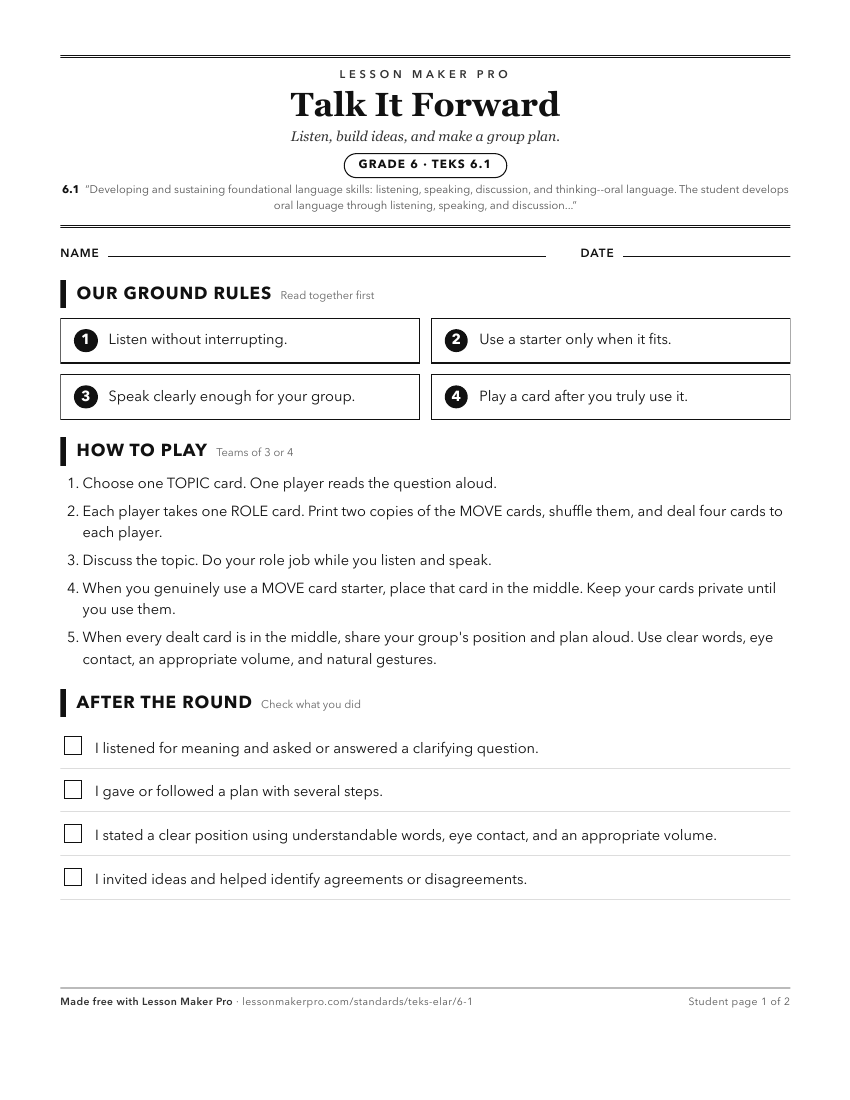
A ready-to-print activity worksheet aligned to 6.1, with an answer key for the teacher on its own page. No account needed.
PDF, US Letter, prints cleanly in black and white.
Download the worksheetKeep exploring
Related Standards
Turn this cluster into a lesson
Grade, subject, topic, and the complete cluster are prefilled. Create one free, no account needed.
Also for this cluster:Make a WorksheetMake a QuizMake a Sub Lesson