TEKS ELAR 6.1.D
The Standard
participate in student-led discussions by eliciting and considering suggestions from other group members, taking notes, and identifying points of agreement and disagreement.
Texas Essential Knowledge and Skills for English Language Arts and Reading
Teacher's field guide
What This Standard Means
What Students Need to Do
- Students ask group members for ideas and listen closely to their responses. They take brief notes, build on suggestions, and name points of agreement and disagreement.
What Mastery Looks Like
- Students invite ideas with clear questions and listen without interrupting. Their notes capture key points, and they can explain where group members agree or disagree.
Common Misconceptions
- Students may wait for their turn to speak instead of responding to others. They may copy every word rather than note key ideas, or treat disagreement as a personal conflict.
How to Assess It
- Have groups discuss, “Should school start later?” Each student submits notes listing two peer suggestions, one agreement, one disagreement, and one question asked.
Lesson moves
Ways to Teach It
In groups, rank five survival items; the facilitator asks each person, and students sort sticky-note suggestions into agreement and disagreement columns.
Discuss, “Should homework be limited?” Require each student to ask one follow-up question, paraphrase a peer’s idea, and write one response.
Play Discussion Bingo with squares such as asks for a suggestion, records a point, names agreement, and explains disagreement.
Hold a mock town council on a new park, with students representing residents, taking notes, and finding shared concerns.
Free download
Printable 6.1.D Worksheet
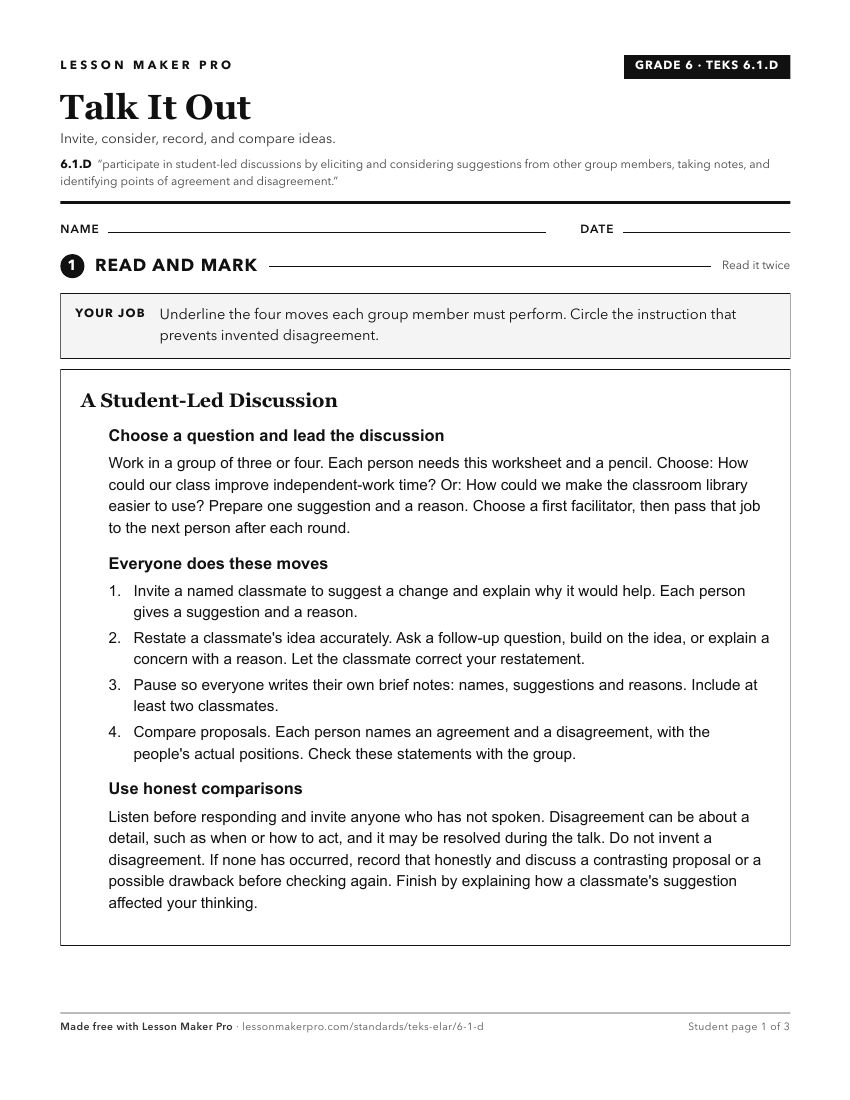
A ready-to-print activity worksheet aligned to 6.1.D, with an answer key for the teacher on its own page. No account needed.
PDF, US Letter, prints cleanly in black and white.
Download the worksheetKeep exploring
Related Standards
- 1.1.D
work collaboratively with others by following agreed-upon rules for discussion, including listening to others, speaking when recognized, and making appropriate ...
- K.1.D
work collaboratively with others by following agreed-upon rules for discussion, including taking turns; and
- 8.1.D
participate collaboratively in discussions, plan agendas with clear goals and deadlines, set time limits for speakers, take notes, and vote on key issues.
- 2.1.D
work collaboratively with others by following agreed-upon rules for discussion, including listening to others, speaking when recognized, making appropriate cont...
Turn this exact standard into a lesson
Grade, subject, topic, and the complete standard are prefilled. Create one free, no account needed.
Also for this standard:Make a WorksheetMake a QuizMake a Sub Lesson