TEKS ELAR 8.1
Knowledge and Skills Statement (Standard Cluster)
The student develops oral language through listening, speaking, and discussion.
Texas Essential Knowledge and Skills for English Language Arts and Reading
Cluster contents
Student Expectations in This Statement
8.1 is a knowledge and skills statement. These are the student expectations under it.
- 8.1.A
listen actively to interpret a message by summarizing, asking questions, and making comments
- 8.1.B
follow and give complex oral instructions to perform specific tasks, answer questions, or solve problems
- 8.1.C
advocate a position using anecdotes, analogies, and/or illustrations employing eye contact, speaking rate, volume, enunciation, a variety of natural gestures, a...
- 8.1.D
participate collaboratively in discussions, plan agendas with clear goals and deadlines, set time limits for speakers, take notes, and vote on key issues.
Teacher's field guide
What This Cluster Means
What Students Need to Do
- Students listen closely, summarize messages, ask useful questions, and make relevant comments. They follow and give detailed oral directions, then present a clear position using examples and controlled delivery. They also manage group discussions with goals, deadlines, speaker limits, notes, and voting.
What Mastery Looks Like
- Students restate a speaker’s message accurately and ask questions that clarify or extend it. They give precise directions and present a position with a fitting anecdote, analogy, or example. They use effective delivery and keep group discussions focused, timed, recorded, and fair.
Common Misconceptions
- Students may think active listening means staying silent, or they may add opinions to a summary. They often omit steps from oral directions or mistake loudness for persuasion. In group work, they may dominate, skip notes, or vote before hearing each position.
How to Assess It
- Run an eight-minute group decision task about a class policy. Require each student to speak, summarize a peer, ask one question, follow an agenda, keep notes, and vote.
Lesson moves
Ways to Teach It
Give pairs matching blocks; one student builds a hidden model and gives oral directions while the partner reconstructs it, then they compare results.
Ask students to defend or oppose homework using one anecdote, analogy, or illustration, then explain which speaking choices made arguments convincing.
Play Summary, Question, Comment: after each one-minute talk, listeners draw a card and respond using the named listening move.
Hold a mock school board meeting about phone rules, with an agenda, timed speakers, a note taker, and a final vote.
Free download
Printable 8.1 Worksheet
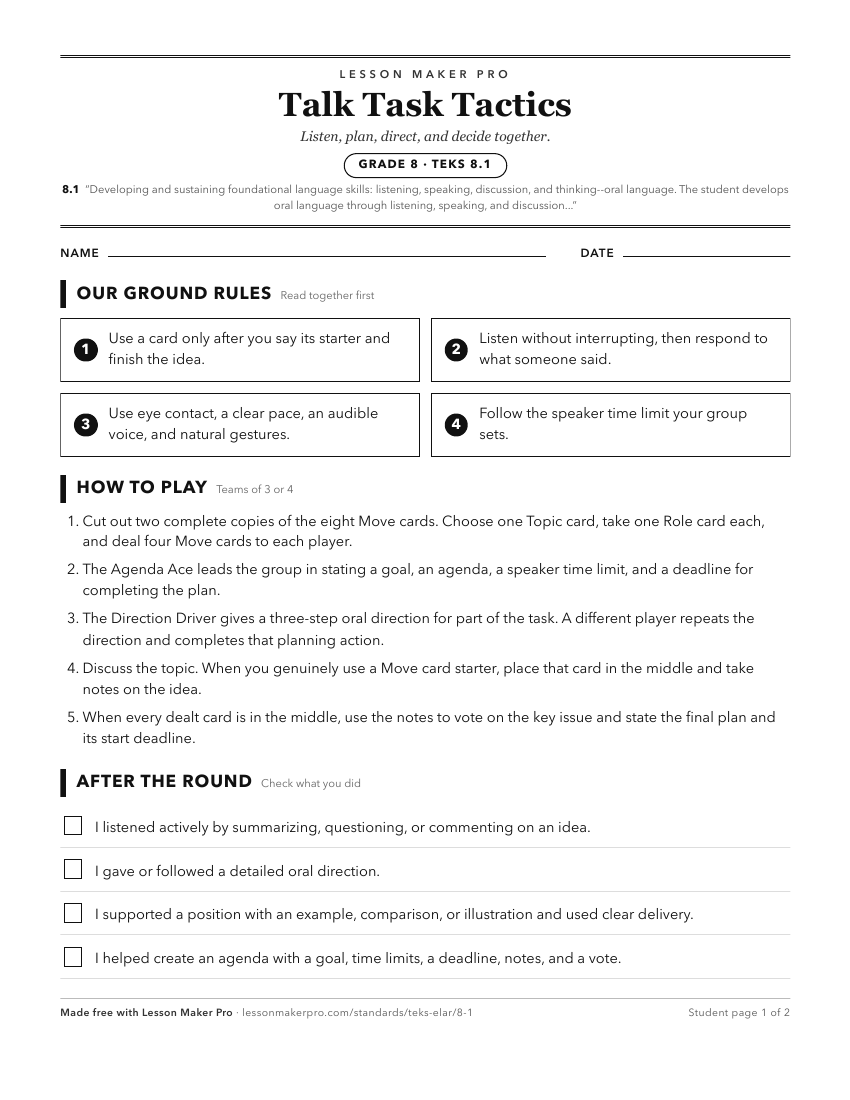
A ready-to-print activity worksheet aligned to 8.1, with an answer key for the teacher on its own page. No account needed.
PDF, US Letter, prints cleanly in black and white.
Download the worksheetKeep exploring
Related Standards
Turn this cluster into a lesson
Grade, subject, topic, and the complete cluster are prefilled. Create one free, no account needed.
Also for this cluster:Make a WorksheetMake a QuizMake a Sub Lesson