TEKS ELAR 5.1
Knowledge and Skills Statement (Standard Cluster)
The student develops oral language through listening, speaking, and discussion.
Texas Essential Knowledge and Skills for English Language Arts and Reading
Cluster contents
Student Expectations in This Statement
5.1 is a knowledge and skills statement. These are the student expectations under it.
- 5.1.A
listen actively to interpret verbal and non-verbal messages, ask relevant questions, and make pertinent comments
- 5.1.B
follow, restate, and give oral instructions that include multiple action steps
- 5.1.C
give an organized presentation employing eye contact, speaking rate, volume, enunciation, natural gestures, and conventions of language to communicate ideas eff...
- 5.1.D
work collaboratively with others to develop a plan of shared responsibilities.
Teacher's field guide
What This Cluster Means
What Students Need to Do
- Students listen for meaning in a speaker’s words, tone, facial expressions, and gestures. They ask useful questions, add comments that fit, and accurately handle spoken directions with several steps. They also plan group work and deliver clear, organized talks using effective voice, language, eye contact, and movement.
What Mastery Looks Like
- A student can restate a four-step direction in order and complete it without repeated reminders. During a short talk, the student stays organized, speaks clearly, and uses eye contact and natural gestures. In a group, the student helps assign jobs, completes their share, and responds directly to others.
Common Misconceptions
- Students may hear individual words but miss tone, gestures, or the speaker’s main point. They often ask off-topic questions, change the order of spoken steps, or treat volume as shouting. Some assume group work means one student leads while everyone else waits.
How to Assess It
- Read groups a four-step task using a book, pencil, and sticky note. Students assign three roles, restate and complete the steps, then report their result and answer one relevant question.
Lesson moves
Ways to Teach It
Give teams cups, craft sticks, and four spoken building steps, then have one student restate directions while teammates complete assigned roles.
Ask, “How can a speaker’s voice and body change a message?” Students cite one observed example and respond to a classmate.
Play Direction Relay: students hear three steps, repeat them accurately, complete them, then earn a point by asking a relevant question.
Teams plan a mock school announcement, divide writing and speaking jobs, then present it with clear volume, pace, eye contact, and gestures.
Free download
Printable 5.1 Worksheet
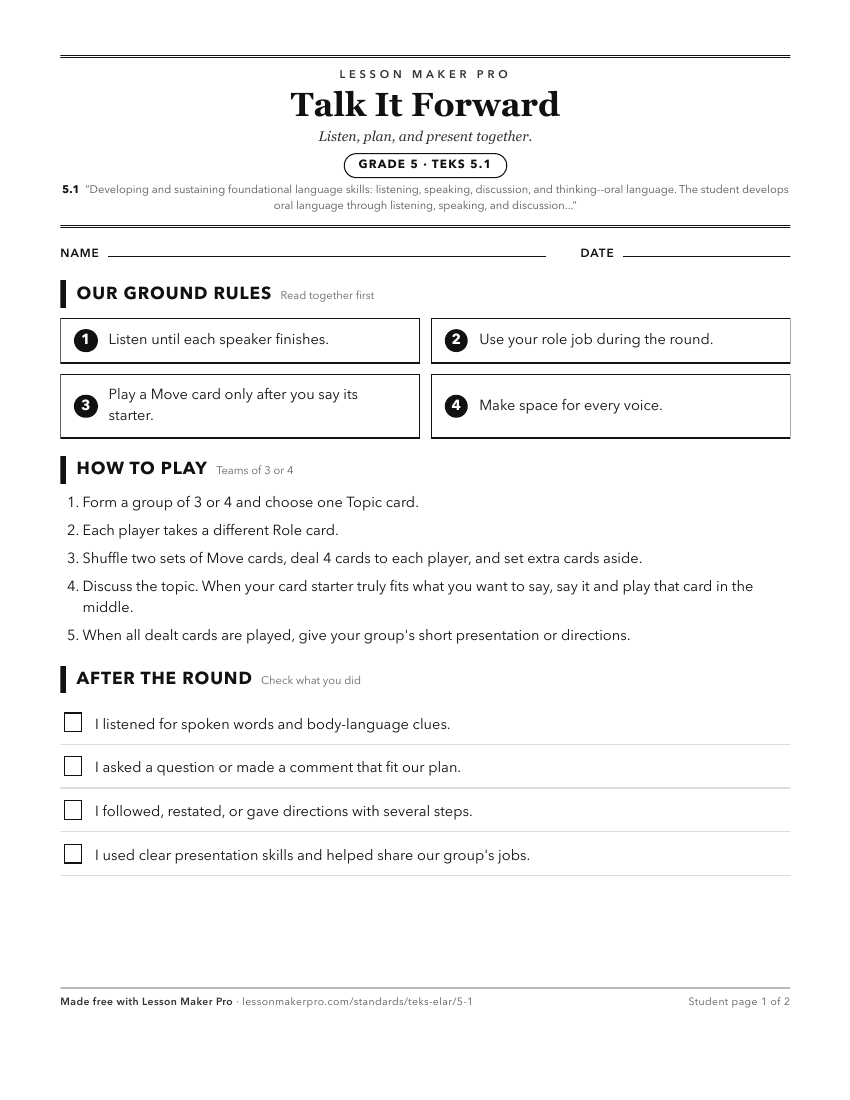
A ready-to-print activity worksheet aligned to 5.1, with an answer key for the teacher on its own page. No account needed.
PDF, US Letter, prints cleanly in black and white.
Download the worksheetKeep exploring
Related Standards
Turn this cluster into a lesson
Grade, subject, topic, and the complete cluster are prefilled. Create one free, no account needed.
Also for this cluster:Make a WorksheetMake a QuizMake a Sub Lesson