TEKS ELAR 6.1.C
The Standard
give an organized presentation with a specific stance and position, employing eye contact, speaking rate, volume, enunciation, natural gestures, and conventions of language to communicate ideas effectively
Texas Essential Knowledge and Skills for English Language Arts and Reading
Teacher's field guide
What This Standard Means
What Students Need to Do
- Students choose a clear opinion, organize reasons and details, and present them in a logical order. They speak clearly, look at listeners, control pace and volume, and use appropriate gestures and grammar.
What Mastery Looks Like
- A student opens with a clear claim, gives connected reasons and details, and ends with a strong closing. The student maintains eye contact, speaks clearly at an even pace, and uses natural gestures and correct grammar.
Common Misconceptions
- Students may list facts without stating a clear opinion or arranging reasons logically. They may read every word, speak too quickly, confuse volume with shouting, or use gestures that distract listeners.
How to Assess It
- Ask students to give a 60-second response to: “Should sixth graders have homework every night?” Require a claim, two reasons, a closing, and clear delivery.
Lesson moves
Ways to Teach It
Students arrange claim, reason, detail, and conclusion cards, then use the sequence to give a one-minute presentation.
Discuss or write: “Which school rule should change, and why?” Students prepare a claim and two supporting reasons.
Play delivery bingo while classmates present, marking clear volume, steady pace, eye contact, precise words, and natural gestures.
Create a 60-second proposal for a school improvement, then present it as if speaking to the principal.
Free download
Printable 6.1.C Worksheet
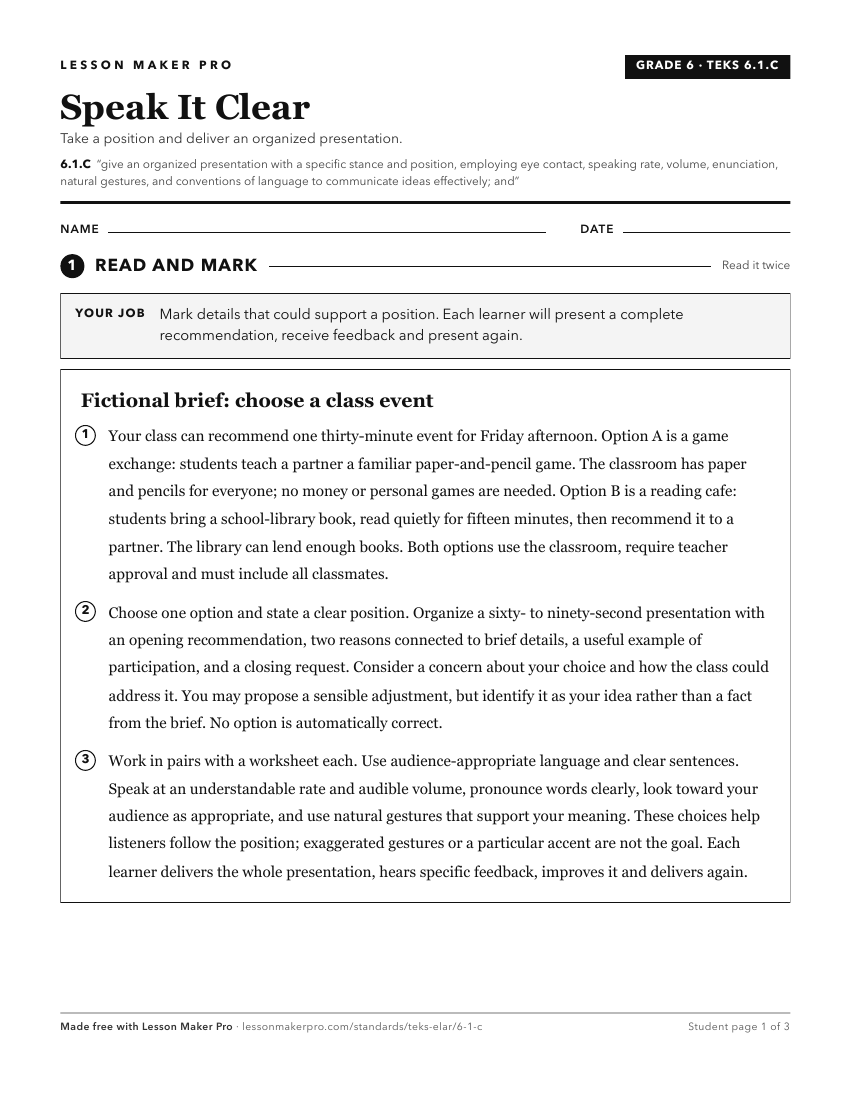
A ready-to-print activity worksheet aligned to 6.1.C, with an answer key for the teacher on its own page. No account needed.
PDF, US Letter, prints cleanly in black and white.
Download the worksheetKeep exploring
Related Standards
- 5.1.C
give an organized presentation employing eye contact, speaking rate, volume, enunciation, natural gestures, and conventions of language to communicate ideas eff...
- 8.1.C
advocate a position using anecdotes, analogies, and/or illustrations employing eye contact, speaking rate, volume, enunciation, a variety of natural gestures, a...
- 3.1.C
speak coherently about the topic under discussion, employing eye contact, speaking rate, volume, enunciation, and the conventions of language to communicate ide...
- 4.1.C
express an opinion supported by accurate information, employing eye contact, speaking rate, volume, enunciation, and the conventions of language to communicate ...
Turn this exact standard into a lesson
Grade, subject, topic, and the complete standard are prefilled. Create one free, no account needed.
Also for this standard:Make a WorksheetMake a QuizMake a Sub Lesson