TEKS ELAR 3.1.C
The Standard
speak coherently about the topic under discussion, employing eye contact, speaking rate, volume, enunciation, and the conventions of language to communicate ideas effectively
Texas Essential Knowledge and Skills for English Language Arts and Reading
Teacher's field guide
What This Standard Means
What Students Need to Do
- Students share ideas that stay focused on the group’s topic. They speak clearly, use an appropriate pace and volume, make eye contact, and use complete, correct sentences.
What Mastery Looks Like
- A student gives a focused explanation that listeners can follow. The student uses complete sentences, clear pronunciation, suitable volume, a steady pace, and regular eye contact.
Common Misconceptions
- Students may speak too softly, rush, mumble, or stare at the floor. They may drift off topic, use sentence fragments, or mistake shouting for clear speech.
How to Assess It
- Ask each student to explain a favorite classroom activity in 30 seconds. Check for a clear main idea, steady pace, suitable volume, clear words, and eye contact.
Lesson moves
Ways to Teach It
Students draw a topic card and give a 30-second talk while partners check pace, volume, clear words, and eye contact.
Ask, "What makes a speaker easy to understand?" Students name one skill and explain why it helps listeners.
Play Speaker Coach, where students repeat a sentence after drawing a card labeled slower, louder, clearer, or eye contact.
Students act as school announcers and present a lunch menu, weather update, or reminder clearly to the class.
Free download
Printable 3.1.C Worksheet
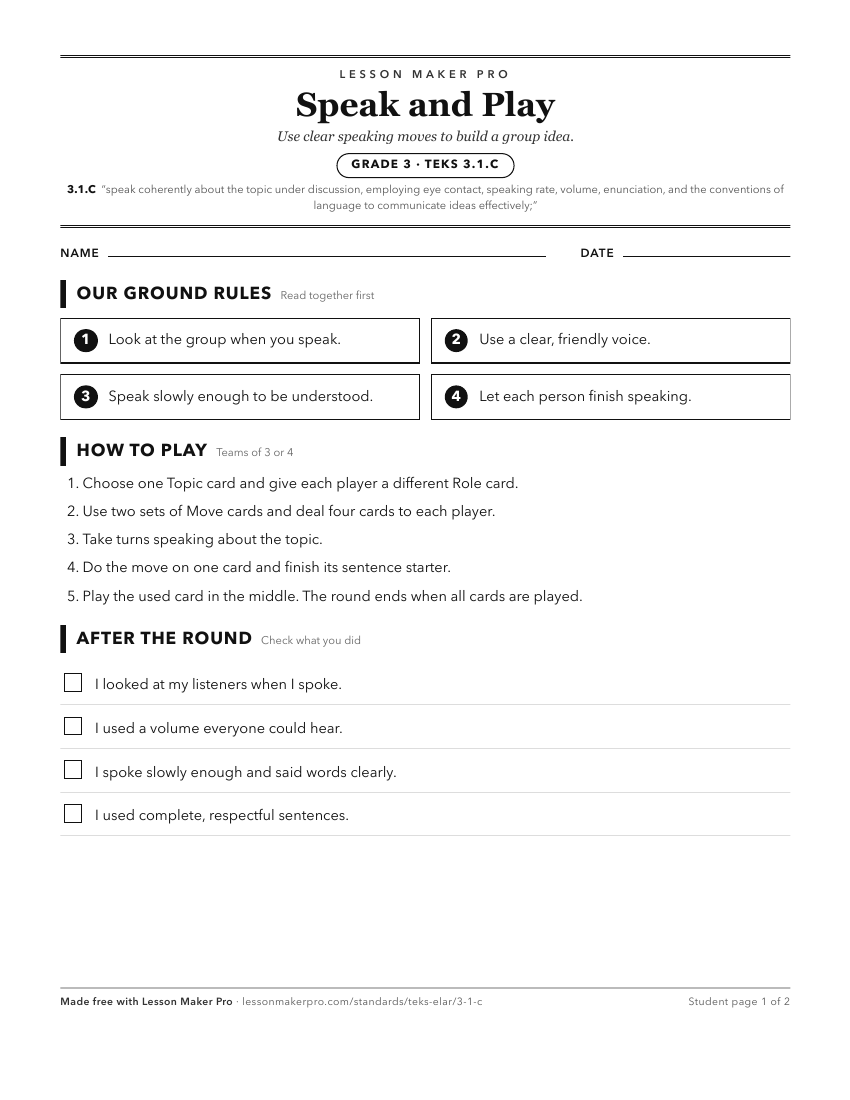
A ready-to-print activity worksheet aligned to 3.1.C, with an answer key for the teacher on its own page. No account needed.
PDF, US Letter, prints cleanly in black and white.
Download the worksheetKeep exploring
Related Standards
- 1.1.C
share information and ideas about the topic under discussion, speaking clearly at an appropriate pace and using the conventions of language;
- 5.1.C
give an organized presentation employing eye contact, speaking rate, volume, enunciation, natural gestures, and conventions of language to communicate ideas eff...
- 2.1.C
share information and ideas that focus on the topic under discussion, speaking clearly at an appropriate pace and using the conventions of language;
- 4.1.C
express an opinion supported by accurate information, employing eye contact, speaking rate, volume, enunciation, and the conventions of language to communicate ...
Turn this exact standard into a lesson
Grade, subject, topic, and the complete standard are prefilled. Create one free, no account needed.
Also for this standard:Make a WorksheetMake a QuizMake a Sub Lesson