Oklahoma Social Studies 4.C.4
Standard Cluster
Examine the United States of America’s economic system and its economic activities which support human development. Describe the features of a market economy and evaluate common benefits and tradeoffs. Define a market economic system, explaining how the United States of America’s market system encourages free enterprise, economic development, private property rights, and individual prosperity. Describe how production, distribution, and consumption of goods and services are economic decisions made by producers and consumers to satisfy their needs and wants. Compare the factors of production (e.g., labor, land, capital, entrepreneurship) and explain how they are used together to produce goods and services, as exemplified by contemporary American entrepreneurs. Describe how economic activities impact the nation’s economy. Identify the major economic activities in which people of each region work to satisfy their needs and wants (e.g., commercial agriculture, manufacturing, energy production, construction, and services such as healthcare and technology). Distinguish between renewable (e.g., water, soil, solar) and nonrenewable resources (e.g., fossil fuels: oil, natural gas, coal) and explain how they are used to produce goods and services, using examples from regional economies. Describe the relative location and importance of natural resources which support human development in each region (e.g., Mid-Continent oilfield, Appalachian and Rocky Mountain coal basins, Ogallala Aquifer, Imperial Valley, Outer Banks). Describe the patterns and networks of economic interdependence among regions and the world. Explain how transportation routes connect economic regions and support economic growth (e.g., St. Lawrence Seaway, Transcontinental Railroad, Route 66, Interstate Highway System). Describe reasons why people and nations trade, providing examples of major imports and exports produced and consumed by Americans.
Oklahoma Academic Standards for Social Studies (2026)
Cluster contents
Standards in This Cluster
4.C.4 is a cluster heading. These are the individual standards under it.
- 4.C.4.1
Describe the features of a market economy and evaluate common benefits and tradeoffs.
- 4.C.4.1.A
Define a market economic system, explaining how the United States of America’s market system encourages free enterprise, economic development, private property ...
- 4.C.4.1.B
Describe how production, distribution, and consumption of goods and services are economic decisions made by producers and consumers to satisfy their needs and w...
- 4.C.4.1.C
Compare the factors of production (e.g., labor, land, capital, entrepreneurship) and explain how they are used together to produce goods and services, as exempl...
- 4.C.4.2
Describe how economic activities impact the nation’s economy.
- 4.C.4.2.A
Identify the major economic activities in which people of each region work to satisfy their needs and wants (e.g., commercial agriculture, manufacturing, energy...
- 4.C.4.2.B
Distinguish between renewable (e.g., water, soil, solar) and nonrenewable resources (e.g., fossil fuels: oil, natural gas, coal) and explain how they are used t...
- 4.C.4.2.C
Describe the relative location and importance of natural resources which support human development in each region (e.g., Mid-Continent oilfield, Appalachian and...
- 4.C.4.3
Describe the patterns and networks of economic interdependence among regions and the world.
- 4.C.4.3.A
Explain how transportation routes connect economic regions and support economic growth (e.g., St. Lawrence Seaway, Transcontinental Railroad, Route 66, Intersta...
- 4.C.4.3.B
Describe reasons why people and nations trade, providing examples of major imports and exports produced and consumed by Americans.
Teacher's field guide
What This Cluster Means
What Students Need to Do
- Students explain how business owners and customers make choices in a market. They show how natural resources, workers, tools, and business ideas produce goods and services. They use maps to trace how products travel between U.S. regions and other countries.
What Mastery Looks Like
- A student can explain why someone might start a business, what the owner owns, and how customers affect what the business sells. They can link a regional resource to a job, a shipping route, and a buyer. They can name a benefit and a tradeoff of a business choice, and tell which resources can be replaced quickly.
Common Misconceptions
- Students may think a business needs only money, not workers, materials, and equipment. They may think renewable resources cannot run out. Some assume each region makes everything its people use, rather than trading with other regions.
How to Assess It
- Exit ticket: A Colorado company makes tables from local wood and ships them by interstate to Oklahoma. Name its natural resource, workers, tools, and business owner, then give one benefit and one tradeoff of making more tables.
Lesson moves
Ways to Teach It
Give teams craft sticks, paper, scissors, and tokens; have them build and price model chairs, then label their materials, labor, tools, and owner.
Ask: Should a farmer pump more water from the Ogallala Aquifer to grow extra corn? Write one benefit and one cost.
Play route match: have students arrange cards for Appalachian coal, a Midwest factory, an interstate, and buyers in another state; explain each link.
Read labels on three classroom items; mark each country of origin on a map and discuss why Americans buy goods made abroad.
Free download
Printable 4.C.4 Worksheet
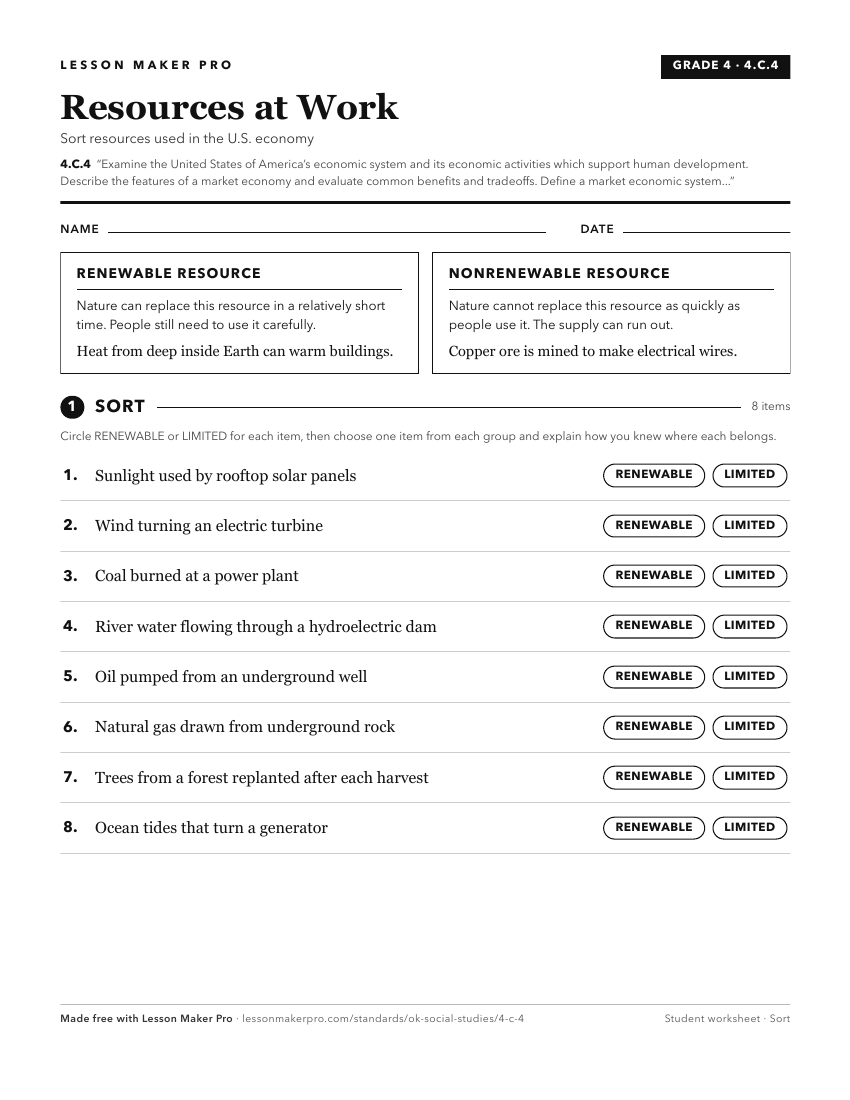
A ready-to-print activity worksheet aligned to 4.C.4, with an answer key for the teacher on its own page. No account needed.
PDF, US Letter, prints cleanly in black and white.
Download the worksheetKeep exploring
Related Standards
- 6.C.6
Analyze economic systems of the world and how they impact the development of a nation and region.
- E.C.8
Examine the impact of the global economy on domestic conditions within the United States of America’s economy.
- 6.C.6.2
Analyze the benefits and limitations of the world’s economic systems.
- 4.C.2.3
Analyze the human characteristics of the United States of America.
Turn this cluster into a lesson
Grade, subject, topic, and the complete cluster are prefilled. Create one free, no account needed.
Also for this cluster:Make a WorksheetMake a QuizMake a Sub Lesson