Oklahoma Social Studies 4.C.4.1
Standard Cluster
- 4.C.4
- Examine the United States of America’s economic system and its economic activities which support human development.
Describe the features of a market economy and evaluate common benefits and tradeoffs. Define a market economic system, explaining how the United States of America’s market system encourages free enterprise, economic development, private property rights, and individual prosperity. Describe how production, distribution, and consumption of goods and services are economic decisions made by producers and consumers to satisfy their needs and wants. Compare the factors of production (e.g., labor, land, capital, entrepreneurship) and explain how they are used together to produce goods and services, as exemplified by contemporary American entrepreneurs.
Oklahoma Academic Standards for Social Studies (2026) · 4.C.4
Cluster contents
Standards in This Cluster
4.C.4.1 is a cluster heading. These are the individual standards under it.
- 4.C.4.1.A
Define a market economic system, explaining how the United States of America’s market system encourages free enterprise, economic development, private property ...
- 4.C.4.1.B
Describe how production, distribution, and consumption of goods and services are economic decisions made by producers and consumers to satisfy their needs and w...
- 4.C.4.1.C
Compare the factors of production (e.g., labor, land, capital, entrepreneurship) and explain how they are used together to produce goods and services, as exempl...
Teacher's field guide
What This Cluster Means
What Students Need to Do
- Students explain how U.S. markets let people own property, start businesses, and choose what to buy or sell. They trace how producers make and move goods or services to meet buyers' needs and wants. They compare the resources used to make things and weigh chances to earn money against risks of loss.
What Mastery Looks Like
- A student can explain how a food truck owner chooses a menu and price, while customers choose whether to buy. They identify farmland, cooks, equipment, and the owner's business plan as land, labor, capital, and entrepreneurship. They explain how a profitable truck can create jobs and earn its owner money, but may lose sales to a rival.
Common Misconceptions
- Students may think producers only make goods, not provide services. They may confuse capital with cash rather than the tools used to produce goods. Some assume every new business earns a profit.
How to Assess It
- Exit ticket: 'Nia owns a taco cart, buys farm-grown corn, hires Lee, uses a grill, and sells tacos at the park.' Have students label the four production factors and name one benefit and one risk for Nia.
Lesson moves
Ways to Teach It
Hand out paper and markers to bookmark makers and tokens to buyers; let makers set prices and buyers choose where to spend.
Ask, 'If you own a lemonade stand, what can you decide, and what happens if another stand charges less?'
Have pairs sort cards labeled farmland, worker, blender, and owner into land, labor, capital, and entrepreneurship.
Show a photo of American entrepreneur Daymond John and a FUBU shirt; list the fabric, workers, machines, and decisions behind it.
Free download
Printable 4.C.4.1 Worksheet
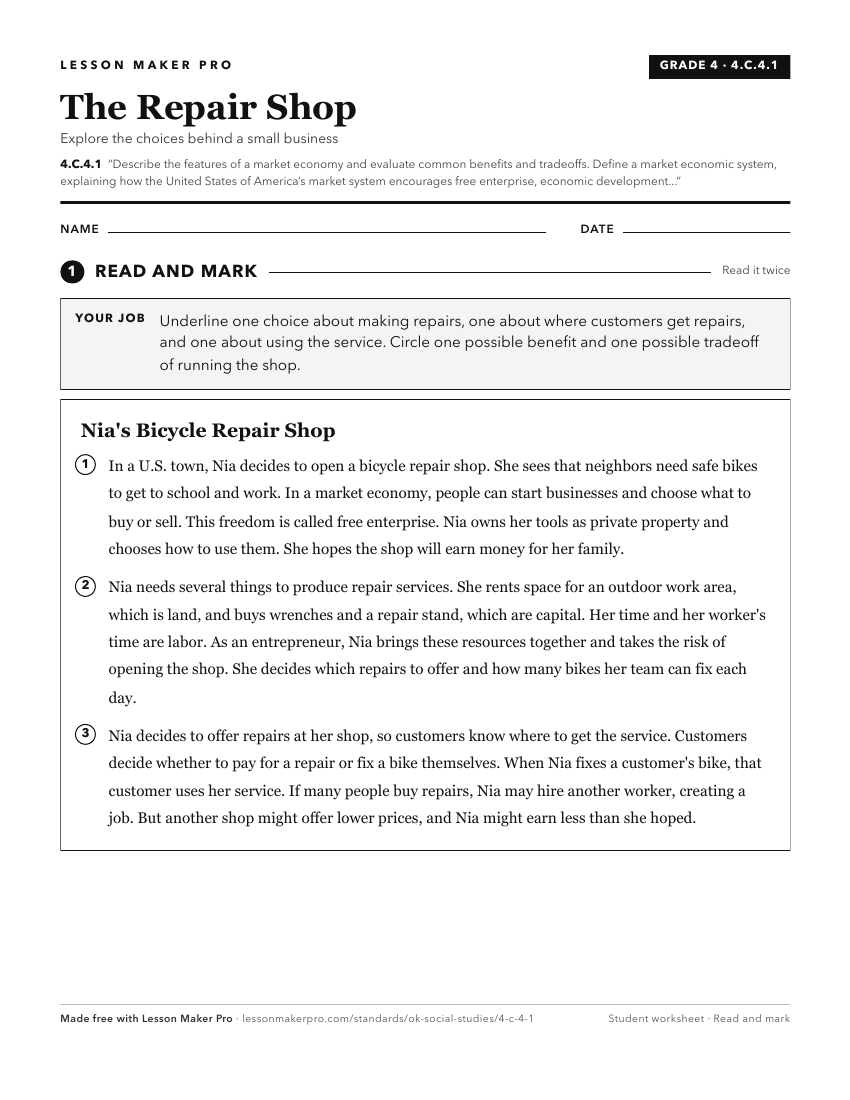
A ready-to-print activity worksheet aligned to 4.C.4.1, with an answer key for the teacher on its own page. No account needed.
PDF, US Letter, prints cleanly in black and white.
Download the worksheetKeep exploring
Related Standards
- 2.P.2.4
Identify the principles of economic systems and develop an understanding of the benefits of a market system in local, national, and global settings.
- 7.C.7.2
Compare the advantages and disadvantages of the traditional, market, and command economic systems, including how government policies affect economic activities ...
- WG.P.2.4
Identify the principles of economic systems and develop an understanding of the benefits of a market system in local, national, and global settings.
- 3.C.4.1
Describe the features of a market economic system.
Turn this cluster into a lesson
Grade, subject, topic, and the complete cluster are prefilled. Create one free, no account needed.
Also for this cluster:Make a WorksheetMake a QuizMake a Sub Lesson