Oklahoma Social Studies WG.P.2.4
Standard Cluster
- WG.P.2
- Use interdisciplinary tools to acquire, apply, and evaluate content understanding of the four strands of social studies.
Identify the principles of economic systems and develop an understanding of the benefits of a market system in local, national, and global settings. Evaluate economic data from charts and graphs, noting trends and making predictions. Construct arguments using a combination of evidence regarding solutions used by nations to address historical or contemporary economic issues. Evaluate the impact, both intended and unintended, of government policies on market outcomes at national and global levels, past and present.
Oklahoma Academic Standards for Social Studies (2026) · WG.P.2
Cluster contents
Standards in This Cluster
WG.P.2.4 is a cluster heading. These are the individual standards under it.
- WG.P.2.4.A
Evaluate economic data from charts and graphs, noting trends and making predictions.
- WG.P.2.4.B
Construct arguments using a combination of evidence regarding solutions used by nations to address historical or contemporary economic issues.
- WG.P.2.4.C
Evaluate the impact, both intended and unintended, of government policies on market outcomes at national and global levels, past and present.
Teacher's field guide
What This Cluster Means
What Students Need to Do
- Compare who owns businesses and sets prices in market, command, and mixed economies. Explain how markets can benefit buyers and sellers locally and across borders. Read economic charts, predict trends, and use evidence to judge government policies.
What Mastery Looks Like
- A student can use price and employment charts to defend a claim about a tariff. They can name its intended benefit, a possible cost to buyers, and an effect on trade with other countries.
Common Misconceptions
- Students may think market economies have no government rules, or that every country uses just one economic system. They may assume a chart proves a policy caused a change. They may count jobs gained in one industry but miss higher costs elsewhere.
How to Assess It
- Show two sample charts: steel jobs rise from 140,000 to 145,000, and steel prices rise from $700 to $850 after a tariff. Ask students to predict one effect, name a winner and a loser, and explain why the charts alone cannot prove cause.
Lesson moves
Ways to Teach It
Give pairs buyer and seller price cards, run a two-round steel market, then add a $2 tariff to imported steel cards.
Ask students to write a claim about steel tariffs using a steel jobs chart and a steel prices chart as evidence.
Have teams sort scenario cards showing private bakeries, government-owned factories, and mixed health care into economic systems.
Compare local and imported tomato prices in grocery ads, then sketch how an import tariff might affect shoppers and farmers.
Free download
Printable WG.P.2.4 Worksheet
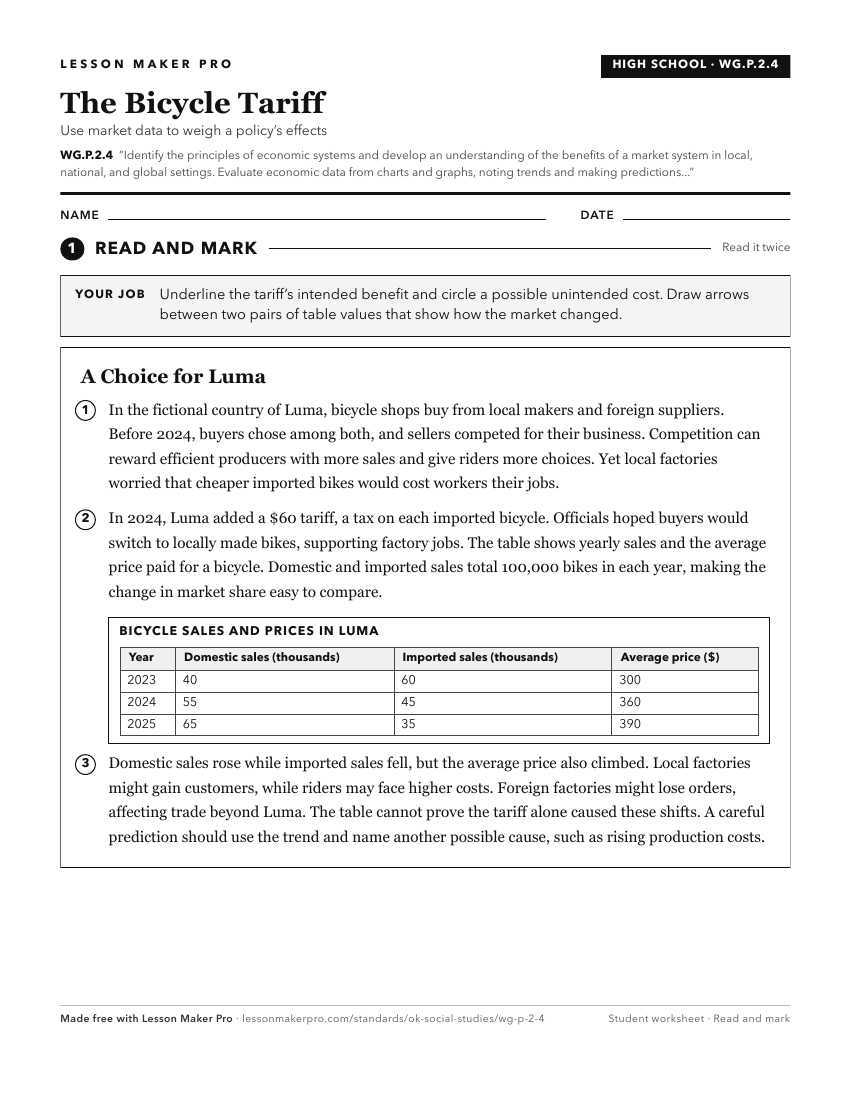
A ready-to-print activity worksheet aligned to WG.P.2.4, with an answer key for the teacher on its own page. No account needed.
PDF, US Letter, prints cleanly in black and white.
Download the worksheetKeep exploring
Related Standards
- 7.P.2.4
Identify the principles of economic systems and develop an understanding of the benefits of a market system in local, national, and global settings.
- OKH.P.2.4
Identify the principles of economic systems and develop an understanding of the benefits of a market system in local, national, and global settings.
- 8.P.2.4
Identify the principles of economic systems and develop an understanding of the benefits of a market system in local, national, and global settings.
- 4.P.2.4
Identify the principles of economic systems and develop an understanding of the benefits of a market system in local, national, and global settings.
Turn this cluster into a lesson
Grade, subject, topic, and the complete cluster are prefilled. Create one free, no account needed.
Also for this cluster:Make a WorksheetMake a QuizMake a Sub Lesson