Oklahoma Social Studies OKH.P.2.4
Standard Cluster
- OKH.P.2
- Use interdisciplinary tools to acquire, apply, and evaluate content understanding of the four strands of social studies.
Identify the principles of economic systems and develop an understanding of the benefits of a market system in local, national, and global settings. Evaluate economic data from charts and graphs, noting trends and making predictions. Construct arguments using a combination of evidence regarding solutions used by nations to address historical or contemporary economic issues. Evaluate the impact, both intended and unintended, of government policies on market outcomes at national and global levels, past and present.
Oklahoma Academic Standards for Social Studies (2026) · OKH.P.2
Cluster contents
Standards in This Cluster
OKH.P.2.4 is a cluster heading. These are the individual standards under it.
- OKH.P.2.4.A
Evaluate economic data from charts and graphs, noting trends and making predictions.
- OKH.P.2.4.B
Construct arguments using a combination of evidence regarding solutions used by nations to address historical or contemporary economic issues.
- OKH.P.2.4.C
Evaluate the impact, both intended and unintended, of government policies on market outcomes at national and global levels, past and present.
Teacher's field guide
What This Cluster Means
What Students Need to Do
- Students compare how market, command, and mixed economies decide what gets made and how prices are set. They explain how competition and trade can help people locally, nationally, and globally. They read economic graphs, make predictions, and use evidence to argue how government policies affect markets.
What Mastery Looks Like
- A student can explain how competition between two food trucks might change prices and choices. They can describe a graph's trend and make a prediction without treating it as a fact. They can use two data points to argue whether a tariff met its goal and name a possible unintended cost.
Common Misconceptions
- Students may think a market economy has no government rules, or that higher prices always mean higher profits. They may treat a graph's trend as proof that a policy caused it. They may assume a tariff helps every domestic worker without raising costs for buyers.
How to Assess It
- Draw two bar charts for three years after a hypothetical steel tariff: jobs at 140,000, 145,000, and 146,000; price per ton at $500, $550, and $610. Ask students to cite a trend, predict the next year, and explain one intended benefit and one possible cost without claiming the tariff caused both trends.
Lesson moves
Ways to Teach It
Give teams paper apples and tokens, run one round with fixed prices and one with negotiated prices, then count unsold apples and unmet demand.
Put shoe prices of $40 before a tariff and $48 after on the board; ask who might gain, who pays, and what else students need to know.
Run a graph relay with unemployment rates of 8%, 6%, and 5%: teams sketch a graph, predict year four, and explain their uncertainty.
Bring a grocery flyer and banana label; have students trace possible trade benefits for local shoppers, national distributors, and overseas growers.
Free download
Printable OKH.P.2.4 Worksheet
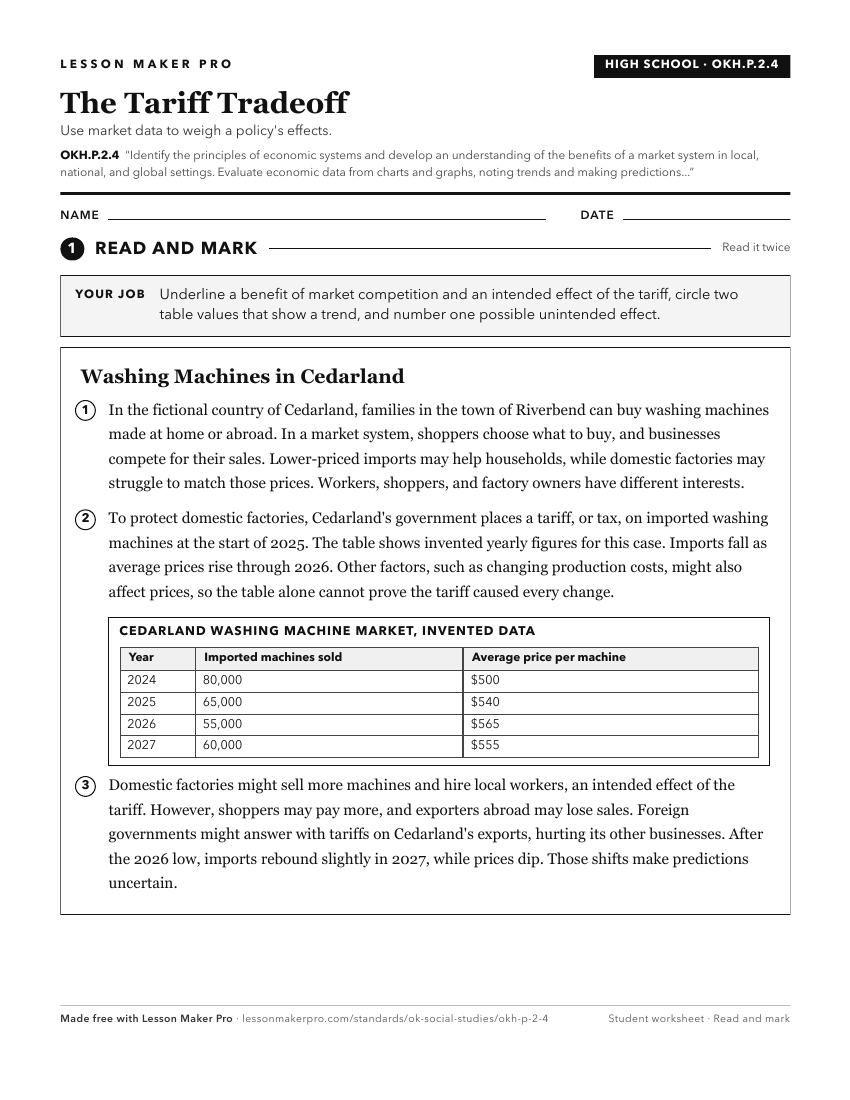
A ready-to-print activity worksheet aligned to OKH.P.2.4, with an answer key for the teacher on its own page. No account needed.
PDF, US Letter, prints cleanly in black and white.
Download the worksheetKeep exploring
Related Standards
- 7.P.2.4
Identify the principles of economic systems and develop an understanding of the benefits of a market system in local, national, and global settings.
- WG.P.2.4
Identify the principles of economic systems and develop an understanding of the benefits of a market system in local, national, and global settings.
- 8.P.2.4
Identify the principles of economic systems and develop an understanding of the benefits of a market system in local, national, and global settings.
- 4.P.2.4
Identify the principles of economic systems and develop an understanding of the benefits of a market system in local, national, and global settings.
Turn this cluster into a lesson
Grade, subject, topic, and the complete cluster are prefilled. Create one free, no account needed.
Also for this cluster:Make a WorksheetMake a QuizMake a Sub Lesson