Oklahoma Social Studies 7.P.2.4
Standard Cluster
- 7.P.2
- Use interdisciplinary tools to acquire, apply, and evaluate content understanding of the four strands of social studies.
Identify the principles of economic systems and develop an understanding of the benefits of a market system in local, national, and global settings. Analyze, interpret, and compare economic data from multiple charts and graphs. Identify different types of economic systems, comparing advantages and disadvantages for citizens and the growth of a nation’s economy. Explain how technology and trade impact standard of living and economic interdependence, using historical or contemporary examples.
Oklahoma Academic Standards for Social Studies (2026) · 7.P.2
Cluster contents
Standards in This Cluster
7.P.2.4 is a cluster heading. These are the individual standards under it.
- 7.P.2.4.A
Analyze, interpret, and compare economic data from multiple charts and graphs.
- 7.P.2.4.B
Identify different types of economic systems, comparing advantages and disadvantages for citizens and the growth of a nation’s economy.
- 7.P.2.4.C
Explain how technology and trade impact standard of living and economic interdependence, using historical or contemporary examples.
Teacher's field guide
What This Cluster Means
What Students Need to Do
- Students compare who owns businesses, who sets prices, and who decides what to make in market, planned, and mixed economies. They use numbers from two graphs to compare economic changes. They explain how trade and technology affect prices, jobs, living conditions, and ties between places.
What Mastery Looks Like
- A student can cite numbers from two graphs without claiming that one trend caused the other. They can name a benefit and a drawback of market choices for households and a country's growth, compared with government planning. They can explain how a shipping delay abroad might affect a local store.
Common Misconceptions
- Students may think a market economy has no government rules or that a planned economy has no buying and selling. They may treat two rising lines as proof that one caused the other. They may assume cheaper imports help every worker or that new technology raises everyone's income.
How to Assess It
- Draw two bar charts for one country: exports at $10 million then $20 million, and average income at $20,000 then $25,000. Ask students to cite both changes, name one trade risk, and explain who decides what to produce in a market economy versus a planned economy.
Lesson moves
Ways to Teach It
Give groups 12 pencils and 20 request cards; distribute pencils by teacher rule, then auction them with tokens and count unmet requests.
Ask, 'Should our school buy cheaper imported laptops or locally repaired ones?' Have students cite a price chart and a local jobs chart.
Draw two bar charts, exports and income for three countries; pairs race to match claim cards to numbers in both charts.
Trace a smartphone's chips, assembly, and shipping on a map; students explain how factory automation or a shipping delay changes local prices.
Free download
Printable 7.P.2.4 Worksheet
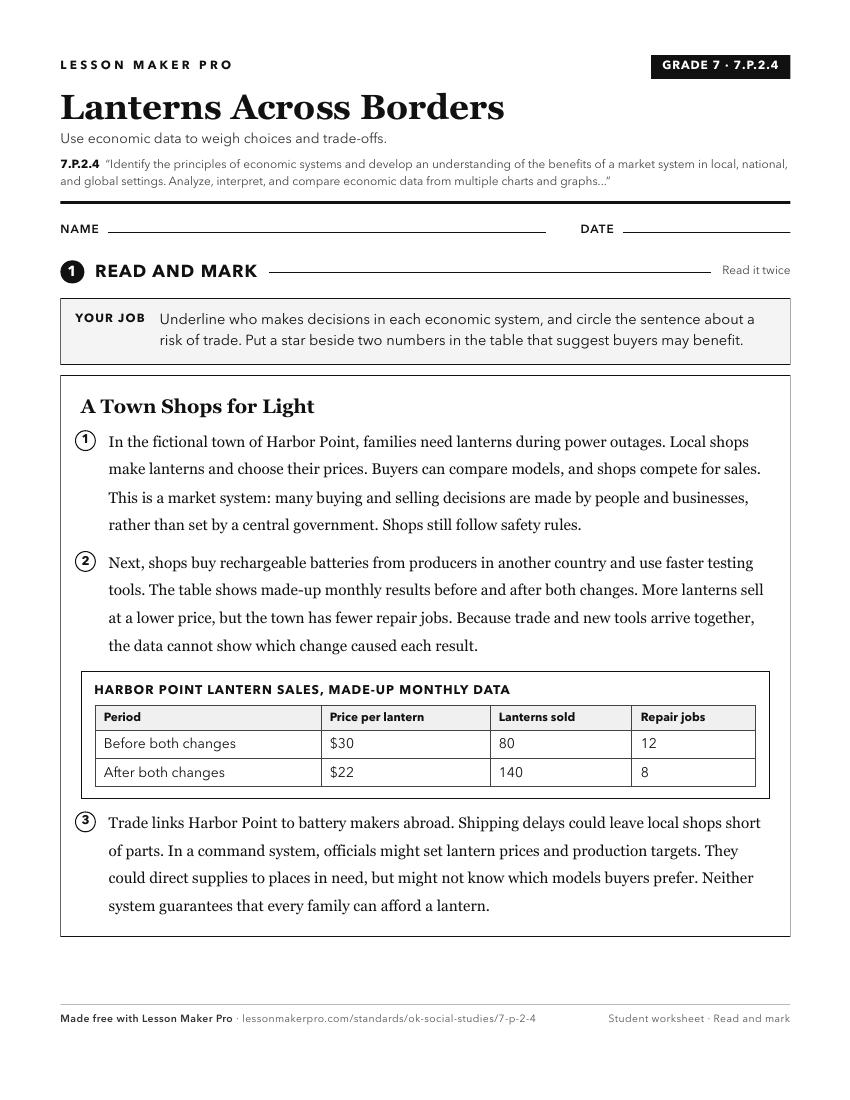
A ready-to-print activity worksheet aligned to 7.P.2.4, with an answer key for the teacher on its own page. No account needed.
PDF, US Letter, prints cleanly in black and white.
Download the worksheetKeep exploring
Related Standards
- WG.P.2.4
Identify the principles of economic systems and develop an understanding of the benefits of a market system in local, national, and global settings.
- OKH.P.2.4
Identify the principles of economic systems and develop an understanding of the benefits of a market system in local, national, and global settings.
- 8.P.2.4
The 8th Grade version of this standard.
- 4.P.2.4
The 4th Grade version of this standard.
Turn this cluster into a lesson
Grade, subject, topic, and the complete cluster are prefilled. Create one free, no account needed.
Also for this cluster:Make a WorksheetMake a QuizMake a Sub Lesson