NGSS MS-LS3-2
The Standard
Develop and use a model to describe why asexual reproduction results in offspring with identical genetic information and sexual reproduction results in offspring with genetic variation.
Next Generation Science Standards
Teacher's field guide
What This Standard Means
What Students Need to Do
- Students build and use models that show how genetic information passes from parent organisms to offspring. They compare genetic copying in asexual reproduction with allele mixing in sexual reproduction.
What Mastery Looks Like
- Students can use a Punnett square, chromosome diagram, or simulation to trace genetic information from parents to offspring. They explain why one parent produces genetic copies while two parents produce new allele combinations.
Common Misconceptions
- Students may think sexual offspring copy one parent or receive exactly half of their visible traits from each parent. They may treat Punnett square results as guaranteed outcomes rather than possible combinations. They may also assume genetically identical organisms always look identical, ignoring environmental effects.
How to Assess It
- Exit ticket: Draw one model for asexual reproduction and one for sexual reproduction. Label the genetic source of each offspring and explain the expected variation.
Lesson moves
Ways to Teach It
Give students color-coded chromosome cards to model copying one parent's set, then randomly combine half-sets from two parents.
Ask students to explain why siblings can differ even when they have the same parents, using allele cards as evidence.
Run a Punnett square relay where teams draw parent allele cards, complete a cross, and compare possible offspring genotypes.
Compare strawberry runners with dog breeding records, then have students identify which reproductive process produces more inherited variation.
Free download
Printable MS-LS3-2 Worksheet
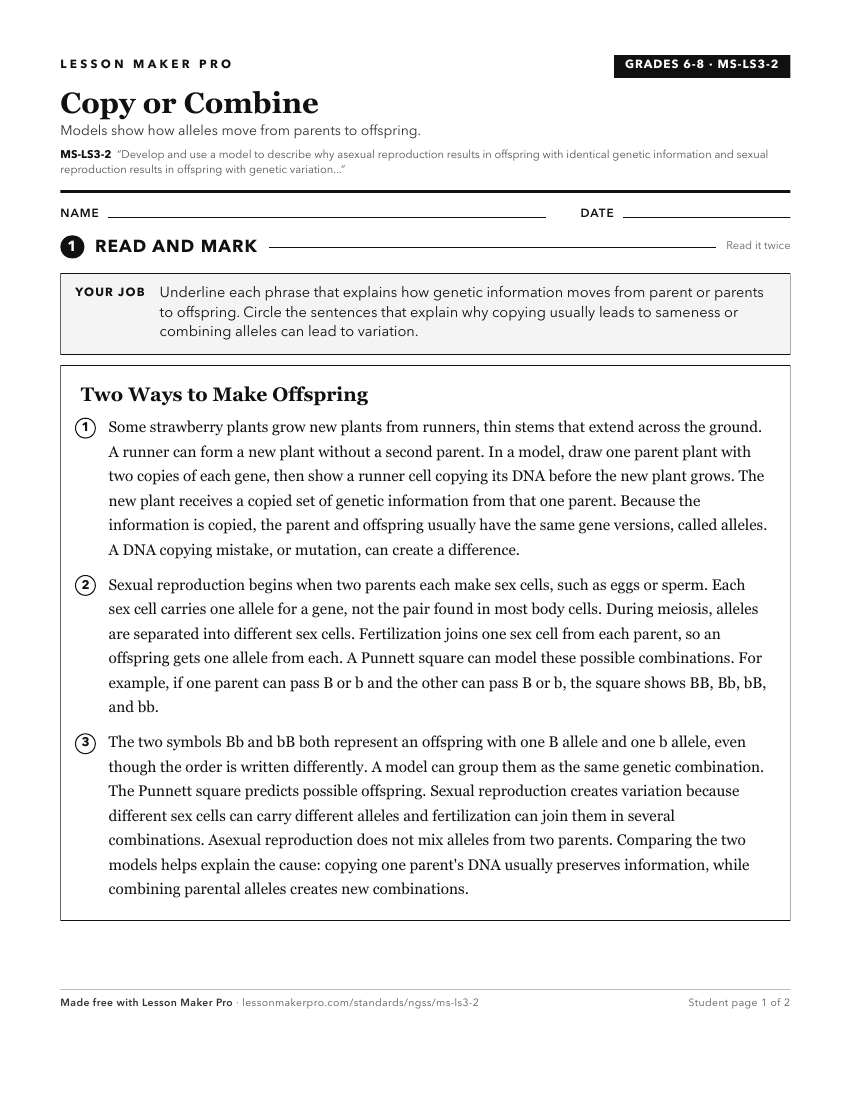
A ready-to-print activity worksheet aligned to MS-LS3-2, with an answer key for the teacher on its own page. No account needed.
PDF, US Letter, prints cleanly in black and white.
Download the worksheetBefore This Standard
If students are struggling here, check these first.
- 3-LS3-2
Understanding that environments influence expressed traits supports separating inherited genetic information from trait variation in reproduction models.
- 3-LS3-1
Understanding inherited traits and variation prepares students to model how reproduction passes genetic information and creates or preserves variation.
What This Unlocks
Mastery here sets students up for these next.
- HS-LS3-2
Understanding sexual reproduction as creating genetic variation prepares students to explain meiosis, replication errors, and mutations as sources of heritable variation.
- HS-LS3-3
Understanding how reproduction creates genetic variation helps students explain why expressed traits vary and are distributed across populations.
- HS-LS3-1
Students extend inheritance models from reproduction and variation to questions about how DNA and chromosomes carry trait instructions.
- HS-LS1-4
Modeling how asexual reproduction preserves genetic information supports understanding mitosis as producing identical cells for growth and repair.
Keep exploring
Related Standards
- MS-LS3-1
Develop and use a model to describe why structural changes to genes (mutations) located on chromosomes may affect proteins and may result in harmful, beneficial...
- MS-LS4-4
Construct an explanation based on evidence that describes how genetic variations of traits in a population increase some individuals' probability of surviving a...
- 3-LS1-1
Develop models to describe that organisms have unique and diverse life cycles but all have in common birth, growth, reproduction, and death.
Turn this exact standard into a lesson
Grade, subject, topic, and the complete standard are prefilled. Create one free, no account needed.
Also for this standard:Make a WorksheetMake a QuizMake a Sub Lesson