NGSS HS-LS1-4
The Standard
Use a model to illustrate the role of cellular division (mitosis) and differentiation in producing and maintaining complex organisms.
Next Generation Science Standards
Teacher's field guide
What This Standard Means
What Students Need to Do
- Students build and interpret a model showing how one cell produces many cells and how some become specialized. They explain how these processes support growth, repair, and cell replacement.
What Mastery Looks Like
- Students can trace how repeated cell division increases cell number and how specialization produces different cell types. They can use their model to explain growth, tissue repair, and cell replacement.
Common Misconceptions
- Students may think mitosis creates different kinds of cells or that differentiation changes a cell’s DNA sequence. They may also think growth only makes cells larger, or that cell division stops after adulthood.
How to Assess It
- Exit ticket: Draw a four-stage model from one cell to a group of specialized cells. Add captions explaining how the same processes support growth and skin repair.
Lesson moves
Ways to Teach It
Have groups copy identical cell cards, add tissue-role labels to selected copies, then replace cards removed from a paper skin layer.
Write why muscle and nerve cells can differ even though both descended from the same fertilized cell.
Run a card sort matching diagrams of cell division, specialization, growth, and repair with written explanations.
Analyze images of a healing cut, then annotate where cell division and specialization help rebuild skin.
Free download
Printable HS-LS1-4 Worksheet
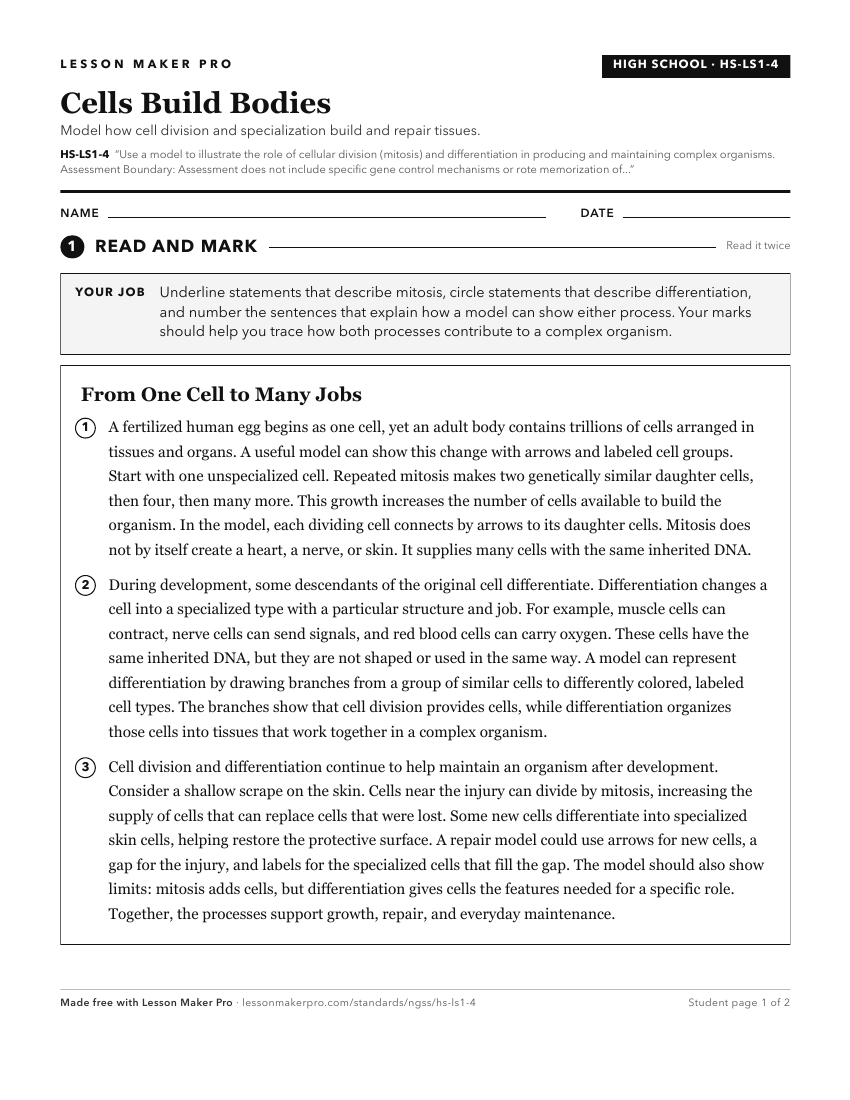
A ready-to-print activity worksheet aligned to HS-LS1-4, with an answer key for the teacher on its own page. No account needed.
PDF, US Letter, prints cleanly in black and white.
Download the worksheetBefore This Standard
If students are struggling here, check these first.
- MS-LS3-2
Modeling how asexual reproduction preserves genetic information supports understanding mitosis as producing identical cells for growth and repair.
- MS-LS1-5
Explaining organism growth from genetic and environmental influences prepares students to model cellular growth, division, and specialization mechanisms.
- MS-LS1-4
Understanding reproduction and plant and animal structures supports the shift to cellular mechanisms that build and maintain multicellular organisms.
Keep exploring
Related Standards
- HS-LS1-2
Develop and use a model to illustrate the hierarchical organization of interacting systems that provide specific functions within multicellular organisms.
- 3-LS1-1
Develop models to describe that organisms have unique and diverse life cycles but all have in common birth, growth, reproduction, and death.
- MS-LS1-2
Develop and use a model to describe the function of a cell as a whole and ways parts of cells contribute to the function.
Turn this exact standard into a lesson
Grade, subject, topic, and the complete standard are prefilled. Create one free, no account needed.
Also for this standard:Make a WorksheetMake a QuizMake a Sub Lesson