NGSS MS-LS1-2
The Standard
Develop and use a model to describe the function of a cell as a whole and ways parts of cells contribute to the function.
Next Generation Science Standards
Teacher's field guide
What This Standard Means
What Students Need to Do
- Students build and use a model of a plant or animal cell. They show how the cell controls activities, manages materials, uses energy, and maintains support. They connect each job to the correct cell part.
What Mastery Looks Like
- A student labels the nucleus, mitochondria, and membrane, plus chloroplasts and a wall in plant cells. They use arrows and captions to show each part’s role. They can predict how the whole cell would be affected if one part failed.
Common Misconceptions
- Students often treat cell parts as independent objects or say every cell has a wall and chloroplasts. They may confuse the membrane with the wall, or say mitochondria create energy.
How to Assess It
- Give students an unlabeled plant cell diagram. Ask them to label five parts and add arrows and captions showing how three parts support the whole cell.
Lesson moves
Ways to Teach It
Build a cell model in a clear container using labeled craft materials, then connect each part to one job of the whole cell.
Ask, “What would happen if a cell membrane stopped controlling what entered and left?” Students defend answers using their models.
Run a card sort matching cell parts, functions, and plant or animal cells, then have pairs correct one another’s mismatches.
Compare a leaf cell and a human muscle cell, then explain why chloroplasts help one while many mitochondria help the other.
Free download
Printable MS-LS1-2 Worksheet
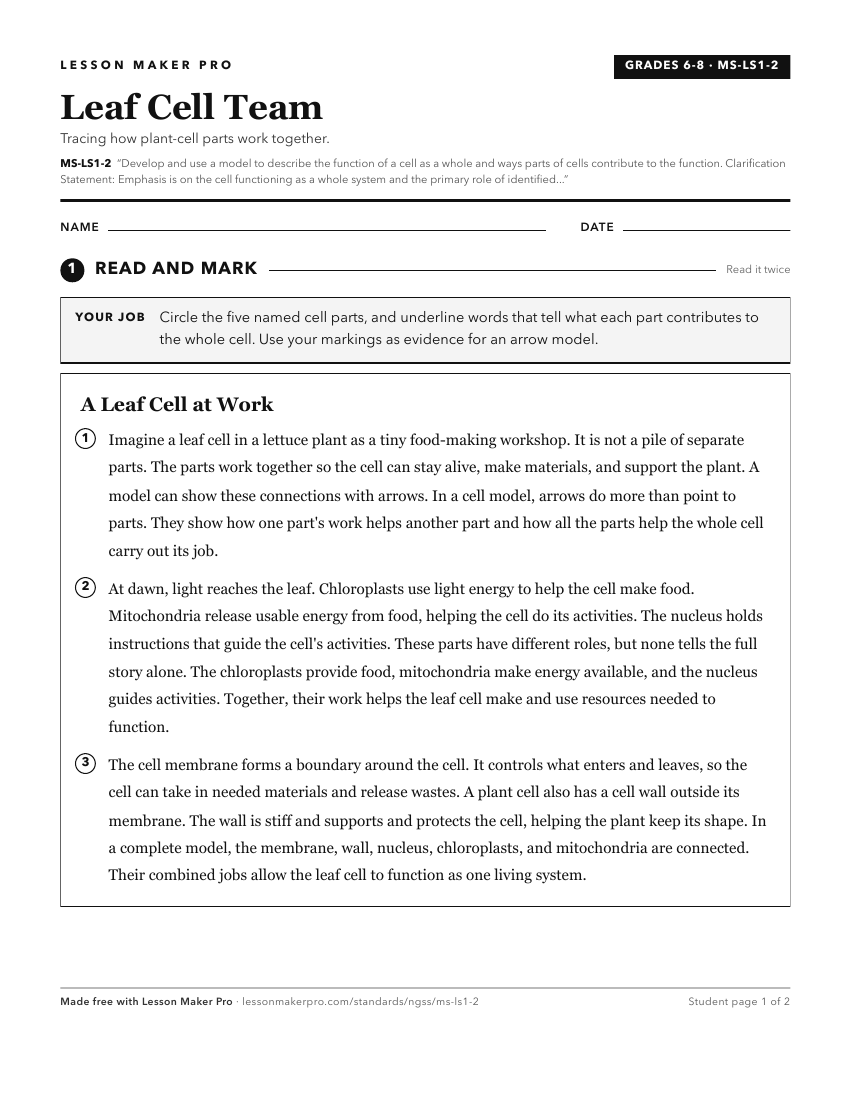
A ready-to-print activity worksheet aligned to MS-LS1-2, with an answer key for the teacher on its own page. No account needed.
PDF, US Letter, prints cleanly in black and white.
Download the worksheetBefore This Standard
If students are struggling here, check these first.
What This Unlocks
Mastery here sets students up for these next.
- HS-LS1-3
Understanding cells as systems with interacting parts supports investigating how feedback mechanisms regulate internal conditions.
- HS-LS1-2
Cell parts and whole-cell function carry into modeling how cells, tissues, organs, and systems interact in multicellular organisms.
- HS-LS1-1
Understanding cells as systems with parts supporting functions prepares students to connect DNA-coded proteins to specialized cell functions.
Keep exploring
Related Standards
- MS-LS1-7
Develop a model to describe how food is rearranged through chemical reactions forming new molecules that support growth and/or release energy as this matter mov...
- 5-LS2-1
Develop a model to describe the movement of matter among plants, animals, decomposers, and the environment.
- HS-LS1-4
Use a model to illustrate the role of cellular division (mitosis) and differentiation in producing and maintaining complex organisms.
Turn this exact standard into a lesson
Grade, subject, topic, and the complete standard are prefilled. Create one free, no account needed.
Also for this standard:Make a WorksheetMake a QuizMake a Sub Lesson