NGSS HS-LS1-2
The Standard
Develop and use a model to illustrate the hierarchical organization of interacting systems that provide specific functions within multicellular organisms.
Next Generation Science Standards
Teacher's field guide
What This Standard Means
What Students Need to Do
- Students build and use a model that connects cells, tissues, organs, and organ systems within a multicellular organism. They show how parts interact to carry out a function, then explain what changes when one part fails.
What Mastery Looks Like
- A strong model places examples at the correct level and uses labeled arrows to show interactions between systems. The student can trace a function through the model and predict the effect of a disruption.
Common Misconceptions
- Students often place organs, tissues, and cells at the same level or reverse their order. They may draw each organ system separately without showing how systems depend on one another. Some label structures but do not explain their functions.
How to Assess It
- Exit ticket: Draw a model showing how a hand pulls away from a hot surface. Include a cell, tissue, organ, and organ system, plus labeled arrows between systems.
Lesson moves
Ways to Teach It
Give groups cell, tissue, organ, and system cards; have them nest the cards and connect two systems with labeled yarn arrows.
Ask students to write how damage to smooth muscle in an artery could change blood delivery to working leg muscles.
Run a model repair game where teams find one missing level or interaction arrow in diagrams and explain the correction.
Have students map what happens after eating, from intestinal tissue through digestive and circulatory systems to nutrient delivery in body tissues.
Free download
Printable HS-LS1-2 Worksheet
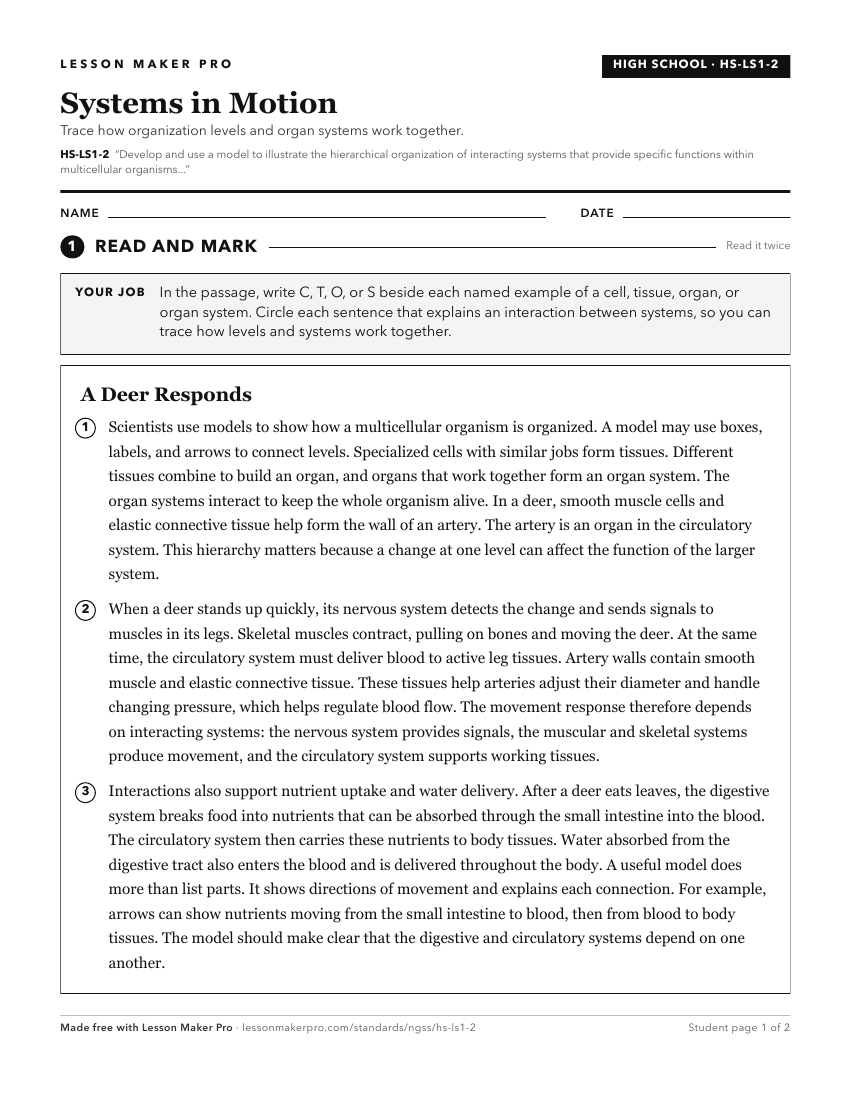
A ready-to-print activity worksheet aligned to HS-LS1-2, with an answer key for the teacher on its own page. No account needed.
PDF, US Letter, prints cleanly in black and white.
Download the worksheetBefore This Standard
If students are struggling here, check these first.
- MS-LS1-1
Understanding organisms as made of cells and different cell types is necessary to model tissues, organs, and interacting body systems.
- MS-LS1-3
Understanding cells, subsystems, and body-system interactions is needed to model the hierarchy and functions in multicellular organisms.
- MS-LS1-2
Cell parts and whole-cell function carry into modeling how cells, tissues, organs, and systems interact in multicellular organisms.
Keep exploring
Related Standards
- 3-LS1-1
Develop models to describe that organisms have unique and diverse life cycles but all have in common birth, growth, reproduction, and death.
- 5-LS2-1
Develop a model to describe the movement of matter among plants, animals, decomposers, and the environment.
- HS-LS1-4
Use a model to illustrate the role of cellular division (mitosis) and differentiation in producing and maintaining complex organisms.
Turn this exact standard into a lesson
Grade, subject, topic, and the complete standard are prefilled. Create one free, no account needed.
Also for this standard:Make a WorksheetMake a QuizMake a Sub Lesson