NGSS MS-LS1-3
The Standard
Use argument supported by evidence for how the body is a system of interacting subsystems composed of groups of cells.
Next Generation Science Standards
Teacher's field guide
What This Standard Means
What Students Need to Do
- Students organize examples from cells to tissues, organs, and body systems. They use observations, data, or model evidence to argue how two or more systems work together during a body function.
What Mastery Looks Like
- A student can identify cardiac muscle cells, cardiac muscle tissue, the heart, and the circulatory system as different levels of organization. They can use pulse and breathing data to explain how several systems coordinate during exercise.
Common Misconceptions
- Students often treat each body system as a separate machine and describe only one system’s job. They may reverse the cell, tissue, organ, system order or assume an organ contains only one tissue type.
How to Assess It
- Exit ticket: After a short sprint, breathing and heart rate increase. Explain why, using two pieces of evidence about interacting body systems.
Lesson moves
Ways to Teach It
Build a body system model with cell, tissue, and organ cards, then connect digestive, circulatory, and muscular parts using yarn.
Write a claim, evidence, and reasoning response: How do the respiratory and circulatory systems work together to supply working muscles?
Play a card sort relay matching cells, tissues, organs, systems, and interaction examples, then justify each placement.
Measure breathing rate and pulse before and after one minute of jumping jacks, then explain which systems interacted.
Free download
Printable MS-LS1-3 Worksheet
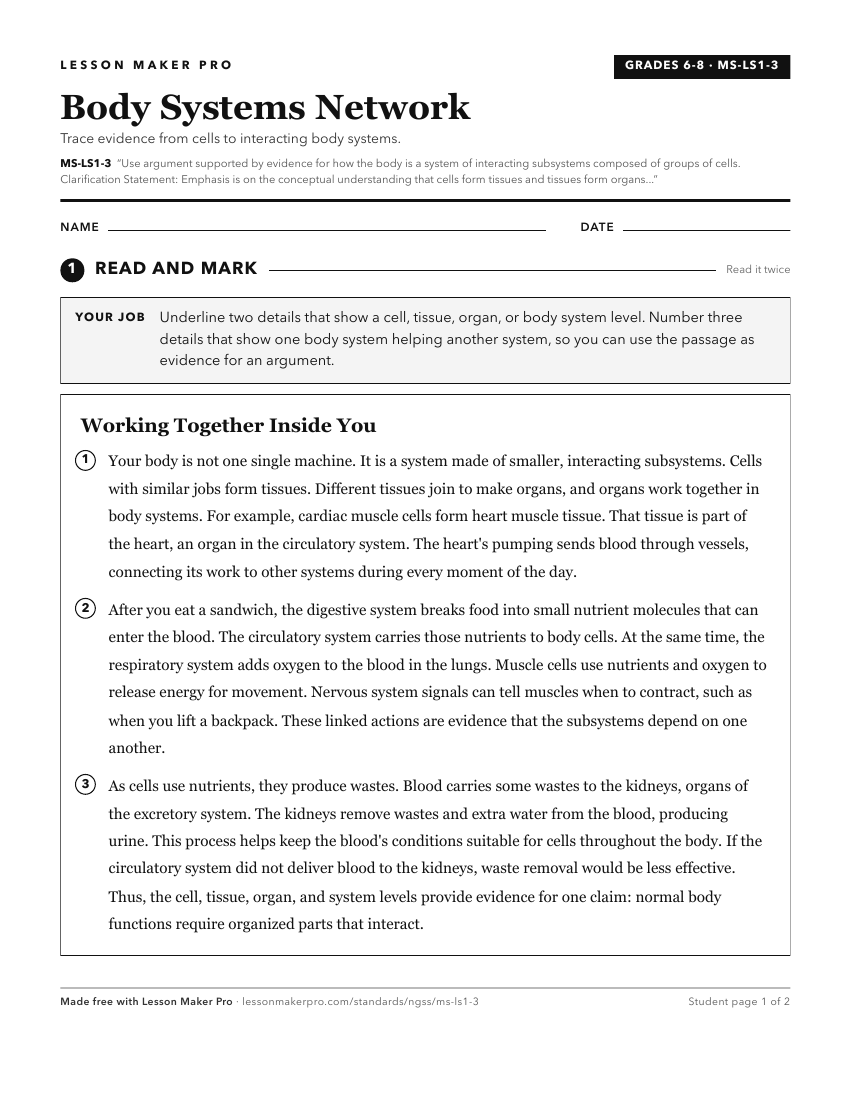
A ready-to-print activity worksheet aligned to MS-LS1-3, with an answer key for the teacher on its own page. No account needed.
PDF, US Letter, prints cleanly in black and white.
Download the worksheetWhat This Unlocks
Mastery here sets students up for these next.
- HS-LS1-2
Understanding cells, subsystems, and body-system interactions is needed to model the hierarchy and functions in multicellular organisms.
- HS-LS1-3
Understanding body subsystems and cell groups supports explaining how feedback loops coordinate those systems to maintain stable internal conditions.
- HS-LS1-1
Understanding specialized cells and body systems helps students connect DNA coded proteins to cell functions in living organisms.
Keep exploring
Related Standards
- HS-ESS2-7
Construct an argument based on evidence about the simultaneous coevolution of Earth systems and life on Earth.
- MS-LS1-1
Conduct an investigation to provide evidence that living things are made of cells, either one cell or many different numbers and types of cells.
- 4-LS1-1
Construct an argument that plants and animals have internal and external structures that function to support survival, growth, behavior, and reproduction.
Turn this exact standard into a lesson
Grade, subject, topic, and the complete standard are prefilled. Create one free, no account needed.
Also for this standard:Make a WorksheetMake a QuizMake a Sub Lesson