NGSS HS-LS1-3
The Standard
Plan and conduct an investigation to provide evidence that feedback mechanisms maintain homeostasis.
Next Generation Science Standards
Teacher's field guide
What This Standard Means
What Students Need to Do
- Students plan and carry out an investigation of how an organism responds to a change. They measure the response over time and use the data to show whether conditions return toward a normal range.
What Mastery Looks Like
- Students design a fair test with a clear stimulus, repeated measurements, and controlled conditions. They use the results to explain how a response moves an internal condition back toward its usual range.
Common Misconceptions
- Students may think homeostasis means conditions never change. They may also label any body response as feedback without showing that it reduces or reverses the original change. Some confuse the stimulus, response, and measured outcome.
How to Assess It
- Give this exit ticket: Plan a test of heart rate recovery after one minute of exercise. Name the variables, measurements, controls, and data pattern that would support homeostasis.
Lesson moves
Ways to Teach It
Measure pulse before exercise, immediately after one minute of jumping jacks, and every minute during recovery, then graph the results.
Write a claim explaining how heart rate recovery shows feedback, using two points from a class data graph as evidence.
Sort stimulus, response, and outcome cards into feedback loops, then race to identify which loops restore a stable range.
Analyze a fitness tracker recovery graph and decide whether the athlete's heart rate returned toward its resting range.
Free download
Printable HS-LS1-3 Worksheet
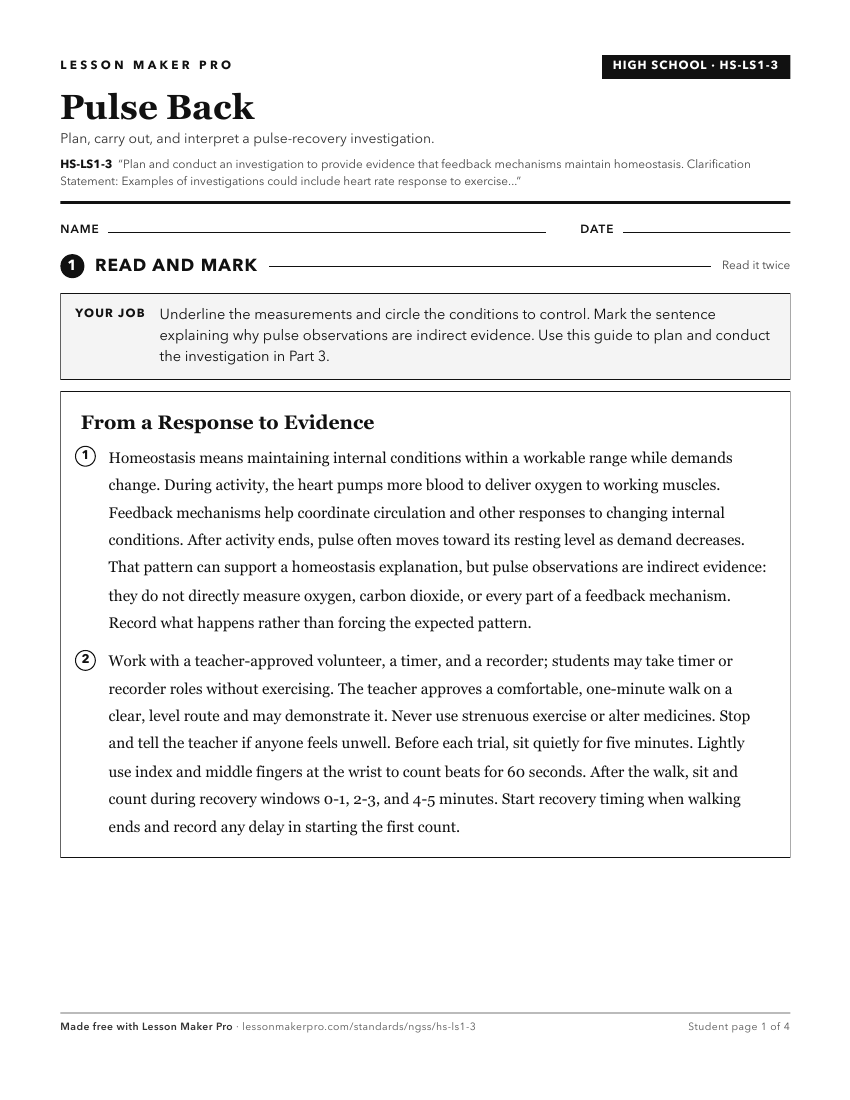
A ready-to-print activity worksheet aligned to HS-LS1-3, with an answer key for the teacher on its own page. No account needed.
PDF, US Letter, prints cleanly in black and white.
Download the worksheetBefore This Standard
If students are struggling here, check these first.
- MS-LS1-3
Understanding body subsystems and cell groups supports explaining how feedback loops coordinate those systems to maintain stable internal conditions.
- MS-LS1-2
Understanding cells as systems with interacting parts supports investigating how feedback mechanisms regulate internal conditions.
- MS-LS1-1
Knowing organisms are made of specialized cells supports investigating how body systems and cellular conditions are regulated by feedback.
Keep exploring
Related Standards
- HS-LS2-6
Evaluate the claims, evidence, and reasoning that the complex interactions in ecosystems maintain relatively consistent numbers and types of organisms in stable...
- 3-PS2-1
Plan and conduct an investigation to provide evidence of the effects of balanced and unbalanced forces on the motion of an object.
- 1-PS4-1
Plan and conduct investigations to provide evidence that vibrating materials can make sound and that sound can make materials vibrate.
- HS-LS2-3
Construct and revise an explanation based on evidence for the cycling of matter and flow of energy in aerobic and anaerobic conditions.
Turn this exact standard into a lesson
Grade, subject, topic, and the complete standard are prefilled. Create one free, no account needed.
Also for this standard:Make a WorksheetMake a QuizMake a Sub Lesson