NGSS MS-LS1-1
The Standard
Conduct an investigation to provide evidence that living things are made of cells, either one cell or many different numbers and types of cells.
Next Generation Science Standards
Teacher's field guide
What This Standard Means
What Students Need to Do
- Students plan and carry out microscope observations of several specimens. They record patterns, compare cellular and noncellular samples, and use their observations to support a claim about cell number and type.
What Mastery Looks Like
- Students can use microscope observations to identify cells and separate cellular specimens from noncellular materials. They can explain whether an organism has one cell or many cells and compare visible cell types.
Common Misconceptions
- Students may think only animals and plants have cells, or that every organism has many cells. They may mistake air bubbles, crystals, or stains for cells and assume all cells look alike.
How to Assess It
- Show microscope images of onion tissue, Euglena, and salt crystals. Ask students to classify each as unicellular, multicellular, or nonliving and cite one visible detail as evidence.
Lesson moves
Ways to Teach It
Prepare wet mounts of onion epidermis and observe prepared Euglena slides, then sketch cell boundaries and compare cell numbers.
Write a claim explaining whether onion tissue and Euglena are cellular, using two labeled observations as evidence.
Sort organism and object cards into unicellular, multicellular, or nonliving groups, then challenge a partner to defend one placement.
Examine a yogurt culture image and a cheek-cell image to connect microbial cells and human cells with food and health.
Free download
Printable MS-LS1-1 Worksheet
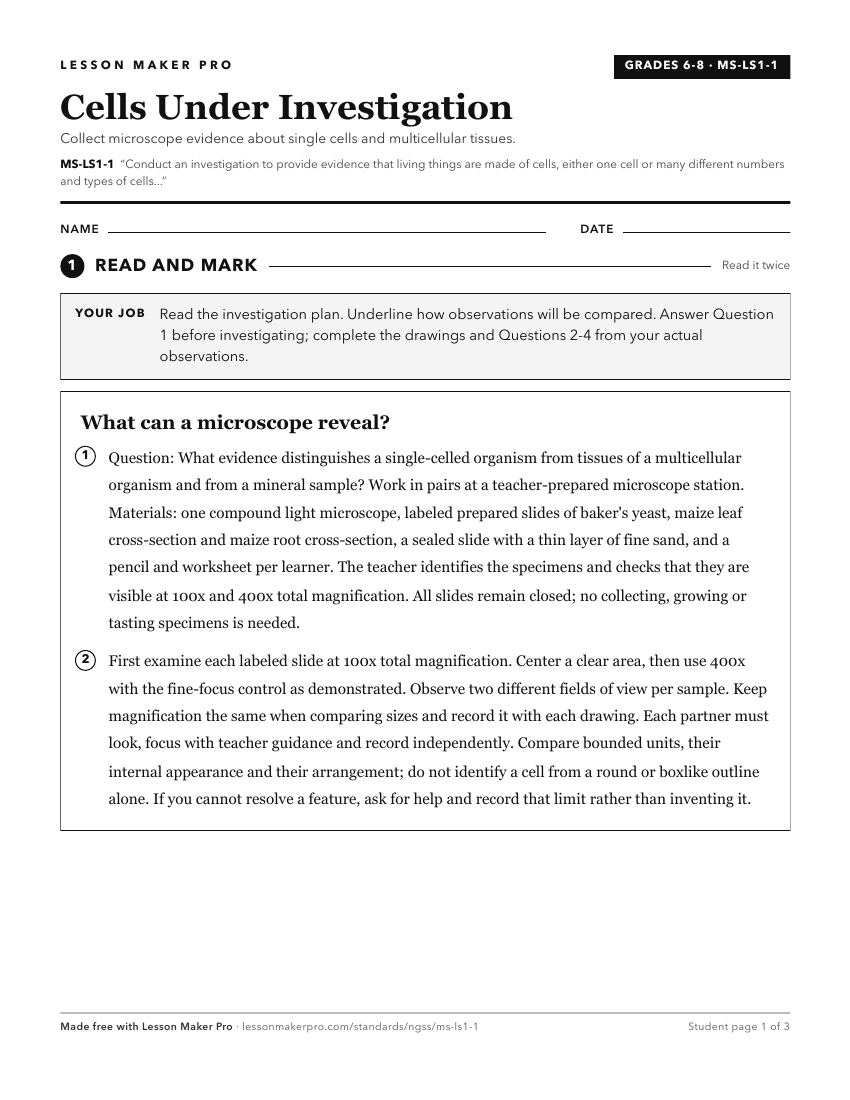
A ready-to-print activity worksheet aligned to MS-LS1-1, with an answer key for the teacher on its own page. No account needed.
PDF, US Letter, prints cleanly in black and white.
Download the worksheetWhat This Unlocks
Mastery here sets students up for these next.
- HS-LS1-2
Understanding organisms as made of cells and different cell types is necessary to model tissues, organs, and interacting body systems.
- HS-LS1-1
Cell theory and specialized cell types prepare students to explain how DNA-coded proteins support functions in specialized cells.
- HS-LS1-3
Knowing organisms are made of specialized cells supports investigating how body systems and cellular conditions are regulated by feedback.
Keep exploring
Related Standards
- 3-LS3-1
Analyze and interpret data to provide evidence that plants and animals have traits inherited from parents and that variation of these traits exists in a group o...
- MS-LS1-3
Use argument supported by evidence for how the body is a system of interacting subsystems composed of groups of cells.
- MS-LS1-2
Develop and use a model to describe the function of a cell as a whole and ways parts of cells contribute to the function.
Turn this exact standard into a lesson
Grade, subject, topic, and the complete standard are prefilled. Create one free, no account needed.
Also for this standard:Make a WorksheetMake a QuizMake a Sub Lesson