NGSS 3-LS3-1
The Standard
Analyze and interpret data to provide evidence that plants and animals have traits inherited from parents and that variation of these traits exists in a group of similar organisms.
Next Generation Science Standards
Teacher's field guide
What This Standard Means
What Students Need to Do
- Students examine pictures, tables, or measurements of traits in related plants or animals. They find patterns showing which traits are shared and how individuals differ.
What Mastery Looks Like
- Students use a table, chart, or set of images to identify trait patterns. They cite specific similarities between parents and offspring and differences within a group.
Common Misconceptions
- Students may think offspring are exact copies of one parent. They may also confuse inherited traits, such as flower color, with acquired features, such as a torn leaf.
How to Assess It
- Give students pictures of two parent dogs and four puppies. Ask them to name one shared trait, one variation, and the evidence in the pictures.
Lesson moves
Ways to Teach It
Give groups parent and offspring plant photo cards to sort by leaf shape, flower color, or stem pattern.
Ask students to write: How can siblings resemble their parents but still look different from one another?
Play Trait Detective by having teams study animal family cards and record shared traits and variations for points.
Compare ears, coat colors, and markings in a litter of puppies using shelter photos and a class data table.
Free download
Printable 3-LS3-1 Worksheet
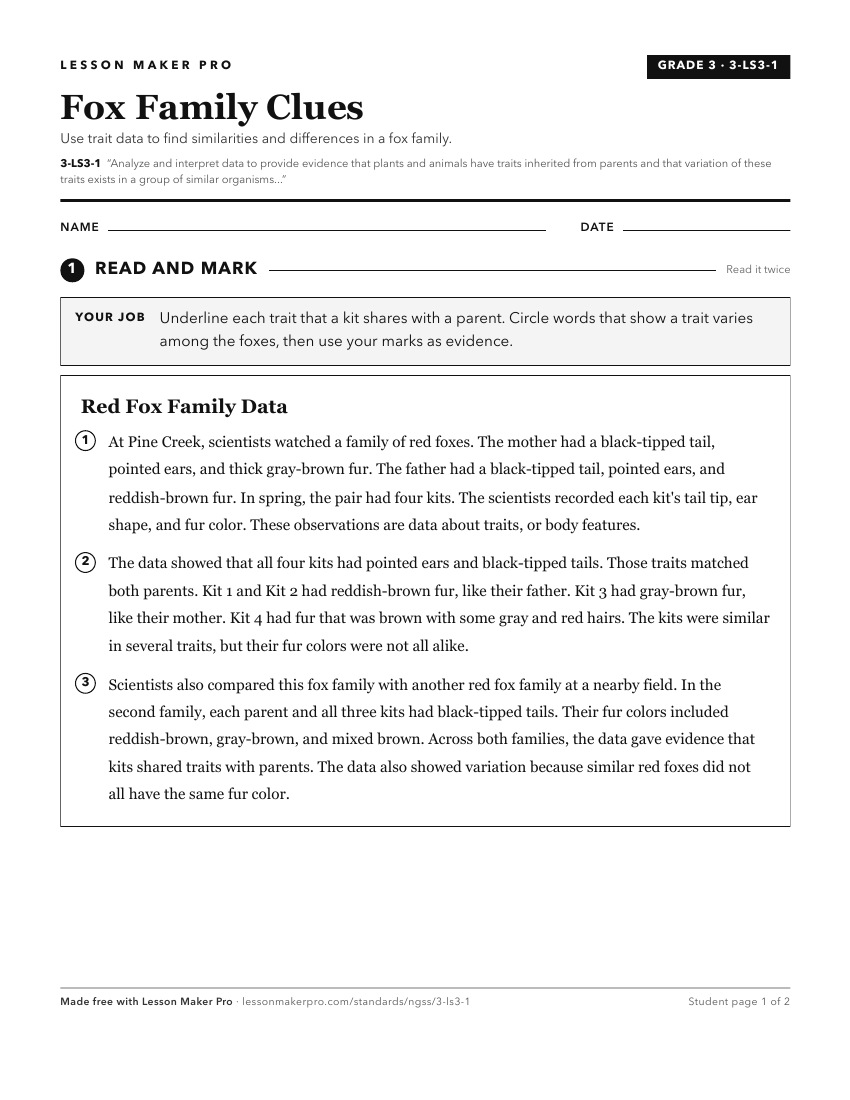
A ready-to-print activity worksheet aligned to 3-LS3-1, with an answer key for the teacher on its own page. No account needed.
PDF, US Letter, prints cleanly in black and white.
Download the worksheetWhat This Unlocks
Mastery here sets students up for these next.
- MS-LS3-2
Understanding inherited traits and variation prepares students to model how reproduction passes genetic information and creates or preserves variation.
- MS-LS3-1
Understanding inherited traits and variation prepares students to model genes, mutations, and their effects on organism structures and functions.
Keep exploring
Related Standards
- 1-LS3-1
Make observations to construct an evidence-based account that young plants and animals are like, but not exactly like, their parents.
- MS-LS2-1
Analyze and interpret data to provide evidence for the effects of resource availability on organisms and populations of organisms in an ecosystem.
- 3-LS4-2
Use evidence to construct an explanation for how the variations in characteristics among individuals of the same species may provide advantages in surviving, fi...
- 3-LS4-1
Analyze and interpret data from fossils to provide evidence of the organisms and the environments in which they lived long ago.
Turn this exact standard into a lesson
Grade, subject, topic, and the complete standard are prefilled. Create one free, no account needed.
Also for this standard:Make a WorksheetMake a QuizMake a Sub Lesson