NGSS 1-LS3-1
The Standard
Make observations to construct an evidence-based account that young plants and animals are like, but not exactly like, their parents.
Next Generation Science Standards
Teacher's field guide
What This Standard Means
What Students Need to Do
- Students study photos or examples of parent plants or animals and their young. They name visible similarities and differences, then use those observations to explain a family pattern.
What Mastery Looks Like
- Given a parent and young pair, a student identifies at least one shared trait and one differing trait. The student points to visible evidence, such as leaf shape, fur color, markings, or size.
Common Misconceptions
- Some students expect offspring to look exactly like one parent. Others treat any two animals of the same kind as a parent and young pair, or use facts not shown in their observations. Students may also use size alone to claim two organisms are different kinds.
How to Assess It
- Show a photo of a dog and its puppy. Ask, "Name one way they look alike, one way they look different, and the photo evidence for each answer."
Lesson moves
Ways to Teach It
Give pairs photo cards of parent animals and their young, then have them sort visible features into alike and different groups.
Ask, "How is this puppy like its parent, and how is it different?" Students answer with two visible details.
Play Family Match: students pair young and parent picture cards, then name one similarity and one difference to keep each pair.
Compare family pet photos or pictures from a local farm, recording one shared feature and one feature that varies.
Free download
Printable 1-LS3-1 Worksheet
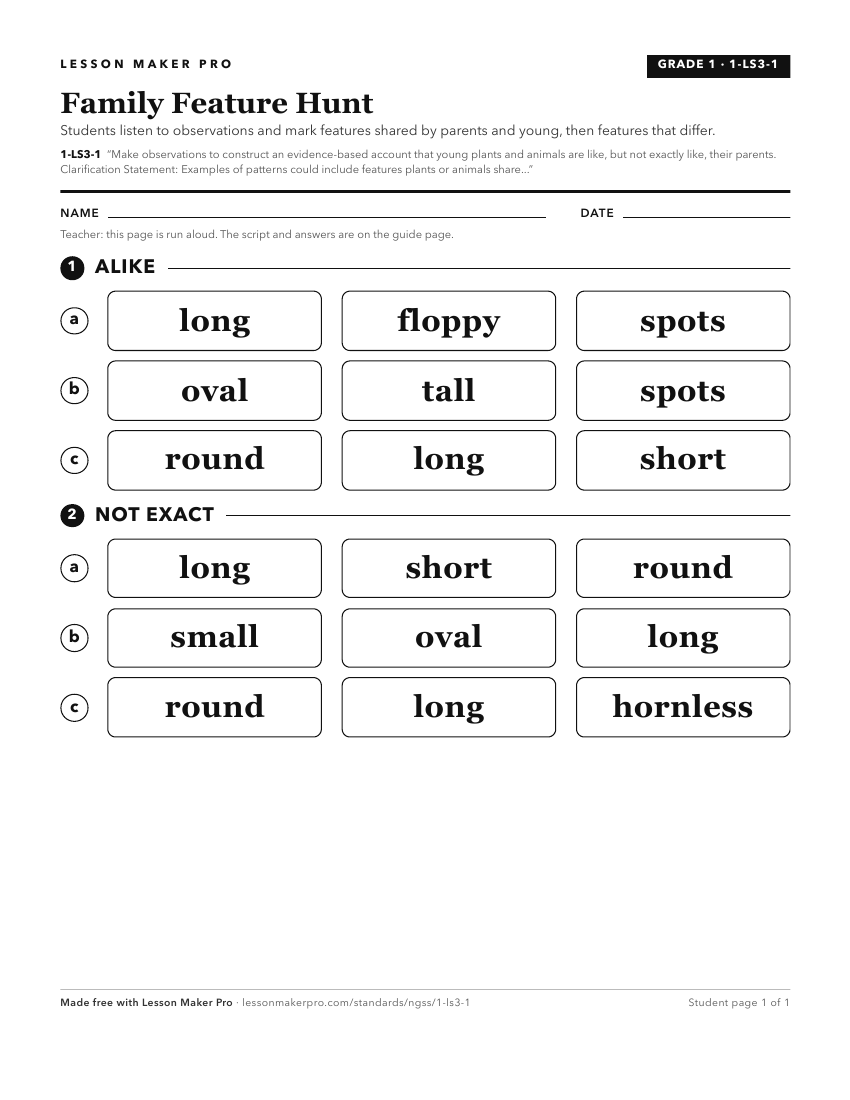
A ready-to-print activity worksheet aligned to 1-LS3-1, with an answer key for the teacher on its own page. No account needed.
PDF, US Letter, prints cleanly in black and white.
Download the worksheetKeep exploring
Related Standards
- 1-LS1-2
Read texts and use media to determine patterns in behavior of parents and offspring that help offspring survive.
- MS-LS4-2
Apply scientific ideas to construct an explanation for the anatomical similarities and differences among modern organisms and between modern and fossil organism...
- 3-LS3-1
Analyze and interpret data to provide evidence that plants and animals have traits inherited from parents and that variation of these traits exists in a group o...
- MS-LS1-4
Use argument based on empirical evidence and scientific reasoning to support an explanation for how characteristic animal behaviors and specialized plant struct...
Turn this exact standard into a lesson
Grade, subject, topic, and the complete standard are prefilled. Create one free, no account needed.
Also for this standard:Make a WorksheetMake a QuizMake a Sub Lesson