NGSS 1-LS1-2
The Standard
Read texts and use media to determine patterns in behavior of parents and offspring that help offspring survive.
Next Generation Science Standards
Teacher's field guide
What This Standard Means
What Students Need to Do
- Students gather evidence from simple books, photos, or videos about how young animals act and how adults respond. They identify repeated signal and response patterns and explain how the response keeps the young animal safe, warm, or fed.
What Mastery Looks Like
- A student can name a young animal’s signal, match it to the adult’s response, and describe the survival benefit. The student can point to details in a text, image, or video as evidence.
Common Misconceptions
- Students may think every baby animal cries like a human baby or that adult responses happen by chance. They may name feeding or protection without connecting it to hunger, danger, warmth, or another need.
How to Assess It
- Show pictures of a chick cheeping, a hen approaching, and the hen covering the chick. Ask, “What pattern do you see, and how does the hen’s response help the chick survive?”
Lesson moves
Ways to Teach It
Give pairs signal, adult response, and need picture cards, then have students match and arrange each set in order.
Read a page about penguins, then ask students to write: What did the chick do, and how did the parent help?
Play Parent Response Match by calling out a baby animal signal and having students hold up the matching adult response card.
Make a class chart of familiar baby signals, caregiver responses, and how each response meets a real need.
Free download
Printable 1-LS1-2 Worksheet
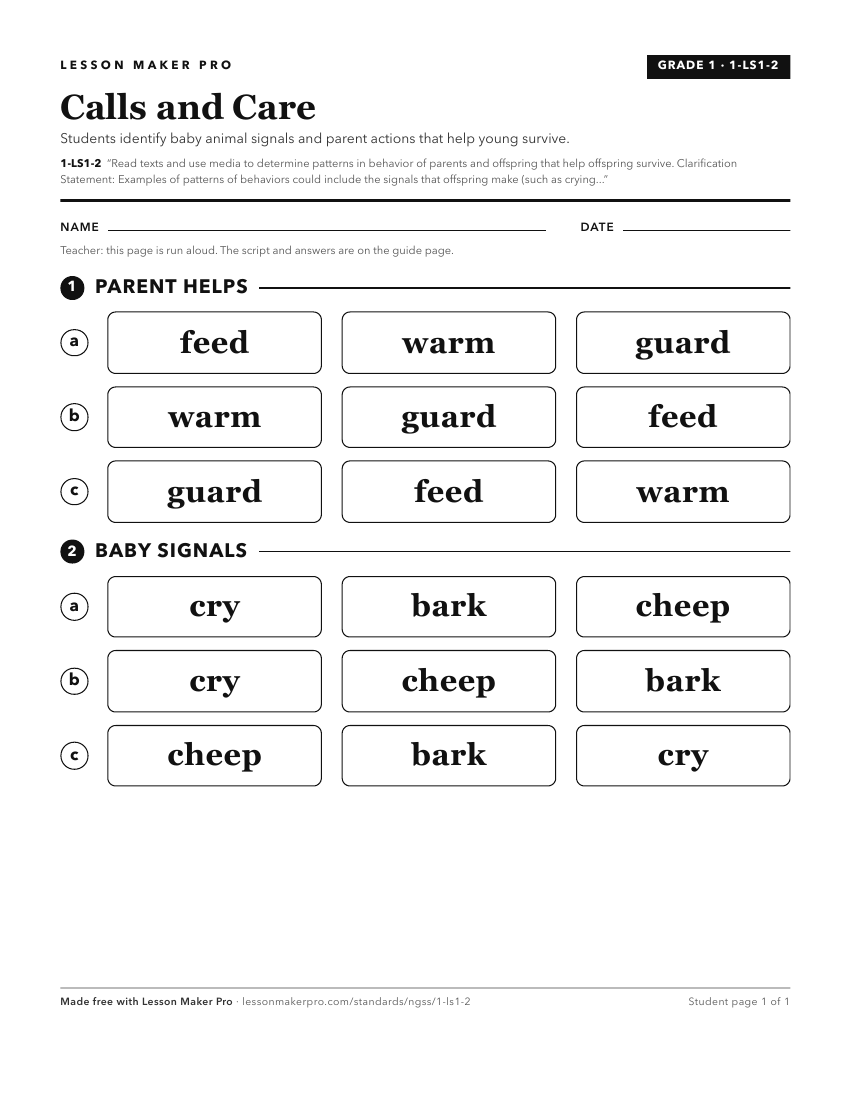
A ready-to-print activity worksheet aligned to 1-LS1-2, with an answer key for the teacher on its own page. No account needed.
PDF, US Letter, prints cleanly in black and white.
Download the worksheetKeep exploring
Related Standards
- 1-LS3-1
Make observations to construct an evidence-based account that young plants and animals are like, but not exactly like, their parents.
- 3-LS4-2
Use evidence to construct an explanation for how the variations in characteristics among individuals of the same species may provide advantages in surviving, fi...
- 3-LS3-1
Analyze and interpret data to provide evidence that plants and animals have traits inherited from parents and that variation of these traits exists in a group o...
- MS-LS4-5
Gather and synthesize information about the technologies that have changed the way humans influence the inheritance of desired traits in organisms.
Turn this exact standard into a lesson
Grade, subject, topic, and the complete standard are prefilled. Create one free, no account needed.
Also for this standard:Make a WorksheetMake a QuizMake a Sub Lesson