NGSS 3-LS4-2
The Standard
Use evidence to construct an explanation for how the variations in characteristics among individuals of the same species may provide advantages in surviving, finding mates, and reproducing.
Next Generation Science Standards
Teacher's field guide
What This Standard Means
What Students Need to Do
- Students compare individuals of the same species and notice differences in traits. They use evidence to explain how one variation may help an organism survive, find a mate, or reproduce.
What Mastery Looks Like
- Students identify a specific variation within one species and connect it to survival, attracting mates, or producing offspring. They support the connection with observations or data and explain the cause and effect clearly.
Common Misconceptions
- Students may think every variation is helpful or that an advantage guarantees survival. They may also say animals change traits because they need to, rather than recognizing that individuals already vary.
How to Assess It
- Give students this prompt: “Some beetles are green and some are brown. On brown soil, birds catch more green beetles. Explain which beetles may leave more offspring, using the evidence.”
Lesson moves
Ways to Teach It
Scatter green and brown paper beetles on grass, then have students collect them and compare which color was easier to find.
Ask students to write how brighter feathers could help one bird attract a mate and produce more offspring.
Play a trait card game where students match variations, such as thick fur, to environments where those traits provide an advantage.
Examine local plant photos and discuss how differences in thorns, leaf size, or flower color might affect survival or reproduction.
Free download
Printable 3-LS4-2 Worksheet
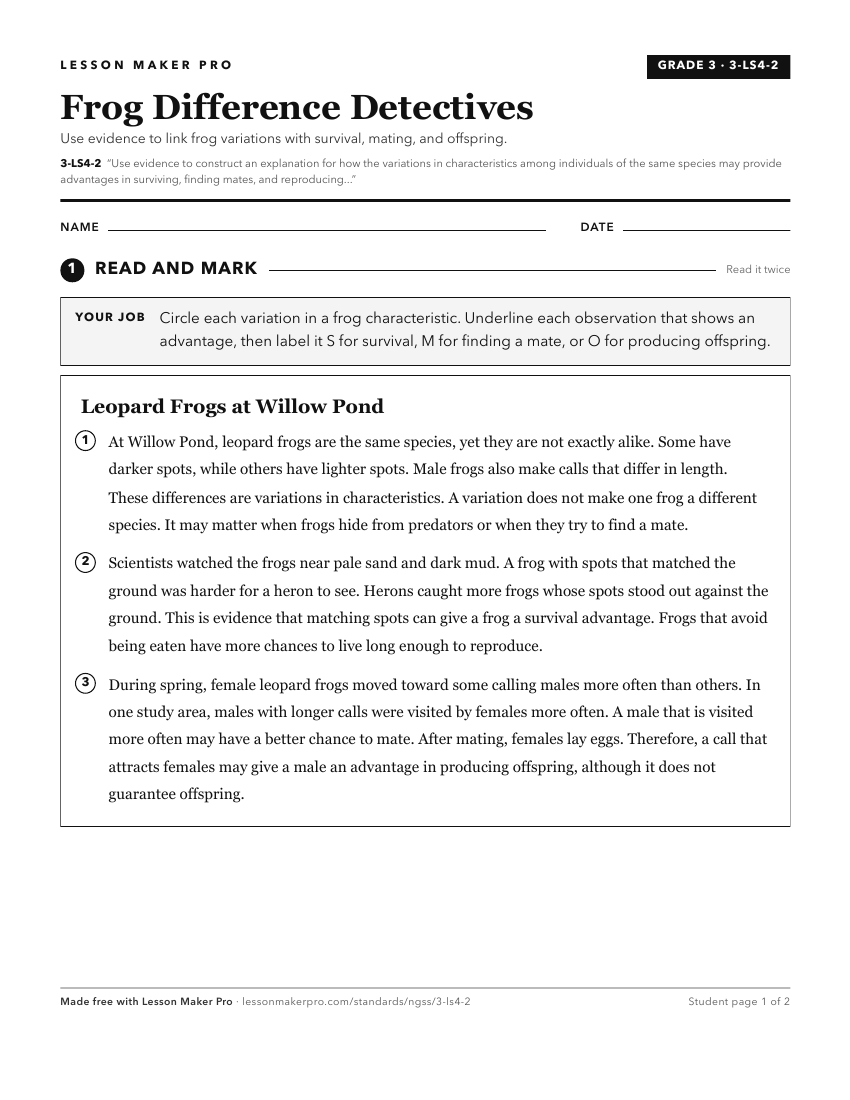
A ready-to-print activity worksheet aligned to 3-LS4-2, with an answer key for the teacher on its own page. No account needed.
PDF, US Letter, prints cleanly in black and white.
Download the worksheetWhat This Unlocks
Mastery here sets students up for these next.
Keep exploring
Related Standards
- HS-LS4-2
Construct an explanation based on evidence that the process of evolution primarily results from four factors: (1) the potential for a species to increase in num...
- HS-LS4-4
Construct an explanation based on evidence for how natural selection leads to adaptation of populations.
- MS-LS1-4
Use argument based on empirical evidence and scientific reasoning to support an explanation for how characteristic animal behaviors and specialized plant struct...
Turn this exact standard into a lesson
Grade, subject, topic, and the complete standard are prefilled. Create one free, no account needed.
Also for this standard:Make a WorksheetMake a QuizMake a Sub Lesson