NGSS MS-LS4-2
The Standard
Apply scientific ideas to construct an explanation for the anatomical similarities and differences among modern organisms and between modern and fossil organisms to infer evolutionary relationships.
Next Generation Science Standards
Teacher's field guide
What This Standard Means
What Students Need to Do
- Students compare visible body structures in living and fossil organisms. They use shared and differing features as evidence to explain which organisms likely share a closer ancestor.
What Mastery Looks Like
- Students can compare an anatomical diagram or data table and identify meaningful patterns. They make a clear claim about relatedness, cite specific structures, and connect the evidence to common ancestry.
Common Misconceptions
- Students may assume organisms that look alike are always closest relatives, or that one modern species evolved directly into another. They may treat any same-function feature as evidence of common ancestry and ignore structural differences or fossil age.
How to Assess It
- Show forelimb diagrams from a human, whale, bat, and fossil mammal. Ask students to identify two shared structures and explain what they suggest about relatedness.
Lesson moves
Ways to Teach It
Give groups printed skull and limb cards to sort by shared structures, then have them draw a possible relationship tree.
Ask students to write which two organisms are most closely related and defend the choice with two anatomical details.
Play a matching game in which students pair modern and fossil organisms using shared bones, teeth, limbs, or body coverings.
Use online museum fossil images to create exhibit labels explaining how one visible structure links extinct and modern organisms.
Free download
Printable MS-LS4-2 Worksheet
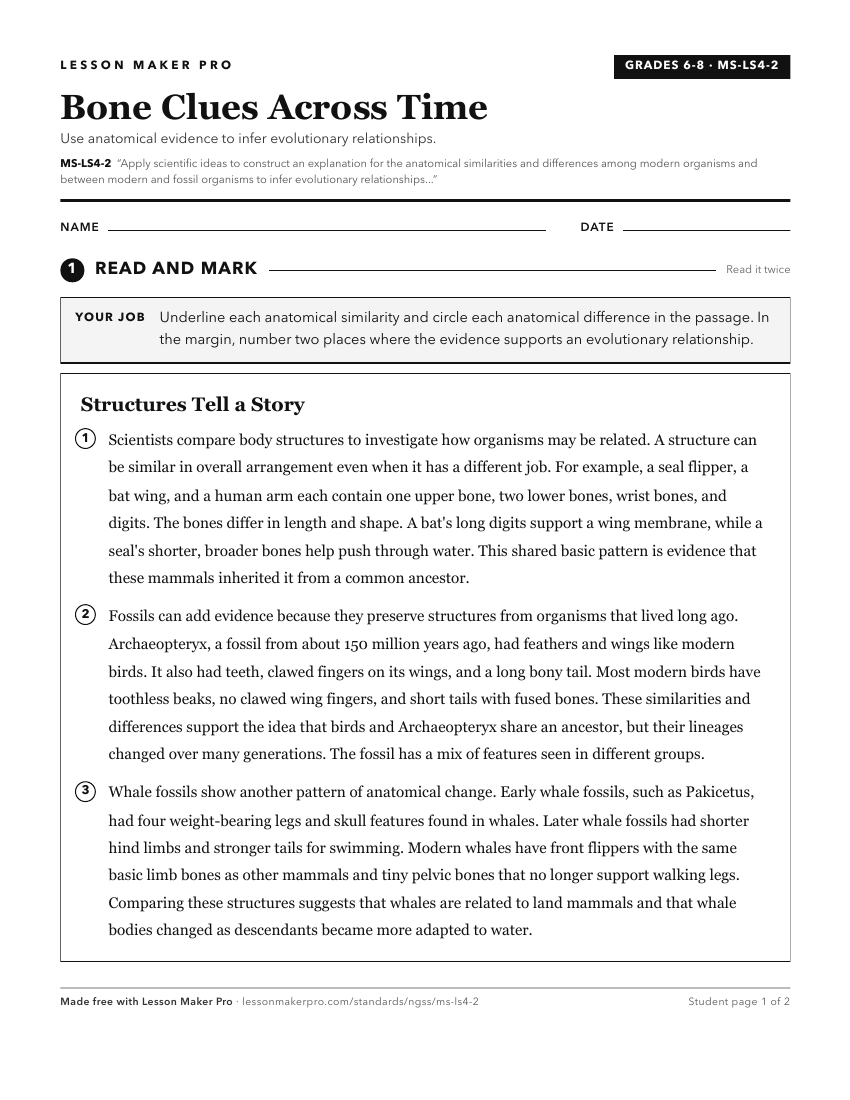
A ready-to-print activity worksheet aligned to MS-LS4-2, with an answer key for the teacher on its own page. No account needed.
PDF, US Letter, prints cleanly in black and white.
Download the worksheetBefore This Standard
If students are struggling here, check these first.
What This Unlocks
Mastery here sets students up for these next.
Keep exploring
Related Standards
- 1-LS3-1
Make observations to construct an evidence-based account that young plants and animals are like, but not exactly like, their parents.
- MS-LS4-1
Analyze and interpret data for patterns in the fossil record that document the existence, diversity, extinction, and change of life forms throughout the history...
- MS-LS4-3
Analyze displays of pictorial data to compare patterns of similarities in the embryological development across multiple species to identify relationships not ev...
Turn this exact standard into a lesson
Grade, subject, topic, and the complete standard are prefilled. Create one free, no account needed.
Also for this standard:Make a WorksheetMake a QuizMake a Sub Lesson