NGSS HS-LS4-1
The Standard
Communicate scientific information that common ancestry and biological evolution are supported by multiple lines of empirical evidence.
Next Generation Science Standards
Teacher's field guide
What This Standard Means
What Students Need to Do
- Students compare patterns in DNA, body structures, embryos, and fossils across species. They use several sources together to explain evolutionary relationships and common ancestry.
What Mastery Looks Like
- Given species data, students identify which organisms share a more recent ancestor and cite at least two independent evidence types. They explain how each source supports the relationship and note any conflicting evidence.
Common Misconceptions
- Students may treat one shared trait as proof of close ancestry, even when the trait evolved independently. They may think embryos are identical or that evolution follows a straight path toward improvement.
How to Assess It
- Give students DNA similarities, limb diagrams, and embryo images for three species. Ask them to name the closest relatives and support the claim with two evidence types.
Lesson moves
Ways to Teach It
Give groups fossil, embryo, anatomy, and DNA evidence cards to sort, then build a claim about relationships among four species.
Ask students to write: Why is a conclusion stronger when DNA, anatomy, and developmental patterns point to the same relationship?
Play Evidence Match, where teams pair observations with DNA, anatomy, embryology, or fossils and justify each match.
Use a mock DNA barcode report to identify an unknown fish species and explain which species is its closest relative.
Free download
Printable HS-LS4-1 Worksheet
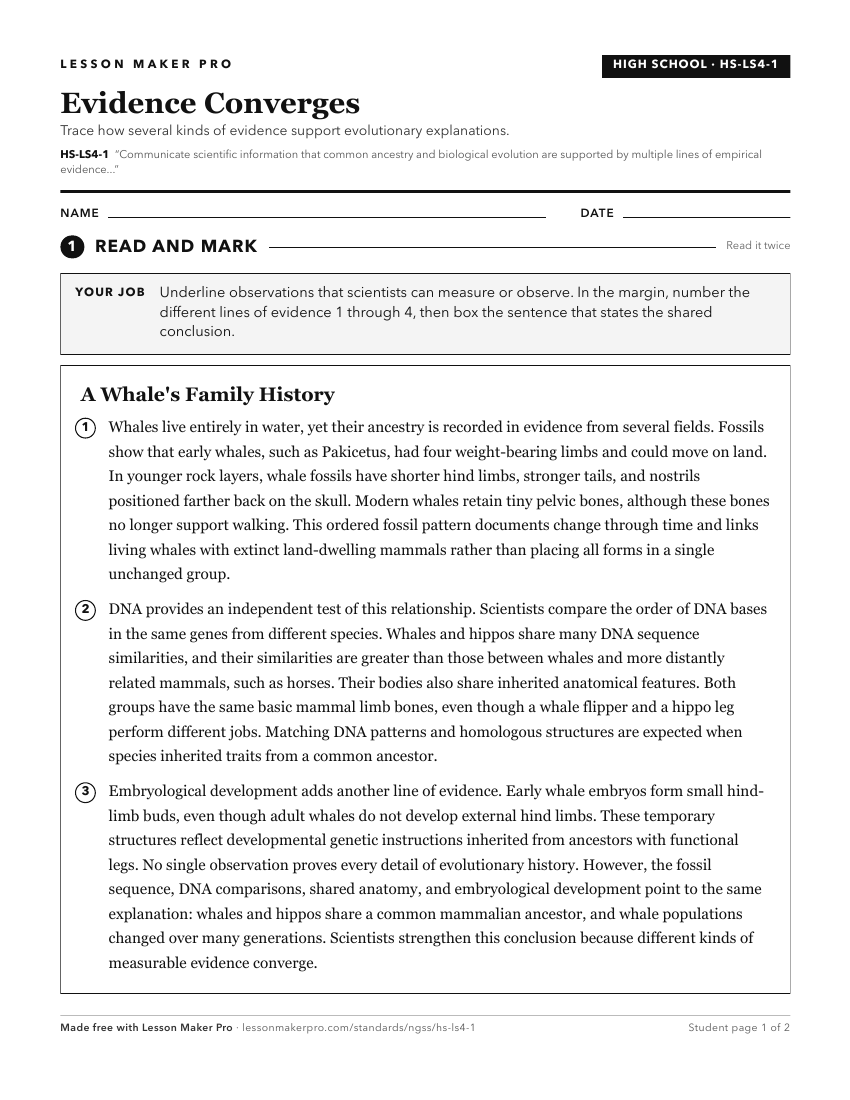
A ready-to-print activity worksheet aligned to HS-LS4-1, with an answer key for the teacher on its own page. No account needed.
PDF, US Letter, prints cleanly in black and white.
Download the worksheetBefore This Standard
If students are struggling here, check these first.
- MS-LS4-3
Embryological similarity patterns become one evidence line students use when explaining common ancestry alongside fossils, anatomy, and molecular data.
- MS-LS4-1
Interpreting fossil record patterns prepares students to use fossils as one evidence line for common ancestry and evolution.
- MS-LS4-2
Inferring relationships from anatomical and fossil evidence prepares students to explain common ancestry using broader empirical evidence.
Keep exploring
Related Standards
- 3-LS3-1
Analyze and interpret data to provide evidence that plants and animals have traits inherited from parents and that variation of these traits exists in a group o...
- MS-LS1-4
Use argument based on empirical evidence and scientific reasoning to support an explanation for how characteristic animal behaviors and specialized plant struct...
Turn this exact standard into a lesson
Grade, subject, topic, and the complete standard are prefilled. Create one free, no account needed.
Also for this standard:Make a WorksheetMake a QuizMake a Sub Lesson