NGSS MS-LS4-3
The Standard
Analyze displays of pictorial data to compare patterns of similarities in the embryological development across multiple species to identify relationships not evident in the fully formed anatomy.
Next Generation Science Standards
Teacher's field guide
What This Standard Means
What Students Need to Do
- Students compare embryo images from several species at similar stages. They identify shared visible structures and use those patterns to infer which species are more closely related.
What Mastery Looks Like
- Students can group species by shared embryo features, such as tails, limb buds, and head shape. They can explain how these patterns suggest relatedness that adult bodies may hide.
Common Misconceptions
- Students may think embryos of different species are identical or that one species passes through the adult form of another. They may compare adult traits instead of matching developmental stages and visible embryonic features.
How to Assess It
- Give students four embryo images from the same developmental stage. Ask them to select the closest related pair and cite two visible similarities as evidence.
Lesson moves
Ways to Teach It
Give groups printed embryo cards to sort by visible similarities, then have them label the features used for each grouping.
Ask students to write which two embryos seem most closely related and support the claim with two visible features.
Play an evidence match game where students pair species names with embryo images and justify each match before earning a point.
Compare whale, bat, and human embryos to show how shared limb buds reveal ancestry despite major differences in adult bodies.
Free download
Printable MS-LS4-3 Worksheet
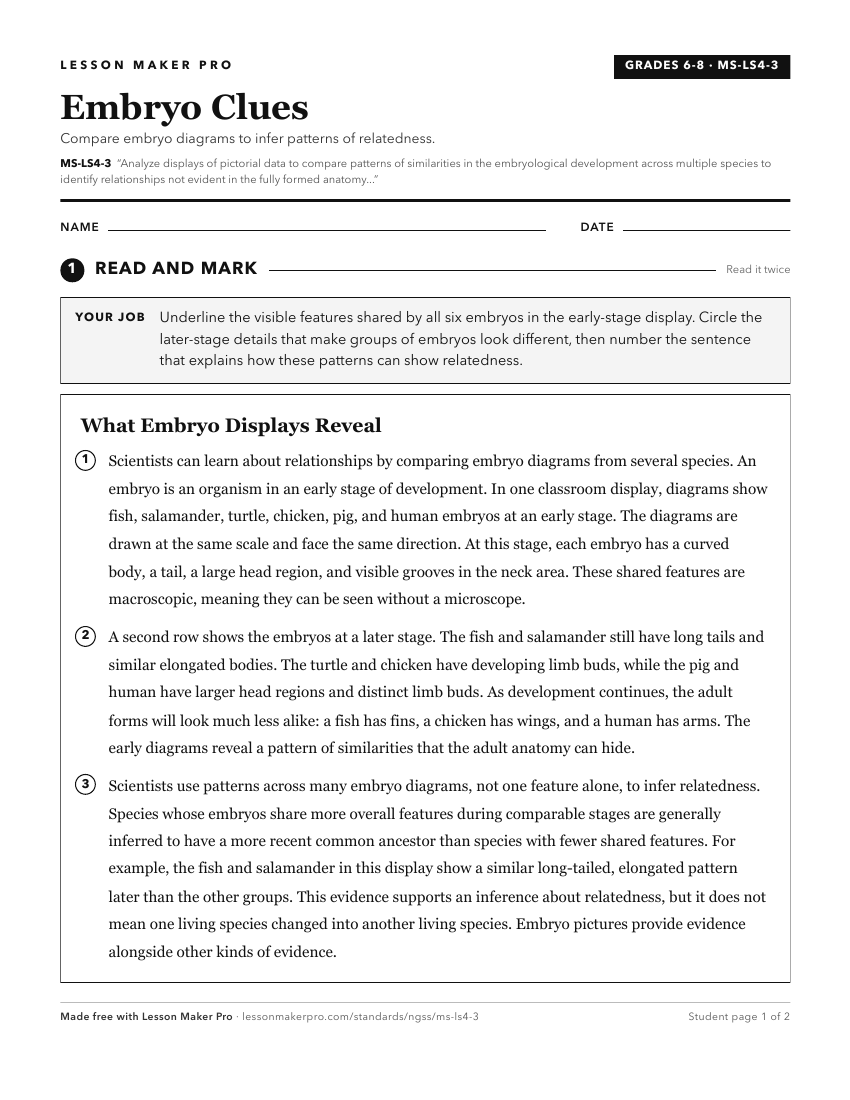
A ready-to-print activity worksheet aligned to MS-LS4-3, with an answer key for the teacher on its own page. No account needed.
PDF, US Letter, prints cleanly in black and white.
Download the worksheetWhat This Unlocks
Mastery here sets students up for these next.
Keep exploring
Related Standards
- HS-LS1-2
Develop and use a model to illustrate the hierarchical organization of interacting systems that provide specific functions within multicellular organisms.
- MS-LS4-2
Apply scientific ideas to construct an explanation for the anatomical similarities and differences among modern organisms and between modern and fossil organism...
- 3-LS3-1
Analyze and interpret data to provide evidence that plants and animals have traits inherited from parents and that variation of these traits exists in a group o...
- 3-LS4-1
Analyze and interpret data from fossils to provide evidence of the organisms and the environments in which they lived long ago.
Turn this exact standard into a lesson
Grade, subject, topic, and the complete standard are prefilled. Create one free, no account needed.
Also for this standard:Make a WorksheetMake a QuizMake a Sub Lesson