NGSS 3-LS4-1
The Standard
Analyze and interpret data from fossils to provide evidence of the organisms and the environments in which they lived long ago.
Next Generation Science Standards
Teacher's field guide
What This Standard Means
What Students Need to Do
- Students examine fossil observations and compare where fossils appear in rock layers or locations. They use patterns in the evidence to describe past organisms, habitats, and relative ages.
What Mastery Looks Like
- Students compare fossil type, size, location, and rock layer. They use those observations to make a supported claim about an ancient habitat and place fossils in relative age order.
Common Misconceptions
- Students may think fossils show where an organism lives today rather than where it lived long ago. They may also assume deeper fossils are newer, or that every fossil belongs to a living species.
How to Assess It
- Give students a diagram showing shell fossils in lower rock layers and leaf fossils above. Ask which environment came first and what fossil evidence supports the answer.
Lesson moves
Ways to Teach It
Press shells, leaves, and toy footprints into clay, then have students infer the organism and habitat from each impression.
Show a marine fossil found on dry land and ask students to write a claim explaining what the area was like long ago.
Play Fossil Layer Sort by arranging picture cards from oldest to youngest using their positions in a model rock column.
Compare local land today with fossil evidence from the area, then sketch how the same place may have looked long ago.
Free download
Printable 3-LS4-1 Worksheet
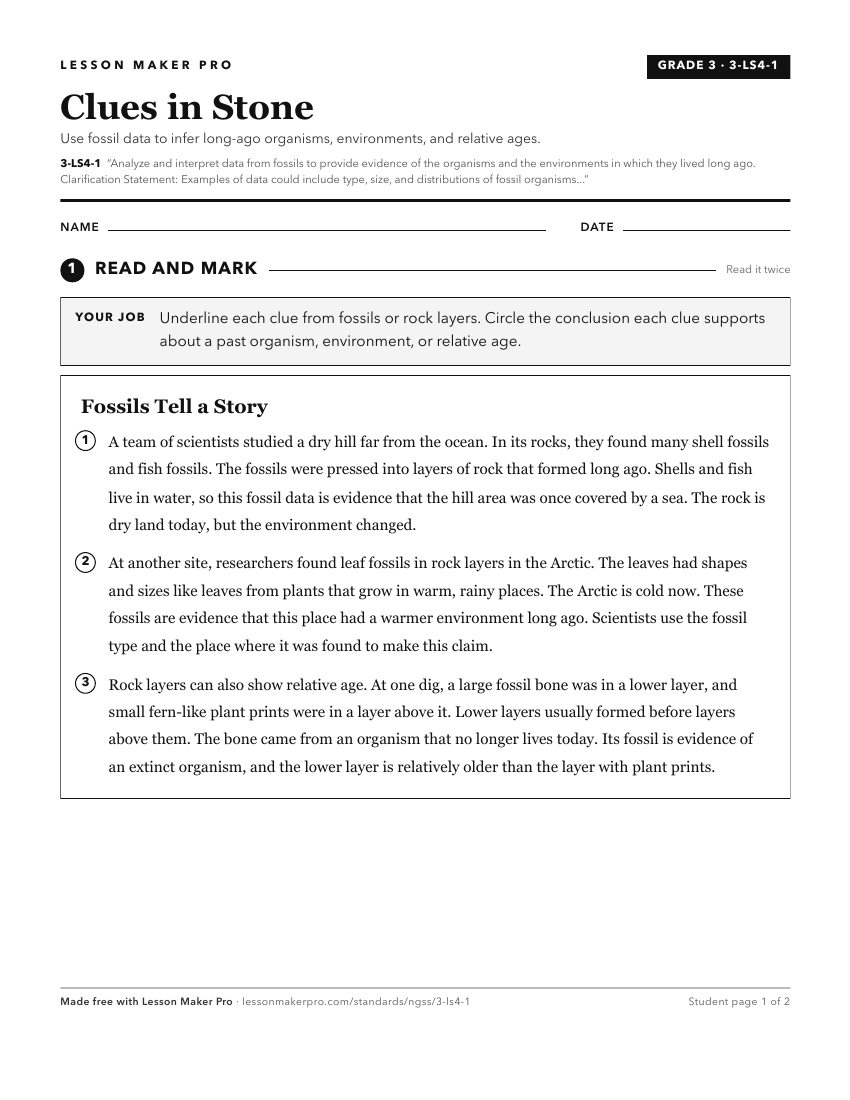
A ready-to-print activity worksheet aligned to 3-LS4-1, with an answer key for the teacher on its own page. No account needed.
PDF, US Letter, prints cleanly in black and white.
Download the worksheetWhat This Unlocks
Mastery here sets students up for these next.
- MS-LS4-2
Interpreting fossil evidence prepares students to compare fossil and modern organisms when explaining anatomical similarities and evolutionary relationships.
- MS-LS4-1
Students extend fossil data about past organisms and environments to broader patterns of diversity, extinction, and change over time.
Keep exploring
Related Standards
- 3-LS3-1
Analyze and interpret data to provide evidence that plants and animals have traits inherited from parents and that variation of these traits exists in a group o...
- 4-ESS1-1
Identify evidence from patterns in rock formations and fossils in rock layers to support an explanation for changes in a landscape over time.
- MS-ESS2-3
Analyze and interpret data on the distribution of fossils and rocks, continental shapes, and seafloor structures to provide evidence of the past plate motions.
Turn this exact standard into a lesson
Grade, subject, topic, and the complete standard are prefilled. Create one free, no account needed.
Also for this standard:Make a WorksheetMake a QuizMake a Sub Lesson