NGSS MS-ESS2-3
The Standard
Analyze and interpret data on the distribution of fossils and rocks, continental shapes, and seafloor structures to provide evidence of the past plate motions.
Next Generation Science Standards
Teacher's field guide
What This Standard Means
What Students Need to Do
- Students compare maps and data showing fossils, rocks, continental shelves, and seafloor features. They identify matching patterns and use them as evidence for past plate locations and movement.
What Mastery Looks Like
- Students identify matching fossil, rock, landform, and seafloor patterns across maps. They use several patterns to explain where plates were located and how they moved over time.
Common Misconceptions
- Students may match modern shorelines instead of continental shelf edges. They may think identical fossils crossed wide oceans rather than living before continents separated. They may also confuse ridges, trenches, and fracture zones.
How to Assess It
- Give students a small map showing continental shelves, matching fossils, rock belts, and an ocean ridge. Ask them to state one past plate motion and cite two supporting patterns.
Lesson moves
Ways to Teach It
Use continent cutouts showing shelf edges, fossil sites, and rock belts; students assemble a past map and label three supporting matches.
Ask students to write which evidence best supports continental movement, fossil matches, rock belts, shelf shapes, or seafloor structures, and explain why.
Run an evidence-card sort where teams match fossil, rock, ridge, trench, and fracture-zone cards to claims about past plate motion.
Overlay earthquake locations on a seafloor map, then compare them with ridges and trenches to connect current hazards with continuing plate movement.
Free download
Printable MS-ESS2-3 Worksheet
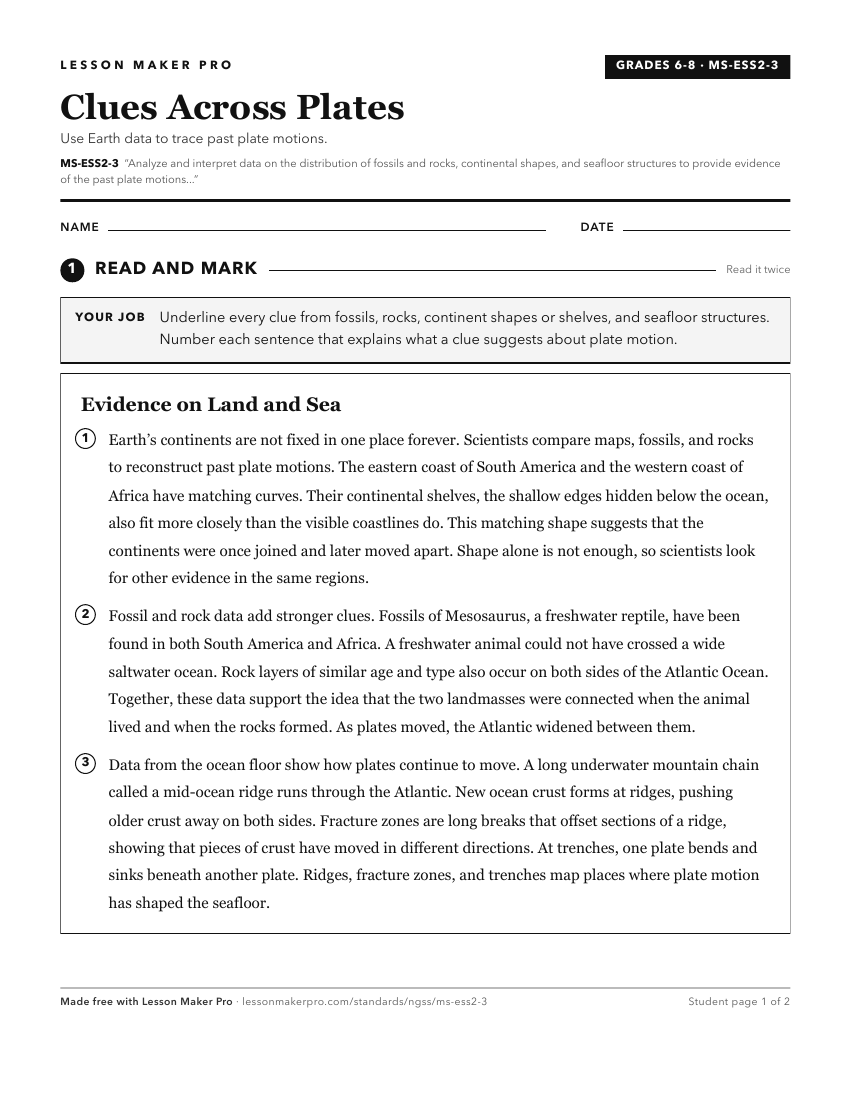
A ready-to-print activity worksheet aligned to MS-ESS2-3, with an answer key for the teacher on its own page. No account needed.
PDF, US Letter, prints cleanly in black and white.
Download the worksheetLearning progression
Where This Standard Sits
See the whole path on the Earth & Space Science progression map.
Before This Standard
If students are struggling here, check these first.
What This Unlocks
Mastery here sets students up for these next.
- HS-ESS1-6
Interpreting rocks and fossils as evidence of past tectonic change supports using ancient Earth materials to explain early Earth history.
- HS-ESS1-5
Students carry forward fossil, rock, shape, and seafloor evidence to evaluate plate motion and explain crustal rock ages.
- HS-ESS2-3
Interpreting evidence for plate motion supports modeling how mantle convection moves and recycles Earth’s materials.
- HS-ESS2-1
Evidence for past plate motions supports HS modeling of how plate-driven internal and surface processes form continents and ocean floors.
Keep exploring
Related Standards
- MS-LS4-1
Analyze and interpret data for patterns in the fossil record that document the existence, diversity, extinction, and change of life forms throughout the history...
- 3-LS4-1
Analyze and interpret data from fossils to provide evidence of the organisms and the environments in which they lived long ago.
Turn this exact standard into a lesson
Grade, subject, topic, and the complete standard are prefilled. Create one free, no account needed.
Also for this standard:Make a WorksheetMake a QuizMake a Sub Lesson