NGSS MS-LS4-1
The Standard
Analyze and interpret data for patterns in the fossil record that document the existence, diversity, extinction, and change of life forms throughout the history of life on Earth under the assumption that natural laws operate today as in the past.
Next Generation Science Standards
Teacher's field guide
What This Standard Means
What Students Need to Do
- Students read fossil and rock-layer data to find when body forms appear, change, become more varied, or disappear. They explain the sequence using layer position and processes that work consistently over time.
What Mastery Looks Like
- A student correctly orders fossil appearances using rock-layer position. The student identifies changes in diversity and body structure, then supports each claim with specific layer data.
Common Misconceptions
- Students may reverse the layer order and place the oldest fossils near the surface. They may treat evolution as a straight ladder toward greater complexity. They may assume a missing fossil proves an organism did not exist then.
How to Assess It
- Exit ticket: Layers A through D run oldest to youngest. A has X, B has X and Y, C has Y, Z, and Q, and D has Z and Q. Name one first appearance, one likely extinction, and one diversity change, citing the layer data.
Lesson moves
Ways to Teach It
Stack index-card rock layers containing paper fossil shapes, then remove layers one at a time and chart first and last appearances.
Write a claim: Does the fossil sequence show steady progress toward complexity, or branching change? Cite two layer observations.
Play Fossil Timeline Relay: teams sort layer cards from oldest to youngest, then earn points for accurate pattern statements backed by evidence.
Use a museum's online fossil collection to compare specimens from older and younger rocks, recording changes in body structures without naming species.
Free download
Printable MS-LS4-1 Worksheet
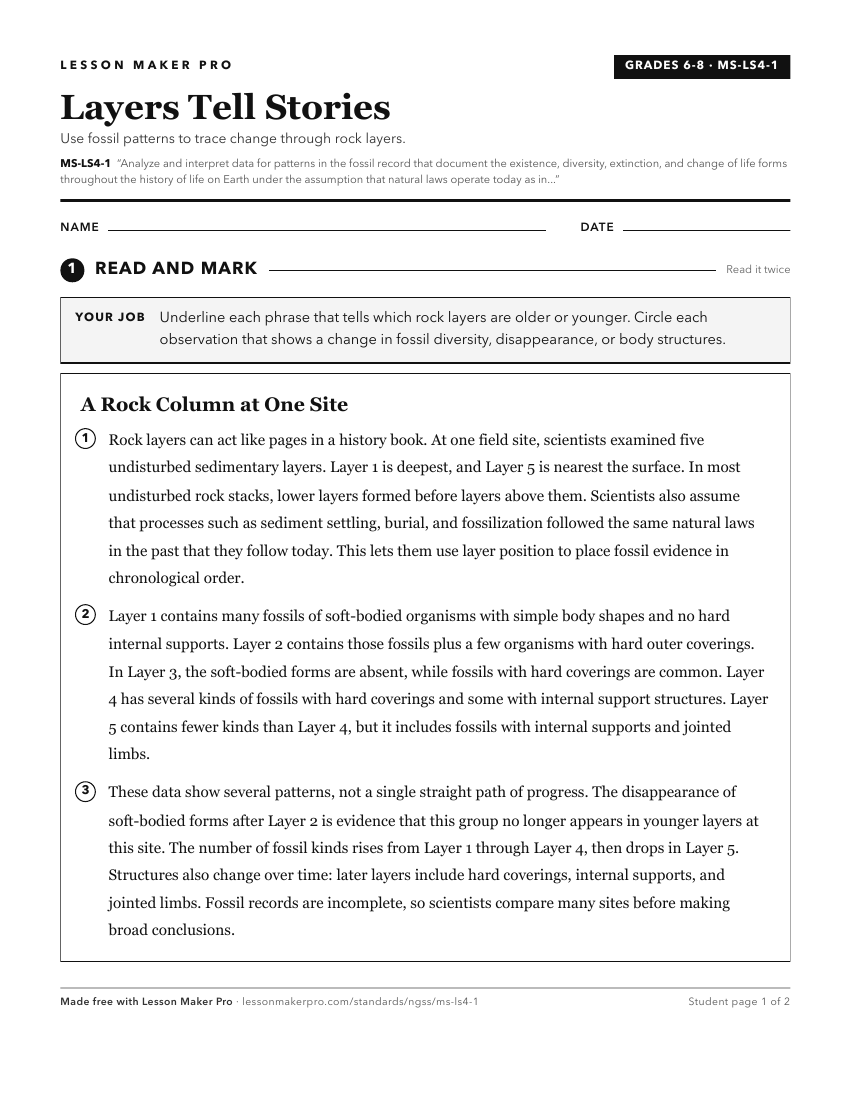
A ready-to-print activity worksheet aligned to MS-LS4-1, with an answer key for the teacher on its own page. No account needed.
PDF, US Letter, prints cleanly in black and white.
Download the worksheetBefore This Standard
If students are struggling here, check these first.
What This Unlocks
Mastery here sets students up for these next.
Keep exploring
Related Standards
- MS-LS4-2
Apply scientific ideas to construct an explanation for the anatomical similarities and differences among modern organisms and between modern and fossil organism...
- 4-ESS1-1
Identify evidence from patterns in rock formations and fossils in rock layers to support an explanation for changes in a landscape over time.
- MS-ESS2-3
Analyze and interpret data on the distribution of fossils and rocks, continental shapes, and seafloor structures to provide evidence of the past plate motions.
Turn this exact standard into a lesson
Grade, subject, topic, and the complete standard are prefilled. Create one free, no account needed.
Also for this standard:Make a WorksheetMake a QuizMake a Sub Lesson