NGSS HS-ESS1-5
The Standard
Evaluate evidence of the past and current movements of continental and oceanic crust and the theory of plate tectonics to explain the ages of crustal rocks.
Next Generation Science Standards
Teacher's field guide
What This Standard Means
What Students Need to Do
- Students read rock-age maps, sample tables, and distance data to find age patterns across oceanic and continental crust. They use those patterns to judge how well plate movement explains where younger and older rocks occur.
What Mastery Looks Like
- Students identify that ocean crust gets older away from spreading ridges and continental crust often gets older toward ancient cores. They cite mapped ages or sample data to support a plate movement explanation.
Common Misconceptions
- Students may think ocean crust is oldest near a ridge because the ridge formed first. They may also confuse rock age with Earth’s age or assume continental crust gets younger toward its ancient core.
How to Assess It
- Give students these data: ocean crust at 0, 400, and 800 km from a ridge is 2, 22, and 43 million years old. Ask them to explain the pattern, name the plate process, and cite two data points.
Lesson moves
Ways to Teach It
Build a paper seafloor model by pulling colored age bands apart from a central slit, then label the youngest and oldest crust.
Write a claim explaining why Atlantic crust ages form matching bands on both sides of the Mid-Atlantic Ridge, using map evidence.
Sort cards showing rock ages, locations, and plate settings, then match each set with spreading, collision, or continental growth.
Use an ocean-floor age map to choose two possible drilling sites for young and old crust, then defend each choice.
Free download
Printable HS-ESS1-5 Worksheet
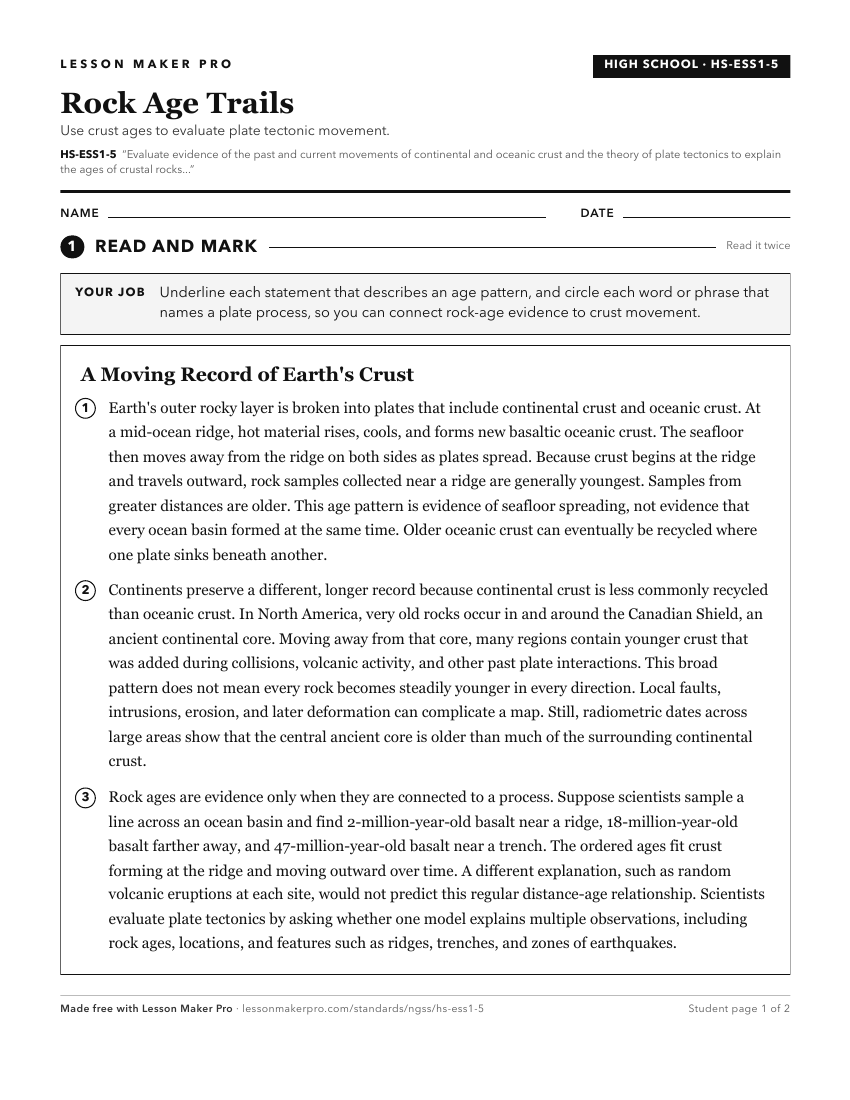
A ready-to-print activity worksheet aligned to HS-ESS1-5, with an answer key for the teacher on its own page. No account needed.
PDF, US Letter, prints cleanly in black and white.
Download the worksheetLearning progression
Where This Standard Sits
See the whole path on the Earth & Space Science progression map.
Before This Standard
If students are struggling here, check these first.
Keep exploring
Related Standards
- MS-ESS2-2
Construct an explanation based on evidence for how geoscience processes have changed Earth's surface at varying time and spatial scales.
- 4-ESS1-1
Identify evidence from patterns in rock formations and fossils in rock layers to support an explanation for changes in a landscape over time.
- HS-ESS1-6
Apply scientific reasoning and evidence from ancient Earth materials, meteorites, and other planetary surfaces to construct an account of Earth's formation and ...
Turn this exact standard into a lesson
Grade, subject, topic, and the complete standard are prefilled. Create one free, no account needed.
Also for this standard:Make a WorksheetMake a QuizMake a Sub Lesson