NGSS MS-LS2-1
The Standard
Analyze and interpret data to provide evidence for the effects of resource availability on organisms and populations of organisms in an ecosystem.
Next Generation Science Standards
Teacher's field guide
What This Standard Means
What Students Need to Do
- Students analyze tables, graphs, or observations that show changing resource levels and organism responses. They use data to explain how abundant or scarce resources affect individual growth and population size.
What Mastery Looks Like
- Students identify patterns in tables or graphs and connect resource levels to changes in organisms or populations. They support each claim with accurate data and explain the cause and effect link.
Common Misconceptions
- Students may treat food as the only resource, overlooking water, space, shelter, light, and nutrients. They may confuse growth of one organism with growth in population size. They may also assume extra resources cause unlimited growth.
How to Assess It
- Give students this table: seeds available, 20, 40, 80; mouse population, 6, 11, 19. Ask them to make a claim and cite two data points as evidence.
Lesson moves
Ways to Teach It
Grow radish seedlings with different water amounts, measure their heights for one week, and graph the group averages.
Show two deer population graphs and ask students to explain which resource might be scarce, using graph evidence.
Play a matching game where students pair resource data cards with the most likely population graph.
Compare local rainfall records with bird count data, then write a claim about how water availability may affect bird populations.
Free download
Printable MS-LS2-1 Worksheet
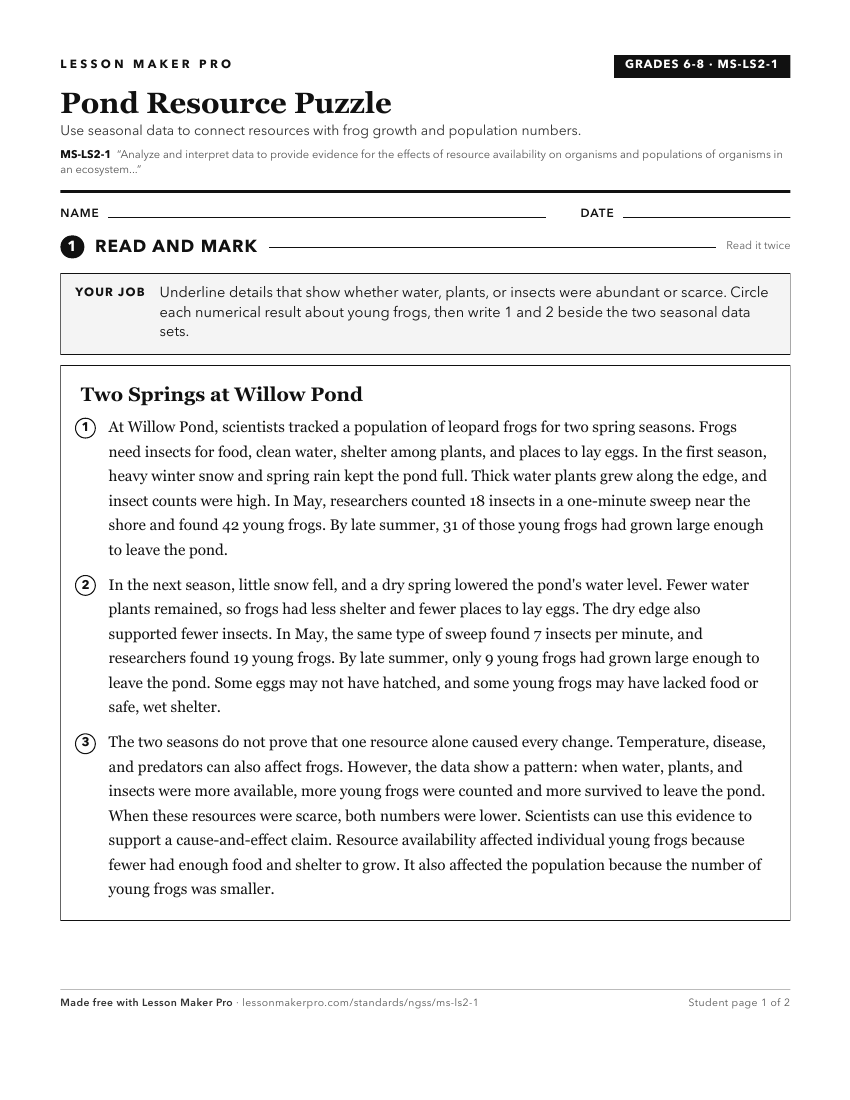
A ready-to-print activity worksheet aligned to MS-LS2-1, with an answer key for the teacher on its own page. No account needed.
PDF, US Letter, prints cleanly in black and white.
Download the worksheetBefore This Standard
If students are struggling here, check these first.
What This Unlocks
Mastery here sets students up for these next.
Keep exploring
Related Standards
- MS-LS2-4
Construct an argument supported by empirical evidence that changes to physical or biological components of an ecosystem affect populations.
- 3-LS3-1
Analyze and interpret data to provide evidence that plants and animals have traits inherited from parents and that variation of these traits exists in a group o...
- 3-LS4-1
Analyze and interpret data from fossils to provide evidence of the organisms and the environments in which they lived long ago.
Turn this exact standard into a lesson
Grade, subject, topic, and the complete standard are prefilled. Create one free, no account needed.
Also for this standard:Make a WorksheetMake a QuizMake a Sub Lesson