NGSS HS-ESS2-7
The Standard
Construct an argument based on evidence about the simultaneous coevolution of Earth systems and life on Earth. Clarification Statement: Emphasis is on the dynamic causes, effects, and feedbacks between the biosphere and Earth's other systems, whereby geoscience factors control the evolution of life, which in turn continuously alters Earth's surface. Examples of include how photosynthetic life altered the atmosphere through the production of oxygen, which in turn increased weathering rates and allowed for the evolution of animal life; how microbial life on land increased the formation of soil, which in turn allowed for the evolution of land plants; or how the evolution of corals created reefs that altered patterns of erosion and deposition along coastlines and provided habitats for the evolution of new life forms. Assessment Boundary: Assessment does not include a comprehensive understanding of the mechanisms of how the biosphere interacts with all of Earth's other systems.
Next Generation Science Standards
Teacher's field guide
What This Standard Means
What Students Need to Do
- Students use evidence to explain how living things and Earth systems changed each other over time. They build an argument that traces causes, effects, and feedbacks.
What Mastery Looks Like
- Students make a clear claim and support it with relevant geologic and biological evidence. They explain a feedback loop, including how life changed Earth and how that change affected later life.
Common Misconceptions
- Students may treat Earth systems as acting on life in only one direction. They may confuse changes in populations over generations with individual adaptation, or use timing alone as proof of causation.
How to Assess It
- Exit ticket: Photosynthetic organisms spread, oxygen rose, weathering increased, and animals diversified. Use two facts to argue for a two-way interaction between life and Earth systems.
Adopted as
This framework is adopted as written in California, Connecticut, Delaware, District of Columbia, Hawaii, Illinois, Kansas, Maryland, Nevada, New Hampshire, New Mexico, Rhode Island, Vermont.
Lesson moves
Ways to Teach It
Build coastline trays with sand and sponge reefs, then compare erosion and deposition after making identical waves.
Write a claim explaining how photosynthetic organisms and atmospheric oxygen changed each other, using two facts from a provided timeline.
Play a feedback-loop card sort, matching organism changes, Earth-system changes, evidence, and resulting evolutionary effects.
Analyze local soil, reef, or vegetation data and explain how living things alter land, water, or air over time.
Free download
Printable HS-ESS2-7 Worksheet
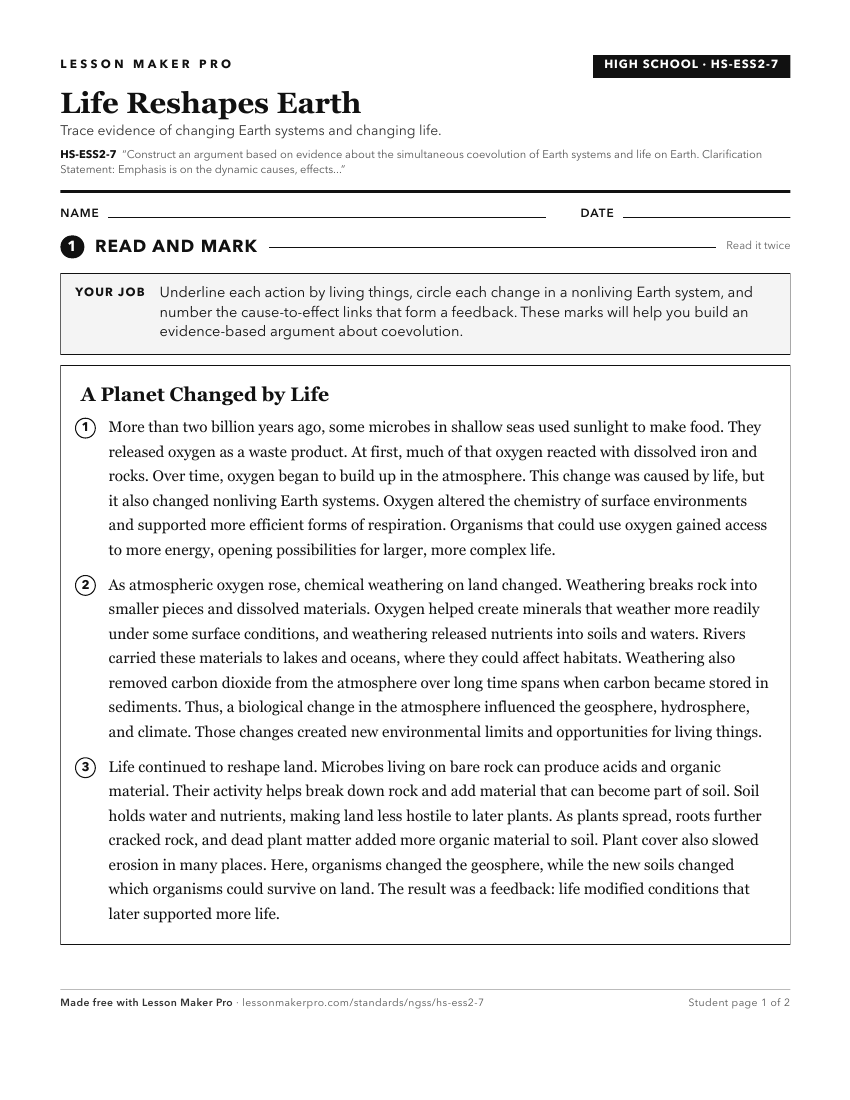
A ready-to-print activity worksheet aligned to HS-ESS2-7, with an answer key for the teacher on its own page. No account needed.
PDF, US Letter, prints cleanly in black and white.
Download the worksheetKeep exploring
Related Standards
- MS-ESS3-4
Construct an argument supported by evidence for how increases in human population and per-capita consumption of natural resources impact Earth's systems.
- K-ESS2-2
Construct an argument supported by evidence for how plants and animals (including humans) can change the environment to meet their needs.
- 3-LS4-3
Construct an argument with evidence that in a particular habitat some organisms can survive well, some survive less well, and some cannot survive at all.
- MS-ESS2-2
Construct an explanation based on evidence for how geoscience processes have changed Earth's surface at varying time and spatial scales.
Turn this exact standard into a lesson
Grade, subject, topic, and the complete standard are prefilled. Create one free, no account needed.
Also for this standard:Make a WorksheetMake a QuizMake a Sub Lesson