NGSS 4-LS1-1
The Standard
Construct an argument that plants and animals have internal and external structures that function to support survival, growth, behavior, and reproduction.
Next Generation Science Standards
Teacher's field guide
What This Standard Means
What Students Need to Do
- Students identify large, observable plant and animal structures and explain the job each one does. They make a claim about a structure, then support it with observations, facts, and reasoning.
What Mastery Looks Like
- Students can identify internal and external structures in familiar organisms and describe their functions. They can make a clear claim and connect evidence about a structure to survival, growth, behavior, or reproduction.
Common Misconceptions
- Students may think every structure has only one job, or that all organisms have the same structures. They may name a body part without explaining how its function helps the organism.
How to Assess It
- Show a labeled duck diagram with lungs, webbed feet, and feathers. Ask students to choose two structures and explain, using evidence, how each helps the duck survive.
Lesson moves
Ways to Teach It
Dissect a flower, then label the stem, petals, and reproductive parts and record how each part helps the plant.
Ask students to compare cactus spines and turtle shells, then write which structure offers better protection and defend their choice.
Play a card match game pairing structures, such as roots or lungs, with functions, then require students to explain each match.
Inspect plants around the school, photograph useful structures, and create captions explaining how each structure helps the plant live.
Free download
Printable 4-LS1-1 Worksheet
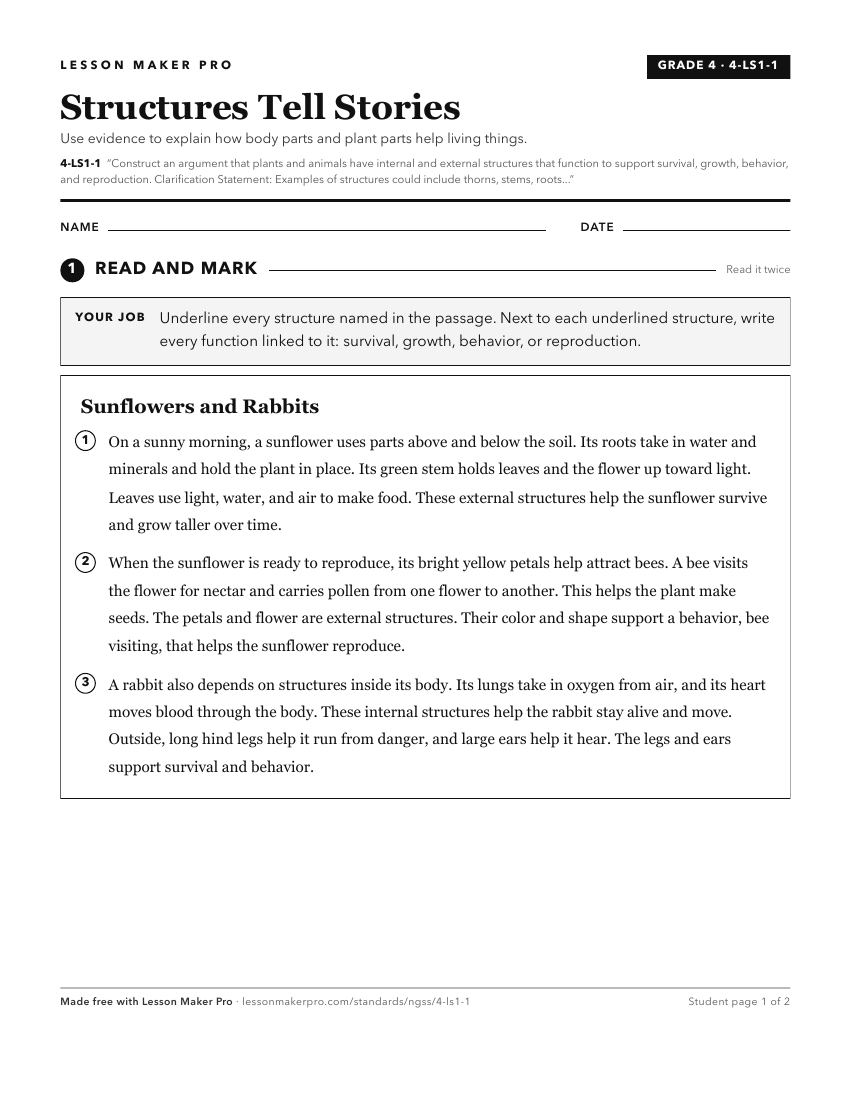
A ready-to-print activity worksheet aligned to 4-LS1-1, with an answer key for the teacher on its own page. No account needed.
PDF, US Letter, prints cleanly in black and white.
Download the worksheetWhat This Unlocks
Mastery here sets students up for these next.
Keep exploring
Related Standards
- 3-LS2-1
Construct an argument that some animals form groups that help members survive.
- K-ESS2-2
Construct an argument supported by evidence for how plants and animals (including humans) can change the environment to meet their needs.
- 3-LS4-3
Construct an argument with evidence that in a particular habitat some organisms can survive well, some survive less well, and some cannot survive at all.
- MS-LS1-4
Use argument based on empirical evidence and scientific reasoning to support an explanation for how characteristic animal behaviors and specialized plant struct...
Turn this exact standard into a lesson
Grade, subject, topic, and the complete standard are prefilled. Create one free, no account needed.
Also for this standard:Make a WorksheetMake a QuizMake a Sub Lesson