NGSS 3-LS2-1
The Standard
Construct an argument that some animals form groups that help members survive.
Next Generation Science Standards
Teacher's field guide
What This Standard Means
What Students Need to Do
- Students make a clear claim about how group behavior can improve an animal's chances of staying alive. They use observations or data as evidence, then explain how that evidence supports the claim.
What Mastery Looks Like
- Given information about wolves, meerkats, fish, or insects, students identify a group behavior and its benefit. They make a claim, cite relevant evidence, and connect it to protection, finding food, or caring for young.
Common Misconceptions
- Students may think every animal lives in a group, or that any animals seen together form a cooperative group. They may name a benefit without evidence, generalize from one species, or assume groups never create risks.
How to Assess It
- Exit ticket: Ten meerkats take turns watching while others eat, while a lone meerkat stops eating often to scan; make a claim, use both observations, and explain your reasoning.
Lesson moves
Ways to Teach It
Give teams cups, craft sticks, and one-minute predator interruptions; compare food-token collection by lone foragers and groups with assigned lookouts.
Ask: How could living in a group help and hurt meerkats? Students state a claim, cite an observation, and explain their reasoning.
Sort animal scenario cards into group benefit, no clear benefit, or solitary behavior, then defend each choice with evidence from the card.
Observe ants or flocking birds outdoors, record group actions, and infer how one action may improve access to food or safety.
Free download
Printable 3-LS2-1 Worksheet
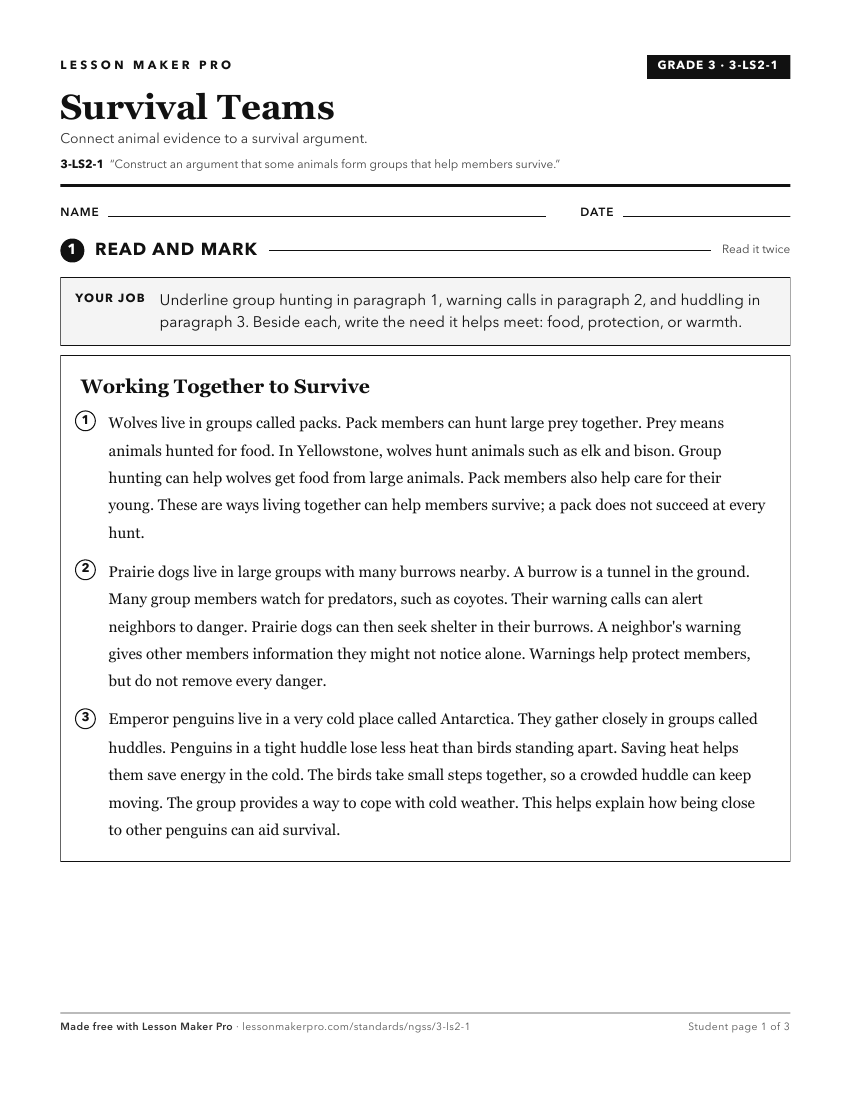
A ready-to-print activity worksheet aligned to 3-LS2-1, with an answer key for the teacher on its own page. No account needed.
PDF, US Letter, prints cleanly in black and white.
Download the worksheetKeep exploring
Related Standards
- HS-LS2-8
Evaluate the evidence for the role of group behavior on individual and species' chances to survive and reproduce.
- K-ESS2-2
Construct an argument supported by evidence for how plants and animals (including humans) can change the environment to meet their needs.
- 3-LS4-3
Construct an argument with evidence that in a particular habitat some organisms can survive well, some survive less well, and some cannot survive at all.
- 4-LS1-1
Construct an argument that plants and animals have internal and external structures that function to support survival, growth, behavior, and reproduction.
Turn this exact standard into a lesson
Grade, subject, topic, and the complete standard are prefilled. Create one free, no account needed.
Also for this standard:Make a WorksheetMake a QuizMake a Sub Lesson