NGSS 3-LS1-1
The Standard
Develop models to describe that organisms have unique and diverse life cycles but all have in common birth, growth, reproduction, and death.
Next Generation Science Standards
Teacher's field guide
What This Standard Means
What Students Need to Do
- Students build diagrams, picture sequences, or physical models showing how organisms change over their lives. They use arrows and labels to compare cycles and show how each new generation repeats the pattern.
What Mastery Looks Like
- A student can correctly sequence and label the life cycle of an animal and a flowering plant. They can explain similarities, differences, and how offspring begin another cycle.
Common Misconceptions
- Students may think metamorphosis happens in every animal, or that a seed is not alive. They may stop the cycle at adulthood, confuse growth with reproduction, or assume offspring look exactly like adults.
How to Assess It
- Complete butterfly and bean plant life cycle diagrams with arrows and missing stages. Write one way the cycles differ and one pattern they share.
Lesson moves
Ways to Teach It
Give groups butterfly, frog, chicken, and sunflower stage cards to arrange in circles, then connect each stage with yarn and arrows.
Ask students to write: How is a sunflower’s life cycle like a butterfly’s, and what change is unique to each?
Play Life Cycle Relay: teams race to order picture cards, add arrows, and explain why the final card links to the first.
Observe flowering plants in the schoolyard, photograph visible stages, and build a class timeline that predicts what each plant will do next.
Free download
Printable 3-LS1-1 Worksheet
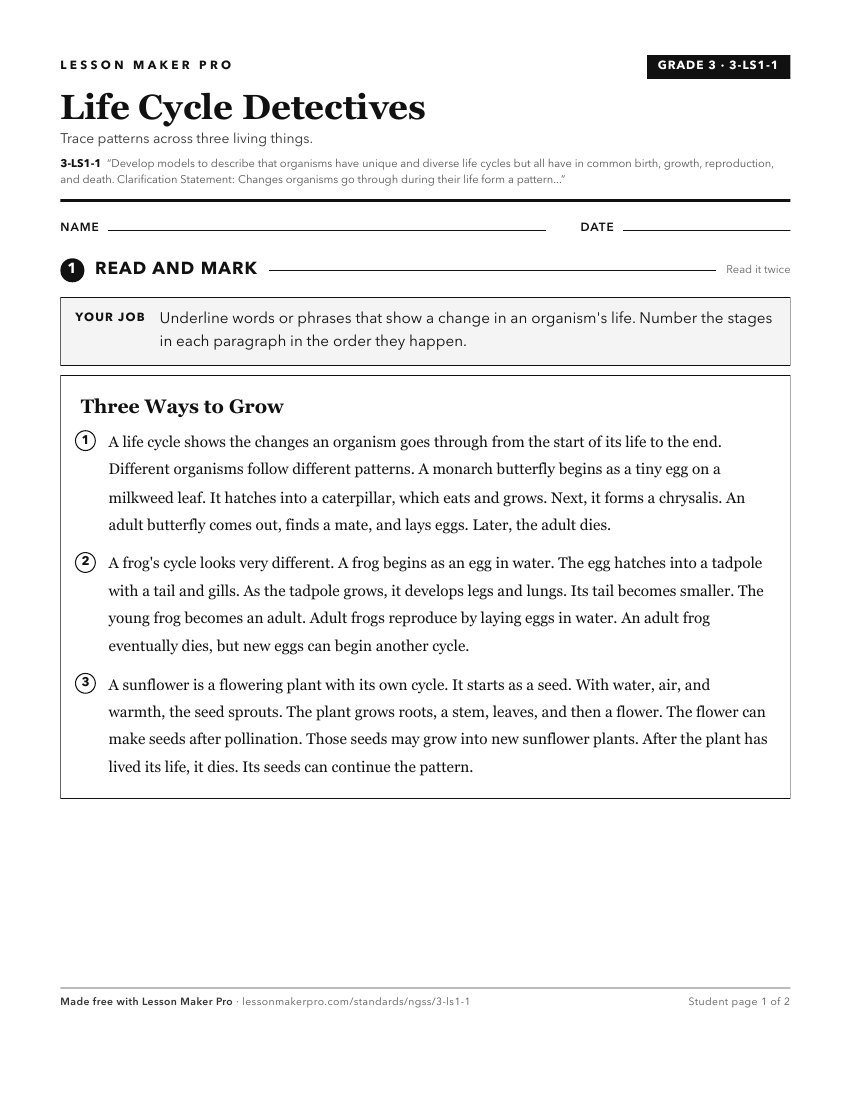
A ready-to-print activity worksheet aligned to 3-LS1-1, with an answer key for the teacher on its own page. No account needed.
PDF, US Letter, prints cleanly in black and white.
Download the worksheetWhat This Unlocks
Mastery here sets students up for these next.
Keep exploring
Related Standards
- HS-LS1-2
Develop and use a model to illustrate the hierarchical organization of interacting systems that provide specific functions within multicellular organisms.
- MS-LS2-3
Develop a model to describe the cycling of matter and flow of energy among living and nonliving parts of an ecosystem.
- MS-LS3-2
Develop and use a model to describe why asexual reproduction results in offspring with identical genetic information and sexual reproduction results in offsprin...
- HS-LS1-4
Use a model to illustrate the role of cellular division (mitosis) and differentiation in producing and maintaining complex organisms.
Turn this exact standard into a lesson
Grade, subject, topic, and the complete standard are prefilled. Create one free, no account needed.
Also for this standard:Make a WorksheetMake a QuizMake a Sub Lesson