NGSS MS-LS1-5
The Standard
Construct a scientific explanation based on evidence for how environmental and genetic factors influence the growth of organisms. Clarification Statement: Examples of local environmental conditions could include availability of food, light, space, and water. Examples of genetic factors could include large breed cattle and species of grass affecting growth of organisms. Examples of evidence could include drought decreasing plant growth, fertilizer increasing plant growth, different varieties of plant seeds growing at different rates in different conditions, and fish growing larger in large ponds than they do in small ponds. Assessment Boundary: Assessment does not include genetic mechanisms, gene regulation, or biochemical processes.
Next Generation Science Standards
Teacher's field guide
What This Standard Means
What Students Need to Do
- Students compare growth data and identify environmental conditions and inherited traits that could explain differences. They make a claim, cite evidence, and connect that evidence to the claim with reasoning.
What Mastery Looks Like
- Given a table, graph, or investigation, students identify evidence of environmental and inherited influences on growth. They write a clear claim and explain how specific data support it.
Common Misconceptions
- Students may assume all growth differences are genetic or all are caused by the environment. They may treat correlation as proof, or confuse growth with health, development, or reproduction.
How to Assess It
- Exit ticket: Variety A grows 12 cm in full light and 5 cm in low light. Variety B grows 8 cm and 3 cm. Explain how light and plant variety influence growth, citing two values.
Adopted as
This framework is adopted as written in California, Connecticut, Delaware, District of Columbia, Hawaii, Illinois, Kansas, Maryland, Nevada, New Hampshire, New Mexico, Rhode Island, Vermont.
Lesson moves
Ways to Teach It
Grow two radish varieties under full and limited light, then measure height weekly and graph the results.
Ask students to write which factors might explain why identical seedlings grow differently in two classroom locations.
Use factor cards and growth scenarios for teams to sort causes as environmental, genetic, both, or unsupported.
Compare seed catalog descriptions for two tomato varieties, then predict how sunlight, water, and variety could affect plant growth.
Free download
Printable MS-LS1-5 Worksheet
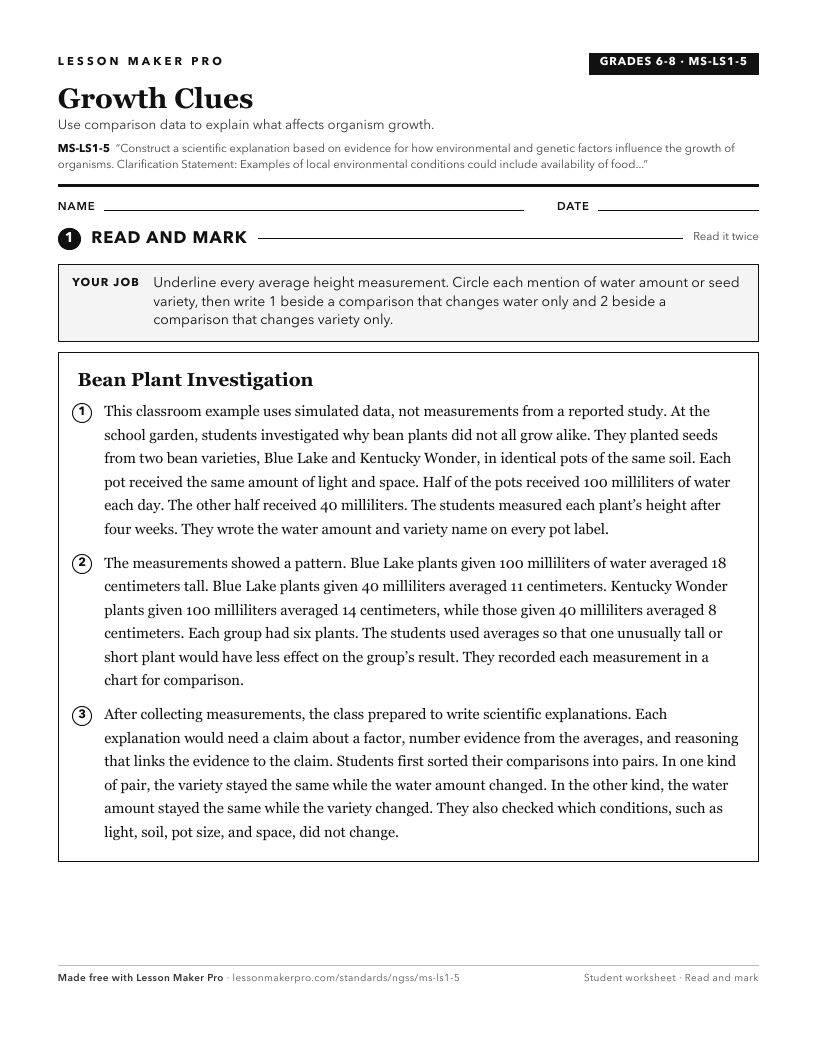
A ready-to-print activity worksheet aligned to MS-LS1-5, with an answer key for the teacher on its own page. No account needed.
PDF, US Letter, prints cleanly in black and white.
Download the worksheetBefore This Standard
If students are struggling here, check these first.
What This Unlocks
Mastery here sets students up for these next.
Keep exploring
Related Standards
- MS-LS4-4
Construct an explanation based on evidence that describes how genetic variations of traits in a population increase some individuals' probability of surviving a...
- MS-LS1-6
Construct a scientific explanation based on evidence for the role of photosynthesis in the cycling of matter and flow of energy into and out of organisms.
- 3-LS3-2
Use evidence to support the explanation that traits can be influenced by the environment.
- K-ESS2-2
Construct an argument supported by evidence for how plants and animals (including humans) can change the environment to meet their needs.
Turn this exact standard into a lesson
Grade, subject, topic, and the complete standard are prefilled. Create one free, no account needed.
Also for this standard:Make a WorksheetMake a QuizMake a Sub Lesson