Mississippi Science CHE.7
Standard Cluster
Students will demonstrate an understanding of the structure and behavior of gases. Analyze the behavior of ideal and real gases in terms of pressure, volume, temperature, and number of particles. Enrichment: Use an engineering design process to develop models (e.g., online simulations or student interactive activities) to explain and predict the behavior of each state of matter using the movement of particles and intermolecular forces to explain the behavior of matter. * Analyze and interpret heating curve graphs to explain the energy relationship between states of matter (e.g., thermochemistry-water heating from -20oC to 120oC). Use mathematical computations to describe relationships comparing pressure, temperature, volume, and number of particles, including Boyle’s law, Charles’s law, Dalton’s law, combined gas laws, and ideal gas laws. Enrichment: Use an engineering design process and online simulations or lab investigations to design and model the results of controlled scientific investigations to produce mathematical evidence that confirms the gas-laws relationships. * Use the ideal gas law to support the prediction of volume, mass, and number of particles produced in chemical reactions (i.e., gas stoichiometry). Plan and conduct controlled scientific investigations to produce mathematical evidence that confirms that reactions involving gases conform to the law of conservation of mass. Enrichment: Using gas stoichiometry, calculate the volume of carbon dioxide needed to inflate a balloon to occupy a specific volume. Use an engineering design process to design, construct, evaluate, and improve a simulated air bag. *
2026 Mississippi College- and Career-Readiness Standards for Science · Gas Laws
Cluster contents
Standards in This Cluster
CHE.7 is a cluster heading. These are the individual standards under it.
- CHE.7.1
Analyze the behavior of ideal and real gases in terms of pressure, volume, temperature, and number of particles.
- CHE.7.2
Enrichment: Use an engineering design process to develop models (e.g., online simulations or student interactive activities) to explain and predict the behavior...
- CHE.7.3
Analyze and interpret heating curve graphs to explain the energy relationship between states of matter (e.g., thermochemistry-water heating from -20oC to 120oC)...
- CHE.7.4
Use mathematical computations to describe relationships comparing pressure, temperature, volume, and number of particles, including Boyle’s law, Charles’s law, ...
- CHE.7.5
Enrichment: Use an engineering design process and online simulations or lab investigations to design and model the results of controlled scientific investigatio...
- CHE.7.6
Use the ideal gas law to support the prediction of volume, mass, and number of particles produced in chemical reactions (i.e., gas stoichiometry).
- CHE.7.7
Plan and conduct controlled scientific investigations to produce mathematical evidence that confirms that reactions involving gases conform to the law of conser...
- CHE.7.8
Enrichment: Using gas stoichiometry, calculate the volume of carbon dioxide needed to inflate a balloon to occupy a specific volume. Use an engineering design p...
Teacher's field guide
What This Cluster Means
What Students Need to Do
- Students use particle motion to explain changes in gas pressure, volume, and temperature. They read heating curves and use gas laws to calculate unknown values. They predict gas produced in a reaction and track its mass.
What Mastery Looks Like
- Given measurements, students choose a gas law, convert temperatures to kelvin, and show correct units. They explain why real gases differ from ideal predictions at high pressure or low temperature. They use a balanced equation to predict gas volume and account for the mass of the gas produced.
Common Misconceptions
- Students may use Celsius in gas-law calculations or think temperature rises throughout a heating curve. They may think compressing a gas removes particles. They may say mass disappears when gas escapes an open flask.
How to Assess It
- Exit ticket: A sealed syringe holds 20 mL of air at 100 kPa. If pressure doubles at constant temperature, what is the new volume, and why?
Lesson moves
Ways to Teach It
Use a capped, needle-free syringe to compress air from 20 mL to 10 mL, then sketch particle collisions at each volume.
Show a water heating curve from -20°C to 120°C and ask, 'Why does temperature stay flat while heat keeps entering?'
Give teams Boyle, Charles, Dalton, and ideal gas law problem cards; have them choose formulas, solve, and check units.
For a 2 L balloon at room temperature, have students calculate the CO2 moles needed, then the mass of baking soda required.
Free download
Printable CHE.7 Worksheet
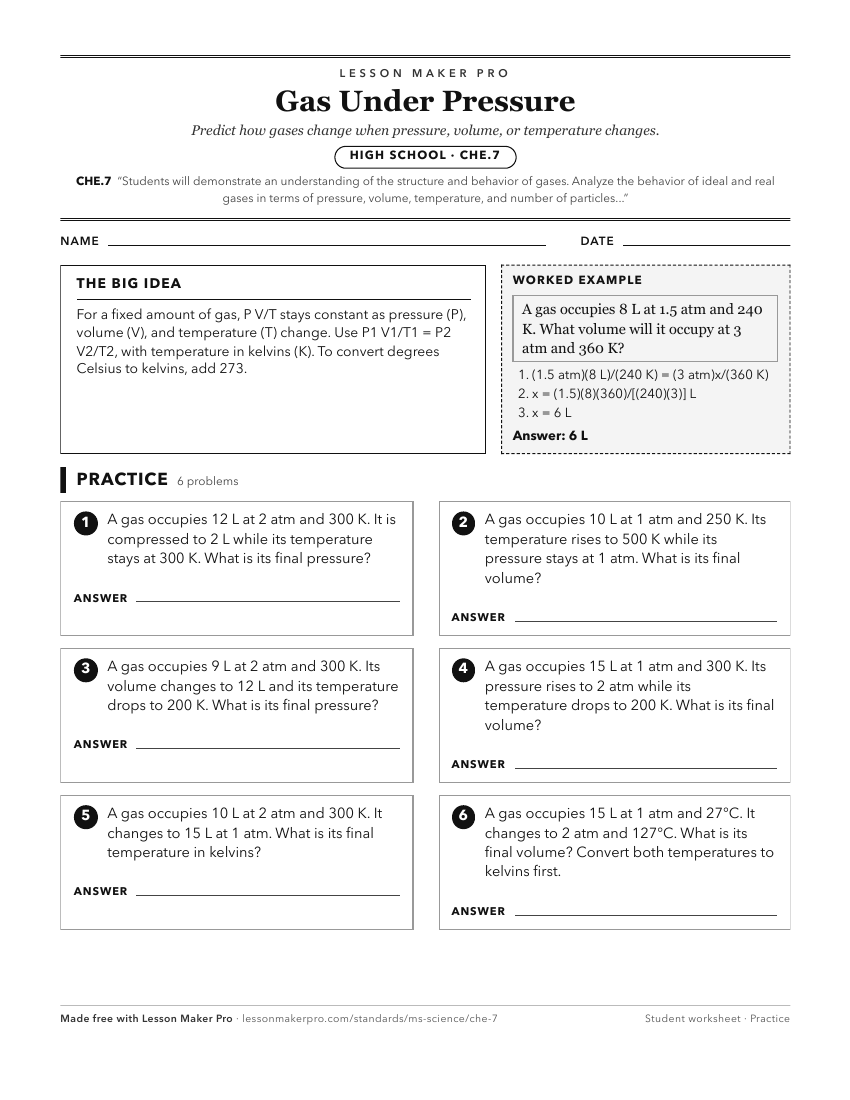
A ready-to-print activity worksheet aligned to CHE.7, with an answer key for the teacher on its own page. No account needed.
PDF, US Letter, prints cleanly in black and white.
Download the worksheetKeep exploring
Related Standards
- PHS.1
Students will demonstrate an understanding of the nature of matter.
- P.K.5A
Students will demonstrate an understanding of the solid and liquid states of matter.
- P.7.5A
Students will demonstrate an understanding of the physical and chemical properties of matter.
- P.2.5
Students will demonstrate an understanding of the properties of matter.
Turn this cluster into a lesson
Grade, subject, topic, and the complete cluster are prefilled. Create one free, no account needed.
Also for this cluster:Make a WorksheetMake a QuizMake a Sub Lesson