Mississippi Science CHE.7.8
The Standard
- CHE.7
- Students will demonstrate an understanding of the structure and behavior of gases.
Enrichment: Using gas stoichiometry, calculate the volume of carbon dioxide needed to inflate a balloon to occupy a specific volume. Use an engineering design process to design, construct, evaluate, and improve a simulated air bag. *
2026 Mississippi College- and Career-Readiness Standards for Science · Gas Laws
Teacher's field guide
What This Standard Means
What Students Need to Do
- Students use a target balloon volume to find the moles of carbon dioxide needed at a stated temperature and pressure. They use a balanced reaction to find the reactant amount, then build, test, and improve a model airbag.
What Mastery Looks Like
- Given a 1.2 L target and 24 L per mole, a student finds that the balloon needs 0.050 mole of carbon dioxide. They calculate that 4.2 g of baking soda will produce it when vinegar is in excess. They use a crash test result to improve their model airbag.
Common Misconceptions
- Students may treat liters of gas as grams of baking soda and skip the mole conversion. They may assume gas volume stays the same at any temperature and pressure, or that more gas always makes a better airbag.
How to Assess It
- Exit ticket: At room conditions, 1 mole of CO2 fills 24 L. If 1 mole of baking soda (84 g) makes 1 mole of CO2, how many grams are needed for a 1.2 L balloon?
Lesson moves
Ways to Teach It
Build a toy car airbag from a balloon, crash the car into a box, and compare clay passenger dents before adjusting balloon size.
Ask pairs why a balloon might miss its calculated volume, then have them name two causes and suggest one fix.
Give pairs target-volume cards and a 1:1 mole ratio; have them calculate baking soda masses using 24 L/mol and 84 g/mol.
Show a car airbag diagram, then have students label the gas source, bag volume, and how inflation cushions a passenger.
Free download
Printable CHE.7.8 Worksheet
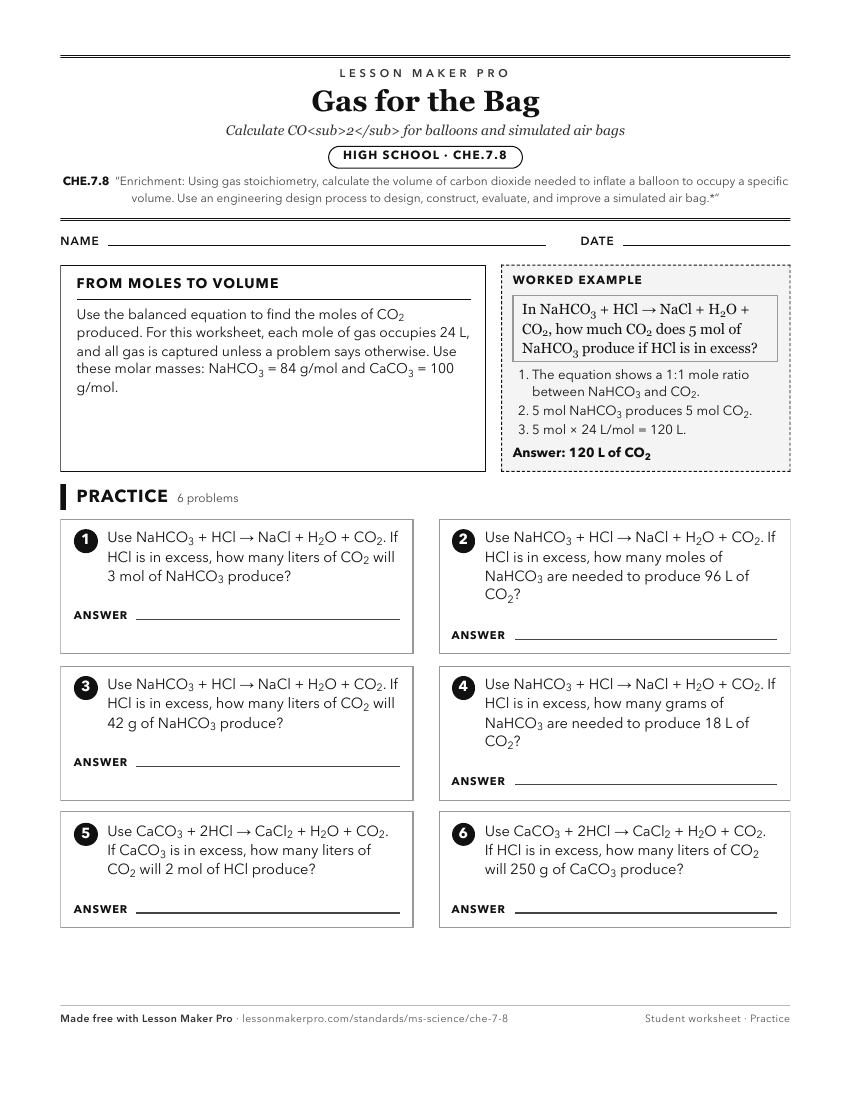
A ready-to-print activity worksheet aligned to CHE.7.8, with an answer key for the teacher on its own page. No account needed.
PDF, US Letter, prints cleanly in black and white.
Download the worksheetKeep exploring
Related Standards
- HAP.12.4
Enrichment: Use an engineering design process to develop a model of the mechanisms that support breathing and illustrate the inverse relationship between volume...
- ZOO.7.8
Enrichment: Use an engineering design process to design a “balloon fish” that has neutral buoyancy (i.e., does not sink or float). Report which materials were u...
- PHY.3.11
Enrichment: Use an engineering design process to design and build a themed Rube Goldberg-type machine that has six or more steps and complete a desired task (e....
- CHE.7.5
Enrichment: Use an engineering design process and online simulations or lab investigations to design and model the results of controlled scientific investigatio...
Turn this exact standard into a lesson
Grade, subject, topic, and the complete standard are prefilled. Create one free, no account needed.
Also for this standard:Make a WorksheetMake a QuizMake a Sub Lesson